
by ISAAC CHOTINER
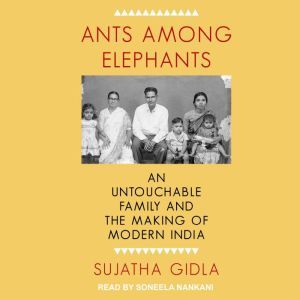
An Indian author’s quest to understand her country’s entrenched and debilitating caste system—and her family’s place in it.
Sujatha Gidla’s new book, Ants Among Elephants: An Untouchable Family and the Making of Modern India, is the author’s story of discovering—and wrestling with—her family’s fraught and wrenching history. Gidla comes from a line of Christian “untouchables” in southern India who are at the bottom of India’s caste-defined social system; by recounting the experiences of her mother and uncles, she explains how the country has stayed mired in discrimination, even after gaining independence in 1947, and the barriers that still exist to social change.
“The untouchables, whose special role—whose hereditary duty—is to labor in the fields of others or to do other work that Hindu society considers filthy, are not allowed to live in the village at all,” Gidla writes. “They must live outside the boundaries of the village proper. They are not allowed to enter temples. Not allowed to come near sources of drinking water used by other castes. Not allowed to eat sitting next to a caste Hindu or to use the same utensils.”
Gidla tells numerous stories of the ways in which her parents were discriminated against, isolated, and humiliated, even though they managed to become college teachers and lead more of a middle-class existence. One of her uncles became a guerilla fighter and activist. This all led to Gidla’s own activism, which landed her in jail for a short time. But after studying physics in school, she came to America at age 26 in 1990. She worked in tech and eventually found her way to the New York subway system, where she is now a conductor—the first Indian woman to hold the job.
I wanted to interview Gidla after reading Ants Among Elephants because it is the best book I have read about India in many years. When we finally spoke by phone recently, she was in New York and seemed excited about the reception her book was getting, even though talking about the subjects it covers is still painful for her. During the course of our conversation, which has been edited and condensed for clarity, we discussed why caste is so hard to hide from, how her family reacted to the book, and what it has been like for her trying to build a life in America.
Isaac Chotiner: You have more of a science and technical background, so what made you want to write this story about your family?
The first question is about being a scientist and writing a book. The second is about what inspired the book. I’ll talk about what inspired the book.
In India, we experience casteism. We experience this as victims, and others experience it as either perpetrators or neutral people. We really don’t know the mechanisms of caste—why it’s like that, why we have this. As a young girl, I really wanted a reason, a concrete reason why we were untouchable. I thought that it was because we were Christians because Christianity is a minority religion, and probably that’s why we were being treated like this.
But that notion was changed when I saw a movie in which there was a Christian family that was very well-off and also socially superior to even Brahmins. That’s when I started thinking: If it’s not Christianity, why were we untouchables? I was exploring that question for a long time, and finally, when I did, it was like going to your drawing board like a detective would do and placing suspects and victims.
Slate for more