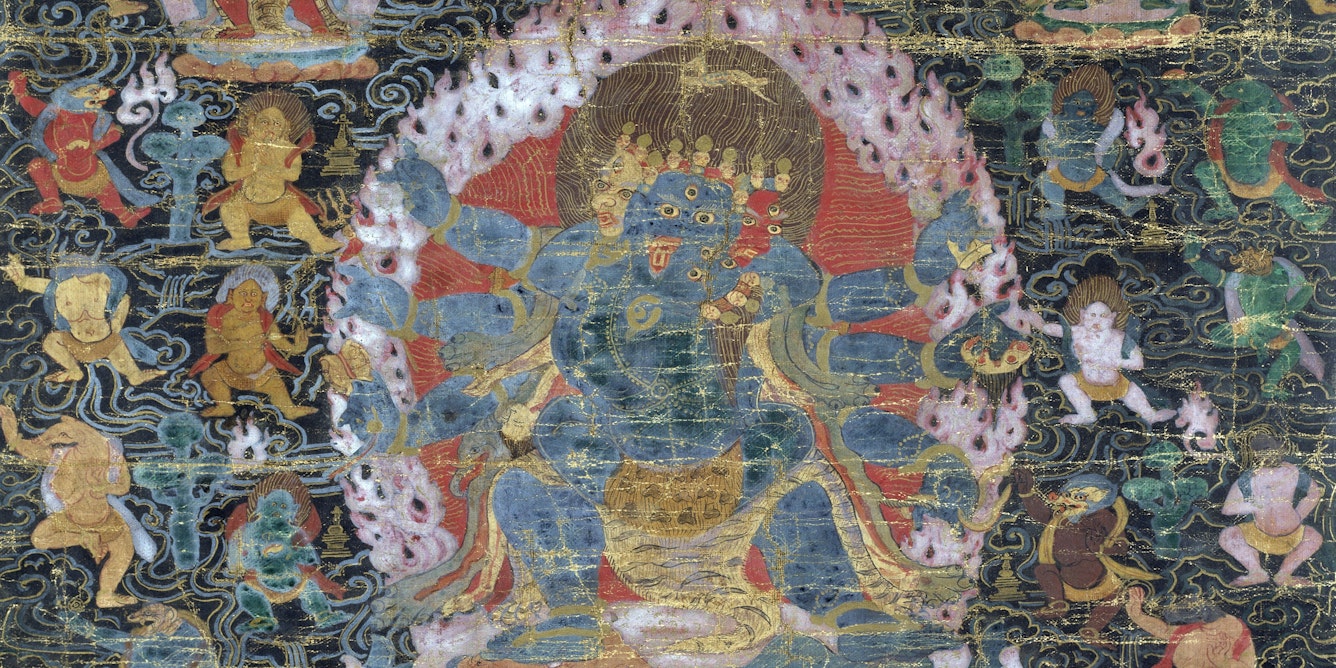
Tibetan fabric painting from the 17th or 18th century depicting a Bardo Cycle deity, representing transitional states between death and rebirth in Tibetan Buddhist belief. IMAGE/Dea/ V. Pirozzi/DeAgostini via Getty Images
You’ve seen it in bookstores – the metallic turquoise spine peeking
out from the shelf under “Eastern Religions.” Or, perhaps, another of
its more understated editions
rendered in muted tones. It is “The Tibetan Book of the Dead,” arguably
the most well-known Tibetan Buddhist text outside Tibet.
In the Princeton University series “Lives of Great Religious Books,” there are only two texts representing Buddhism. One is the “Lotus Sutra,”
the most popular Buddhist scripture on universal compassion, flexible
teaching methods and potential for Buddhahood for all beings; the other
is “The Tibetan Book of the Dead.”
Originally, the book was not even called “The Tibetan Book of the Dead” – and this book is not just about death.
The full title of the original Tibetan text from the 14th century
translates as “The Great Liberation by Hearing in the Intermediate
States.” In Tibetan, it is shortened to “Bardo Thodrol,” which loosely
translated to “liberation upon hearing.”
The English title took off with Evans-Wentz’s first translation. But
Evans-Wentz translated only a part of the book, and the translation was
based on oral commentary rather than the Tibetan text.
The first full translation was done in 2007 by scholar and translator of Tibetan Buddhism Gyurme Dorje.
It has been endorsed through an introduction written by the Dalai Lama,
the most recognized Tibetan Buddhist leader of our time.
The 11 chapters of the book teach one how to seize every opportunity
to become enlightened, even in the least possible place. It all starts
with the teaching of bardo.
The six ‘bardos’
The Tibetan word bardo means “intermediate state” or “the state of
being in-between.” In its origin in Indian Buddhist teachings, the
bardo, or “antarabhava” in Sanskrit, refers to the time period between
the end of this life and the beginning of the next.
“Our sons are used as involuntary organ donors,” said the families of young Palestinian men to Swedish journalist Donald Boström
when they saw their dead bodies stitched “from the abdomen to the
chin.” Israeli soldiers had returned their bodies days after they
disappeared from Gaza and the West Bank during a 1992 organ donation
campaign in occupied Palestine, launched by Ehud Olmert, then Israel’s
minister of health.
More than three
decades later, the same suspicions have resurfaced. Last month, more
than 1,000 kidney donors gathered for a group photograph during a
ceremony celebrating 2,000 living kidney donations in occupied
Palestine. The event was organized by the Israeli nonprofit Matnat Chaim
(gift of life) which applied to the Guinness World Records for official
recognition.
The application was
not initially welcomed. In December 2025, when Matnat Chaim first
contacted Guinness to register the record, it was rejected for
“political reasons.” In a statement
at the time, Guinness said it was aware of “just how sensitive this is
at the moment,” adding that it had stopped processing applications from
the Palestinian Territories or Israel since 2023, except for those
submitted in cooperation with a UN-affiliated humanitarian relief
agency.
According to Israeli media,
the position of Guinness has since changed following legal pressure to
resume submissions from Israel. While the annual record-keepers of the
“greatest of human achievements” have not yet officially certified
Israel’s record, zionist media have promoted the ceremony as evidence
that organ donation rates inside the settler population are now among
the highest in the world.
Dr.
Munir Al-Bursh, Director-General of the Palestinian Ministry of Health
in the Gaza Strip, has called for an independent international
investigation rather than international accolades.
Taking
into consideration the religious restrictions over organ donations and
the small settler population of Israel, this issue poses questions over
the accuracy of such a milestone. So where do all of these donations
come from?
“The
same authority withholding Palestinian bodies for years now boasts
unprecedented ‘donation’ figures,” Al-Bursh said. “Did this generosity
appear overnight? Or are there silent bodies excluded from the
celebration? The occupation has stolen organs from the bodies of
Palestinian martyrs.”
These accusations
intensified during the ongoing genocide in Gaza. Medical teams and
rescue workers tasked with exhuming bodies from mass graves reported
signs of organ removal. At Nasser Medical Complex in Khan Younis, out of the 392 bodies found, 165 disfigured bodies remained unidentified.
“The
bodies arrived stuffed with cotton, with gaps suggesting organs were
removed. What we saw is indescribable,” a doctor at Nasser Medical
Complex said, calling it a “violation of the sanctity of the dead and
human dignity.”
The
allegations first surfaced during the First Intifada. In 1990, Dr. Hatem
Abu Ghazaleh, then chief health official in the occupied West Bank,
told reporters that organs, particularly eyes and kidneys, were being
removed from the bodies of Palestinian martyrs.
Euro-Med Monitor
has documented similar cases across the Gaza Strip. It reported that
the Israeli army confiscated bodies from Al-Shifa Medical Complex, the
Indonesian Hospital, and areas along Salah al-Din Road, a route
designated for displaced civilians heading to the central and southern
parts of the strip. While the organization said dozens of bodies were
later transferred via the International Committee of the Red Cross for
burial, it warned that Israeli forces continue to withhold many others.
Medical
examinations of some of the returned bodies revealed signs of organ
removal, including “missing cochleas and corneas as well as other vital
organs like livers, kidneys, and hearts,” confirmed the organization.
The allegations first surfaced during the First Intifada. In 1990, Dr. Hatem Abu Ghazaleh,
then chief health official in the occupied West Bank, told reporters
that organs, particularly eyes and kidneys, were being removed from the
bodies of Palestinian martyrs. At the time, international media ignored
the testimony from Palestinian medical officials, a pattern that will
repeat itself in the years to follow.
The
issue resurfaced in 1999 when US anthropologist Nancy Scheper-Hughes
launched an investigation into organized “transplant tourism.” Her
research led her to Yehuda Hiss, a pathologist and forensic specialist
at Israel’s Forensic Institute Abu Kabir.
In a July 2000 interview,
Hiss admitted to harvesting skin, bones, corneas, cardiac valves, and
other tissues from bodies undergoing autopsies. He acknowledged that
consent was only required for autopsies, while families were never
informed of the organ harvesting that was conducted during autopsy.
“Whatever was done here was off the record, highly informal,” Hiss said.
“We never asked permission from the family.”
More than 750,000 Palestinian were forcibly expelled from their homeland by Zionist militia in 1948 IIMAGE/AFP/Middle East Eye
Gaza conflict didn’t start in 2023; it is rooted in 75 years of dispossession, occupation, systemic blockade
The war did not begin on October 7, 2023, no
matter how loudly that date is repeated to erase the long history of
occupation and conflict that came before it. October 7 is used as a
licence to forget, a convenient starting line that allows seventy-five
years of dispossession, occupation, siege and repeated military assaults
to be reduced to historical ash.
But the testimonies of the oppressed do not work that way. Wars do
not begin when the powerful decide to start counting; they begin when
people are uprooted from their land, dignity, safety and any right to
futurity, and Gaza’s story begins in 1948, not in 2023.
In 1948, during what Palestinians call Al-Nakba, or ‘The
Catastrophe’, the creation of the State of Israel came with the forced
displacement of at least 750,000 Palestinians from their ancestral land.
Entire villages were cleared, homes demolished or seized, and families
sent into exile under the illusion that it was only for a short time.
It was not. Those refugees were never allowed to return, and Gaza
became one of the places where their descendants were compressed into a
narrow strip of land where loss was perpetuated, not remembered. When
Gaza is bombed today, it is not just a city under fire; it is a refugee
camp built on an unresolved crime.
In 1967, Israel occupied the Gaza Strip following the Six-Day War,
placing its population under military rule and control. From that moment
forward, Gaza’s residents did not control their borders, their
airspace, or their freedom of movement. Daily life was regulated by an
occupying power that could decide who travelled, who entered, who passed
through a checkpoint, who received medicine, and who would have their
name crossed out. This was not a temporary emergency measure; it was the
normalisation of domination, and it hardened a sense of injustice, not
because Palestinians rejected peace, but because they were never offered
freedom.
By 1987, that pressure escalated into the First Intifada, a mass
uprising driven largely by civilians who used protests, strikes and
civil disobedience to confront decades of occupation. It was not an
armed invasion but a civilian-led revolt born from humiliation and
dehumanisation, and it was met with ferocious military force, mass
arrests, beatings and live ammunition. This was the state screaming its
only truth: “We have the guns. Your justice is a fantasy. Obey.”
The 1990s brought the Oslo Accords, which were sold to the world as a
peace process but felt to many Palestinians like an agreement to keep
talking about – an agreement that would never come. While a Palestinian
Authority was created, real sovereignty never followed, and Israel
retained decisive control over borders, armed enforcement and
colonisation. Settlement expansion continued in the West Bank,
occupation remained intact, and Gaza was targeted for further
degradation. What was presented as a diplomatic solution over time
revealed itself as management of the conflict rather than its
resolution, breeding disillusionment instead of reconciliation.
In 2005, Israel announced its unilateral “disengagement” from Gaza,
withdrawing settlers and soldiers from inside the strip while keeping
its chokehold over its airspace, territorial waters, population registry
and all land crossings. Gaza was not freed; it was sealed. Its people
could not move, trade or rebuild freely, and the territory became
dependent on an occupying power that claimed it was no longer
responsible while still maintaining a remote-controlled siege. This
contradiction was the catalyst for what followed.
When Hamas won Palestinian elections in 2006, Gaza was placed under a
strangling blockade by Israel, with Egypt’s cooperation and Western
backing. This was not a counterterrorism operation; it was collective
punishment imposed on over two million people, most of them civilians,
many of them children still in diapers. The blockade crippled Gaza’s
economy, restricted food, medicine, fuel and construction materials, and
trapped every last soul in a sealed enclosure. Despair deepened, and
the world largely accepted it as necessary.
What followed were repeated military assaults that reinforced the
reality of Gaza as a place where civilian life was expendable. In
2008-2009, Operation Cast Lead killed around 1,400 Palestinians,
including hundreds of children, while Israel lost 13 people, several
from friendly fire. In 2012, Operation Pillar of Defence left 167
Palestinians dead in just eight days.
In 2014, Operation Protective Edge devastated Gaza over 51 days,
killing more than 2,200 Palestinians, over 500 of them children, and
flattening densely populated city quarters while Gaza remained
shrink-wrapped and unable to shelter its people. Each assault cycled
back to the same four words: ceasefire, rubble, blockade, trauma.
The second US war on Iran in less than a year has raised a burning
question in popular media: What is the rationale for the war and why is
it changing? Is it because negotiations with Iran over its nuclear
program were not progressing? Is it because Iran was close to developing
nuclear weapons? Is it because Iranian ballistic missiles were going to
reach the US soon? Is it because Israel was going to attack Iran and
the US took pre-emptive measures to ensure the safety of Americans? Is
it because the Iranian government was violating human rights? Or is it
something else? The press in the US has not been able to make sense of
this changing justification. But this is curious. Was the media asleep
over the past few decades?
A quarter of a century ago, I delivered a
presentation on US foreign policy towards Iran at an economics
conference. My presentation concluded by stating that US policy in the
Persian Gulf region had been a series of “regrettably shortsighted
policies,” borrowing a phrase from former US Secretary of State,
Madeleine Albright. I argued that these policies had served to prolong
the life of the theocratic government in Iran. I believed that without
the constant threat of foreign enemies, this government would have had
no one to blame for its social and economic problems but itself.
In my paper, I outlined how Israel and its
lobbying groups in the US were the primary architects of US policy. I
explained how they had developed three justifications, or “sins” as I
referred to them, to justify punishing Iran:
1) the proliferation of weapons of mass destruction,
2) support for “terrorism,” and
3) opposition to the Oslo “peace process” between Israel and the Palestinians.
However, I contended that Israel’s true
objective had always been to overthrow the Islamic Republic, a goal now
commonly known as a “regime change.” The rationale behind this objective
was that Iran and Iraq were the only two countries in the Middle East
that posed a barrier to the creation of Greater Israel (Eretz Yisrael),
which was intended to encompass the West Bank, Gaza, and potentially
more.
The conference paper was published as an article
in an economics journal and, later expanded into a two-volume book. In
the book I discussed the original three sins and noted that Iran’s
opposition to the Oslo peace process was eventually abandoned as Israel
itself moved away from the process. However, over time more sins were
added to the remaining two. I referred to it as a “menu option” for
overthrowing the Iranian government. For instance, the neocons in the
George W. Bush Administration expanded the menu to include accusation of
Iran destabilizing Afghanistan, harbouring Al-Qaeda, lacking democracy,
being ruled by unelected individuals, violating human rights, not
protecting the rights of women, not being forward-looking and modern,
etc.
I also argued that the neocons had used a
menu option to attack Iraq as well, even though Israel was pushing them
to attack Iran instead. But they could not get Bush, an intellectually
challenged president, to go along and bomb Iran. Afterall, before attacking Iraq Bush had visions of talking to God.
Chinese biotechs advancing clinical programs, securing approvals and executing licensing deals at dizzying new speed
The continuous stream of drug approvals by Chinese pharmaceutical
companies should be a source of awe to any global innovation investor.
There are multiple reasons that have led to the current point. However,
one key contributor is China’s drug approval policy transformation,
which is one of the most under-discussed and massively impactful policy
narratives of our era.
The history of the global pharmaceutical industry has largely been a
monologue, spoken by the West and listened to by the East. For the
better part of the post-war era, the United States, through the engines
of the Food and Drug Administration (FDA) and the National Institutes of
Health (NIH), served as the world’s laboratory.
In this established orthodoxy, which also included a handful of
companies from Japan and Europe, China entered decades later, becoming
the world’s factory. In the first phase, it became a massive but
fundamentally replicative engine designed to produce volume rather than
value.
This dynamic was underpinned by a regulatory lag so severe that it
functioned as a non-tariff trade barrier; drugs invented in Cambridge or
Basel would typically arrive in Beijing or Shanghai five to seven years
after their Western debut.
This delay, known colloquially as the “drug lag,” effectively imposed
a “China-last” penalty on the world’s largest aging demographic,
rendering the Chinese patient population a secondary consideration in
the global R&D calculus.
That era is demonstrably over. It did not end with a whimper, nor was
it the result of a slow, organic drift of market forces. It ended with a
calculated, statutory, and industrial restructuring of the Chinese
state’s relationship with biology.
We are currently witnessing the results of a decade-long project of
Acceleration by Design, a deliberate strategy to transform the
regulatory review process from a discretionary gatekeeping function into
a mandatory conveyance system for innovation.
The data emerging from 2024 and early 2025 confirms a tectonic
inversion in the global biopharmaceutical hierarchy. For the first time
in history, the sheer velocity and volume of China’s regulatory
apparatus have not merely caught up to Western standards but, in
specific metrics of efficiency and output, have bypassed them.
In 2024, China’s NMPA approved 83 new drugs (excluding TCM), a 12%
year-on-year increase—significantly outpacing the FDA’s 50 novel
medicines. Of these, 46 were Class 1/1.1 innovative drugs (the
regulatory classification for drugs not previously marketed anywhere),
while 48 qualified as first-in-class by mechanism of action, covering
high-complexity modalities including bispecific antibodies, ADCs, and
novel small molecules.
Average review times collapsed from 663 days in 2017 to approximately 105 days in 2024, an 84% reduction.
This report serves as a deep-dive forensic audit of this
transformation. By verifying internal regulatory documents and
synthesizing external market data, we dissect the seven structural
pillars of the “Accelerationist State” and project the consequences of a
world where the East no longer waits for the West’s medicine.
President Vladimir Putin has given instructions to accept the Trump
Administration’s demand that in exchange for lifting sanctions against
Russia, U.S. capital must return to Russia on preferential terms as soon
as possible.
For the new round of negotiations in Geneva later this week, Putin
has replaced Admiral Igor Kostyukov, the military intelligence chief, as
head of the Russian negotiating team with Vladimir Medinsky, a lower
ranking Kremlin official. Medinsky’s instructions are that the military
terms of settlement on the Ukraine battlefield, insisted on by Kostyukov
at the Abu Dhabi talks, be subordinated to the terms negotiated by
Kirill Dmitriev, Putin’s principal negotiator with the White House.
The change in the Kremlin line is reported in the Russian media as the “Anchorage formula” and the “Dmitriev plan”.
This has been publicly criticized by Foreign Minister Sergei Lavrov
in coded attacks in media interviews and a speech last week to the State
Duma, declaring
“the reality is quite the opposite.” Lavrov—Moscow sources say—was
reflecting the consensus of the General Staff, the Foreign and Defense
Ministries.
Putin reacted through spokesman Dmitry Peskov in defence of the Anchorage formula. “The spirit of Anchorage”—Peskov told
Tass—“reflects a set of mutual understandings between Russia and the
United States that are capable of bringing about a breakthrough,
including in the settlement between Moscow and Kiev…[and] are
fundamental.”
Faction-fighting around the Kremlin over what this means has
triggered dismay among those Russian businessmen who have acquired their
new economic power with takeovers of foreign assets released by the
exit of U.S. and European corporations since 2022. These Russian sources
report resentment at the backing which Putin has given to Russian
Central Bank (CBR) Governor Elvira Nabiullina’s continuing high-interest
rate policy for Russian borrowers in parallel with Dmitriev’s plan for
low-interest rate U.S. investors to re-enter Russia, recover their
former market share, and generate the appearance of an investment
stimulus in the run-up to the the State Duma elections on September 20.
Nabiullina and Dmitriev have combined to persuade Putin to allow them
to make these Anchorage formula concessions to U.S. negotiators Steven
Witkoff, Jared Kushner, and Joshua Gruenbaum. Their last session in
Miami on January 31 also included U.S. Treasury Secretary Scott Bessent.
What makes these concessions a “fundamental breakthrough”, as Peskov
calls them, has been revealed in a memorandum of conversation published
on February 12 by Bloomberg. This reports a “high-level memo which was
drafted this year…which was circulated among senior Russian officials”.
No author, date, subject line, distribution list, or any other detail of
the document has been reported by Bloomberg to authenticate it, or to
indicate whether it was leaked by the Witkoff side or the Dmitriev side
after the Miami talks.
The published summary has seven points, listed without quote marks.
They indicate “U.S. participation in Russian manufacturing” in the
Russian aviation sector; “allow American firms to recover past losses”
in the Russian oil and gas sector, “including offshore and
hard-to-recover reserves”; “preferential conditions for U.S. companies
to return to the Russian consumer market”; “cooperation on nuclear
energy, including for AI ventures”; “Russia’s return to the dollar
settlement system, including possibly for Russian energy transactions”;
“cooperation on raw materials such as lithium, copper, nickel and
platinum”; and “working together to push fossil fuels as an alternative
to climate-friendly ideology and low-emission solutions that favour
China and Europe”.
There was no mention of Dmitriev in the Bloomberg report.
It was a long-awaited pleasure for your many friends
and admirers to see you in Paris. I know it was tiring, but you mustn’t
think you wore out your voice for nothing. I’m afraid you might get
such a negative impression from certain media which seemed to have
“learned nothing and forgotten nothing”. However, I think that the rude
treatment you received from Le Monde in particular merely highlights the
importance of your visit and the deep geopolitical significance that
Chomsky has in France.
Excuse me for neglecting your primary field,
linguistics, in my analysis. I am not qualified to speak about that. But
I tend to believe that the animosity you have aroused in certain
circles in France may have less to do with linguistics than with your
role as the most prominent American critic of US foreign policy. Yes, we
know there are many more, but Chomsky is by far the best-known the
world over. My own opinion is that this role as virtual symbol of
systematic moral criticism of American foreign policy is the fundamental
cause of the campaign against you that began over thirty years ago. To
my mind the uproar first over Cambodia and then over the defense of
Professor Robert Faurisson’s right to express his views freely was
essentially a means to the end of discrediting the leading American
critic of United States imperialism.
I need to put this argument in context.
The end of the Second World War split Europe between
two groups of satellites of the two major victorious powers. The
political methods of the Soviet Union made the satellite status of
Eastern Europe obvious to everybody, and notably to the citizens of
those countries, who were aware of the coercion keeping them in the
Communist bloc.
In the West, American wealth, the ready complicity
of native ruling classes and the far more sophisticated methods of
political persuasion, dramatizing a largely imaginary “Soviet threat”,
succeeded in convincing the satellite countries that they were voluntary
allies of the United States.
This worked most of the time. There were a very few
temporary exceptions. Sweden, never having been conquered or liberated,
had moments of fairly genuine independence, notably under Olof Palme
(whose timely assassination has brought Sweden gradually into the arms
of NATO). In the 1960s, Charles de Gaulle took major steps to regain
political independence for France, notably by criticizing the US war in
Indochina and seeking to strengthen relations with Third World
countries. This drive was shattered by the events of May 1968, and after
the fall of de Gaulle, a normalization process got underway to secure
US hegemony in France once and for all.
Now, it is precisely because France was the scene of
the strongest impulses for independence that the normalization process
had to be the most vigorous.
British prime minister Anthony Eden IMAGE/Wikipedia
Only a man with Napoleon’s vision would have seen the potential of linking the Mediterranean with the Red Sea by digging a canal.
During his campaign in Egypt (1798-1801), Napoleon saw a commercial
advantage in shortening the trade route to India. A miscalculation by
his engineers caused him to abandon the project. Sixty years later, in
1869, his compatriot — engineer Ferdinand de Lesseps — fulfilled
Napoleon’s aim by completing that modern marvel: the Suez Canal.
Napoleon once lamented: “If it had not been for the English, I should
have been emperor of the East.” Ironically, a century later, the
British and the French were co-owners of the Suez Canal. When, in 1956,
Egyptian President Gamal Nasser nationalised the Suez Canal, Israel,
Britain and France launched a combined military invasion. Israel
occupied the Sinai peninsula. Britain and France strafed Egypt and
planted boots in the Canal Zone. The US and the USSR condemned the
invasion and threatened sanctions. Britain and France, humiliated, had
to withdraw.
British prime minister Anthony Eden contended that his action had
been “to strengthen the United Nations”. He was demolished by Aneurin
Bevan’s retort: “Every burglar… could argue that he was entering the
house to train the police.” (Bevan’s remark finds echoes in US President
Donald Trump’s foreign policy.)
Gulf states must prepare themselves for the worst.
Since then, the criticality of the Suez Canal has increased greatly.
Ships use it to transport “30 per cent of the world’s shipping container
volume, 7-10pc of the world’s oil and 8pc of liquefied natural gas
[LNG]”. It is as vital as the Panama Canal is, or the Strait of Hormuz
has now become.
Panama Canal, like the Suez, is a manmade waterway. It connects the
Caribbean Sea with the Pacific Ocean, and joins Panama and the US in an
uneasy political union.
The canal remained under US control from 1914 until 1999, when it
passed to Panama. In January 2025, President Trump announced America’s
intention of recovering control of the Panama Canal, threatening
‘economic and military action against Panama’ to ensure American
“economic security”.
On the other side of the globe, the Strait of Hormuz — a natural
cul-de-sac — is inordinately vital to world trade. Before the present
conflict started, tens of thousands of ships and tankers passed through
it, carrying 30pc of global oil trade and 20pc of global LNG. Today,
Iran has applied a political stranglehold and choked oil and gas
supplies to the world.
How long will this asphyxiation last? It could be days, even years.
Remember: following the Israeli-Arab war in 1967, the Suez Canal
remained blocked for eight years.
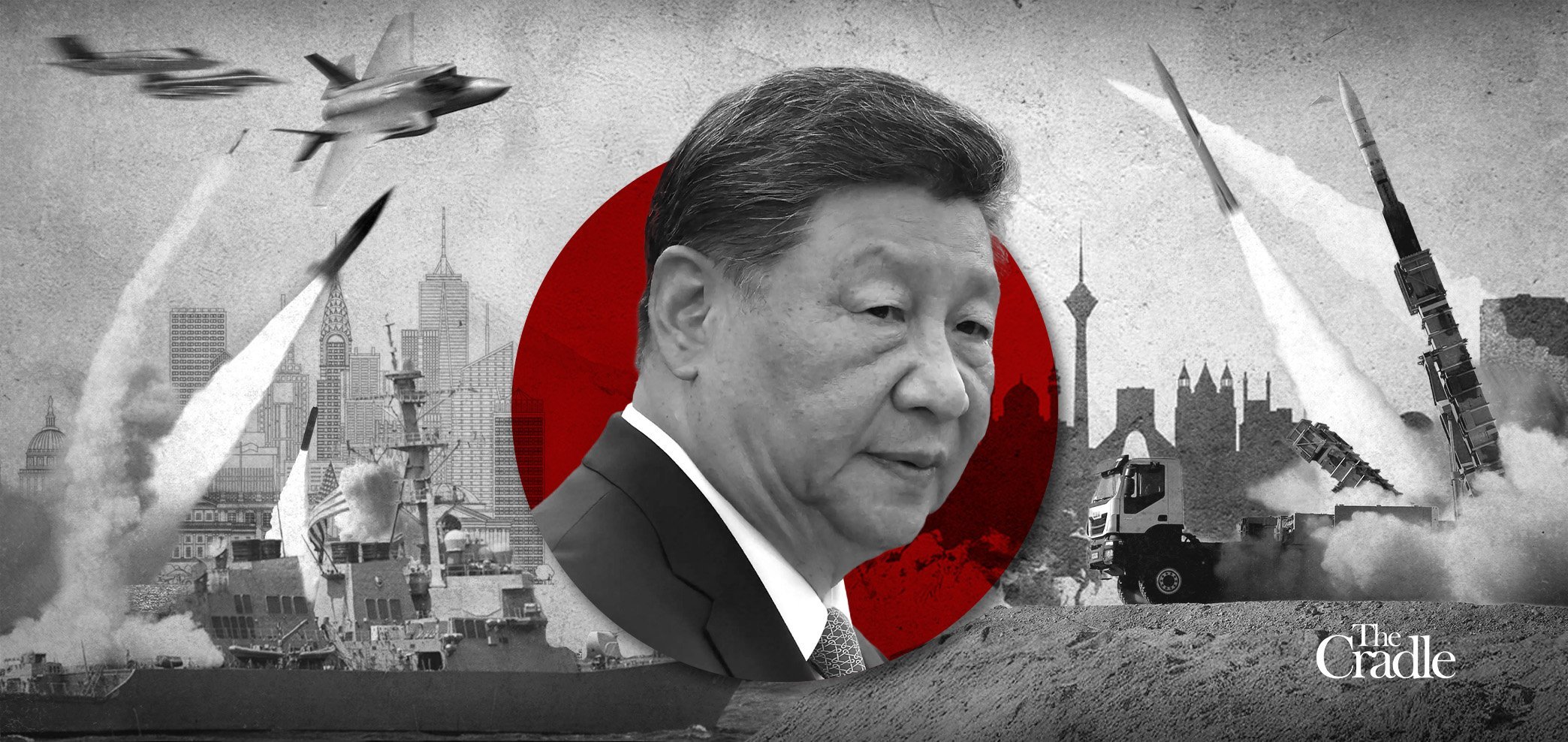
China’s dual-track response to the US–Israeli war on Iran reflects a broader geopolitical and economic strategy that stretches from the battlefield to the global financial system.
China
is officially responding on two parallel tracks to the Epstein
Syndicate – or US-Israeli – war on Iran via a diplomatic spokesman and a
military spokesman.
Translation: China sees the war both as an extreme political/diplomatic tension and a military threat.
China’s
military spokesman, a People’s Liberation Army (PLA) colonel, speaks
with metaphors. It was he who said explicitly that the US is “addicted
to war”, with only 250 years of History and only 16 years of peace.
He clearly positions the US as a global threat. And clearly, also as a moral (italics mine) threat.
Chinese President Xi Jinping is firmly focused on establishing a long-lasting connection between Marxism and Confucianism.
The
key contribution of Confucius to political thinking is the precise use
of language. Only the one who speaks with precise metaphors and moral
weight is able to govern a nation.
So
China is carefully developing a steady moral and ethical criticism of
the American war of choice on Iran. Stressing how this is the attack of a
nation that has lost its moral compass.
The Global South totally understands the message.
Additionally, facts on the battlefield show how China has also changed the rules of war in Iran.
The
Iranian grid is now fully connected to the BeiDou satellite system.
That explains how Iran now strikes with precision, and every move by the
US-Israeli combo faces a China-tech Digital Wall (over 40 BeiDou
satellites in orbit). That accounts for excellent Iranian missile accuracy and increased resistance to jamming.
As
part of their 25-year Comprehensive Strategic Partnership, China has
also supplied Iran with long-range radars, integrated with satellite
systems. The key takeaway is Iran’s now much shorter response time
compared to the 12-day war.
Russia
has helped on a parallel track, allowing Iran to apply in spades what
Russia learned in Ukraine about western systems such as Patriot and
IRIS-T. It’s not only about mass-drone saturation tactics; it’s
learning the Russian way of coordinating drone swarms with ballistic missile volleys. That’s exactly what’s in – devastating – effect in the latest stages of Operation True Promise IV.
Playing Go: It’s all about the petroyuan
Now
let’s focus on the crucial Strait of Hormuz gambit. The key move is
Iran only allowing transit for oil tankers whose cargo has been settled
in petroyuan. No dollars. No euros. Only yuan.
In fact,
China had already started to end the Bretton Woods/petrodollar system in
December 2022, when Beijing invited the Gulf Cooperation Council (GCC)
petro-monarchies to trade oil and gas on the Shanghai Stock Exchange.
Now, couple all of the above with the Chinese 15th Five-Year-Plan, just discussed and approved in Beijing.
Talk about an in-depth systemic vision.
In
a quite holistic way, Beijing planners set GDP growth at four percent;
the digital economy advancing to 12.5 percent of GDP; green energy
solutions at 25 percent; surface water quality at 85 percent; an
avalanche of high-value patents; all that and more, equally tabled, with
hard targets to be achieved and binding indicators all the way to
2030.
This means the Chinese are treating economy, energy
security, ecology, education, and health care as if they are organs of
the same fit body. That is how urbanization fuels productivity: a lot of
investment in R&D fuels more and more patents; patents fuel the
digital economy; and green energy solutions fuel strategic
independence.