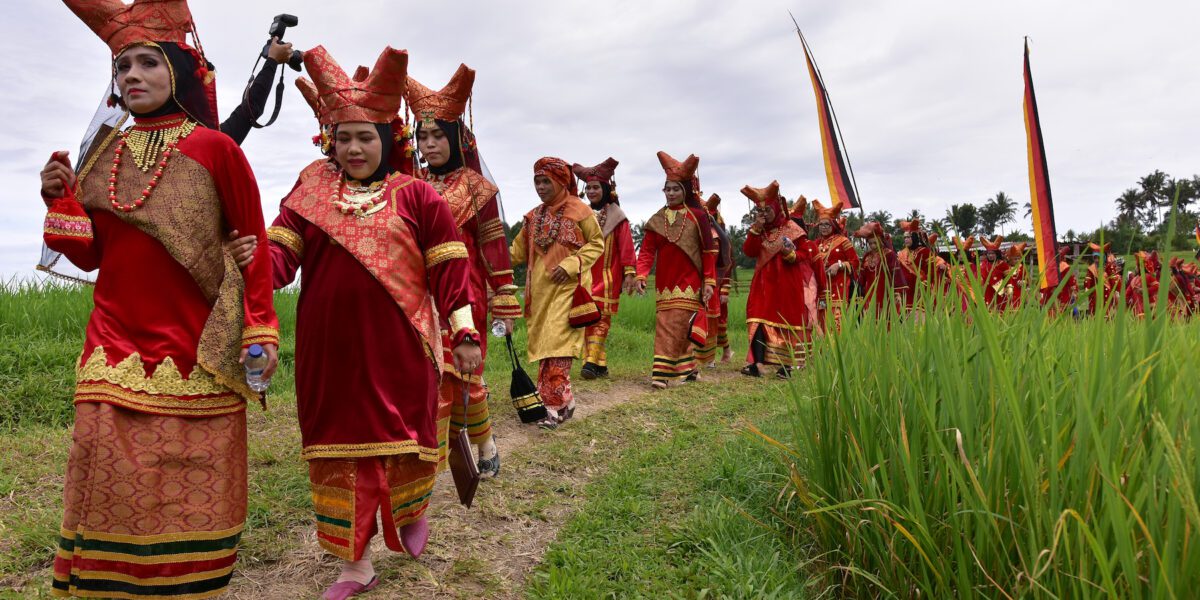
Minangkabau mothers and daughters IMAGE/taufik imran/Shutterstock
Who runs the world? Girls! In these matriarchal
societies, these aren’t just women-empowering lyrics in a Beyoncé song
but a fact of life. Matriarchal societies are those in which women hold
positions of power and authority and are the primary decision-makers in
both their families and community. While patriarchies have been the norm
in most societies throughout history,
the following five countries are home to matriarchal societies that
show what the world would look like if it were indeed run by women.
1. India’s Khasi Tribe
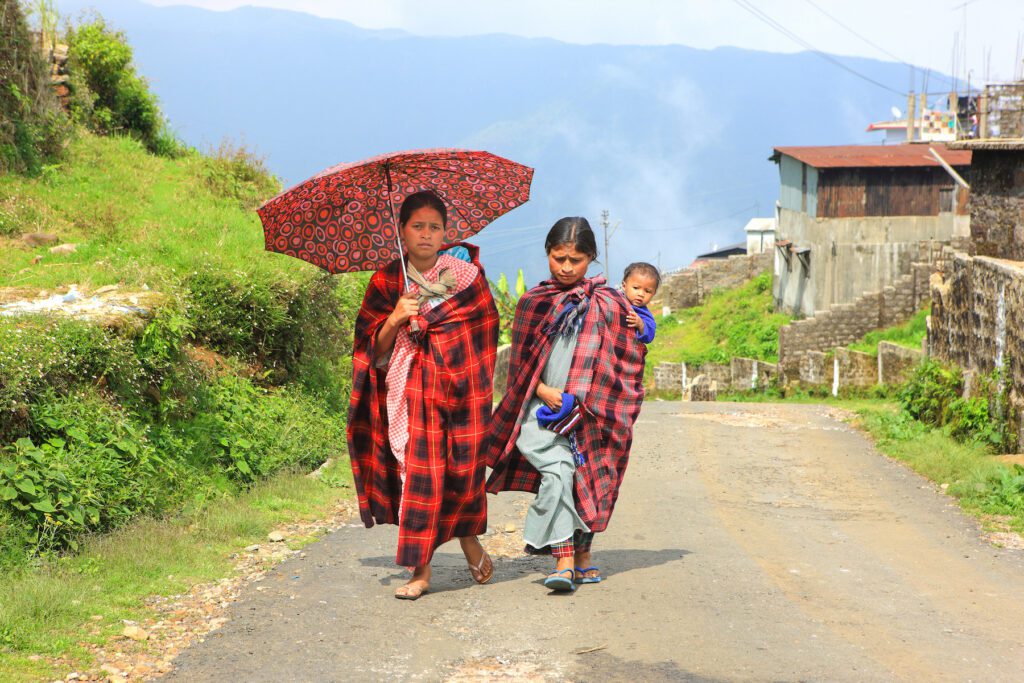
The state of Meghalaya in northeastern India
is home to the Khasi tribe, which is known for its matriarchal society.
In the Khasi culture, property and wealth are inherited through the
female line, and women have a strong say in household and community
decisions. Women are also free to choose their own partners, and divorce
is not stigmatized.
Women of India’s Khasi Tribe | Hari Mahidhar/Shutterstock
2. China’s Mosuo People
The Mosuo people in southwestern China are often referred to as the
“last matrilineal society in China.” In this matriarchal society, any
property is passed down through the female line, and women are the
primary decision-makers in the family. Children are raised by their
mothers and maternal uncles, and there is no concept of marriage as we
know it. Instead, men and women have relationships known as “walking
marriages,” in which they are free to choose their partners and can end
the relationship at any time.
3. Indonesia’s Minangkabau People
The Minangkabau people of West Sumatra, Indonesia, have a matriarchal
society in which property and wealth are inherited through the female
line. Women hold a high status in Minangkabau culture and are often the
ones who make decisions regarding family and community affairs. However,
men still hold important positions in the government and religious
institutions.
“Gord?far?d[1] (Persian: ????????) is one of the heroines of the Sh?hn?meh “The Book of Kings” or “The Epic of Kings”, an enormous poetic opus of Persian literature written by Ferdowsi around 1000 AD. She was a champion who fought against Sohrab (another Iranian hero who was the commander of the Turanian army) and delayed the Turanian troops who were marching on Persia. She is a symbol of courage and wisdom for Persian women.” IMAGE/TEXT/Wikipedia
It was a placard that as students we would draw cartoons on or write slogans with marker pens or thick brushes for college protests. To deter Donald Trump’s vile description of Iranians as an evil lot, the chador-clad Iranian woman chose a verse from the great Persian poet Firdausi for her placard. The 10th-century master poet is credited with reviving Persian literature. His fabled Shahnameh chronicled the legends of Persian kings with motifs and characters that were essentially pre-Islamic. The stories of Rustam and Sohrab, for example, popularised by Firdausi, relate to the early Zoroastrian period of Iran. Colonial upstarts would later drool at the awe-inspiring heritage he spawned. It was reflected in the British pretence at majesty as they attempted to mask an instinct for savage plunder.
After uprooting the Persian-Prakrit-Sanskrit culture nurtured by
Muslim rulers in India, chiefly the Mughals, the British viceroy
installed a Persian painting on the ceiling of the ballroom of the
vice-regal palace, today’s Presidential Palace. The painting still hangs
there, mocking Hindutva’s boorish hatred of Iran’s legacy of refinement
in India. The painting of a Qajar-era ruler on a tiger hunt was created
by an Italian artist as faux inspiration from the legends depicted in
Firdausi’s magnum opus, compiled between 977 AD and 1010 AD.
The verse the woman wrote with a blue brush on a placard for the huge
Nowruz march through Tehran to mark the Persian new year intrigued an
American journalist watching the war. Ergo: there are foreign
journalists invited by the reviled Iranian ‘regime’ to chronicle an
unprovoked assault on their nation; the opposite seems true of the
falsely adulated ‘democracies’ of the US and Israel where opacity and
news blackouts have become a legitimate requirement in a self-harming
and costly military expedition.
Donald Trump the tycoon doesn’t want the markets to shudder at his
foolhardy plans to destroy Iran and thereby the Persian Gulf. Benjamin
Netanyahu desperately needs to cover up the untold damage inflicted on
precisely chosen targets straddling Israeli cities. One missile
cautioned him that Iran could destroy the Dimona nuclear plant at will,
with horrific consequences to the world, if its Bushehr nuclear power
station was damaged. This is the terrifying prospect Trump and Netanyahu
have jointly given birth to in an ultra-volatile region.
In modern Persian culture, Gordafarid is a feminist icon and a symbol of Iranian resistance and ingenuity.
The image of the Iranian woman’s placard was snapped from a news
clip, and as such it was angled, blurred and incomplete. It was her
explanation of the verse to the American interlocutor that helped me
track it down to the Shahnameh. I checked out the verse with an
encyclopaedic Persian scholar. The illustrious Sharif Husain Qasemi is
Delhi’s only expert on Bedil, the 18th-century Persian poet notorious
for being so difficult that he was considered a challenge even by the
great Ghalib, himself notorious for his difficult Persian poetry. He
found the verse and explained its context: “Agar sar be sar tan be
koshtan daham/ Azaan beh ke kishvar be dushman Daham” (“If I give my
body — from head to toe — to be killed/ That is better than giving the
country to the enemy.”)
The verse is one of the most famous examples of heroic ethos
(javanmardi) in Persian literature. It is spoken by a woman warrior, the
legendary hero Gordafarid. The sentiment is echoed throughout the
Shahnameh also by figures like Rustam or other heroes facing
insurmountable odds.
A Mughal miniature from 1574 to 1575 shows the Emperor Akbar’s troops in pursuit of enemies IMAGE/Wikimedia Commons
Since the start of the Iran war, in India and Pakistan there has been a renewed interest in Iran’s cultural ties with South Asia
In March 1986 Sayyid Ali Khamenei, who would three years later become Iran’s supreme leader, gave a speech at a major conference in Tehran on the Indian poet-philosopher Muhammad Iqbal.
Iqbal lived in British India and engaged in the politics of that land. He died in 1938 and never visited Iran.
But Khamenei told
his audience that Iqbal was a “luminous spark that washed out the
darkness of the days of suffocation and repression from our hearts
(through his impressions, poetry, counsel and teachings) and projected a
bright picture of the future before our eyes”.
Describing himself as someone “who for years had been a follower of
Iqbal and has lived emotionally in his company”, Khamenei insisted the
poet “belongs to this nation”.
“Iqbal, whose heart ached to see the Muslim people having lost their
human and Islamic personality,” he said, should he have lived to visit
Iran after the Islamic Revolution, “could have seen a nation standing on
its feet, infused with the rich Islamic spirit.”
The supreme leader, killed earlier this month in the US-Israeli attack on Iran, was able to engage so deeply with Iqbal’s work because much of his oeuvre was in Persian.
This was the case even though Iqbal is remembered in South Asia almost entirely for his Urdu poetry.
Since the start of the current Iran war, in India and Pakistan there has been a renewed interest in Iran’s deep cultural ties with the subcontinent.
Enormous protests
have erupted across Pakistan against the US-Israeli war, and not just
by Shia Muslims who revered Khamenei as their religious leader.
The Pakistani government was swift to criticise the killing of Khamenei, while India – a longtime ally of Iran – has failed to do so.
Perhaps in response to this, and to the Indian government’s strong ties with Israel,
in the past week a flurry of articles have emerged in the Indian
national media highlighting the country’s deep shared heritage with
Iran.
A shared history
This shared heritage has been largely forgotten in the subcontinent.
Most people can’t speak Persian and schools tend not to teach the
language, a legacy of reforms during British rule that promoted English
as the subcontinent’s lingua franca.
In Pakistan in the 1980s, the government of General Zia-ul-Haq embarked on a drive
to replace Persian vocabulary in Urdu, a language formed from a fusion
of Persian and Hindustani, with some Arabic words – hence “Allah Hafiz”
as the term for goodbye becoming more common than the Persian “Khuda
Hafiz”.
More recently in India, the Hindu nationalist government of Narendra Modi has sought to de-emphasise and in many cases erase the Muslim aspects of India’s heritage.
In the 18th, 19th and 20th centuries, the blacks not only fought wars for their masters, but literally built the USA with their sheer hard labour.
The hypocrisy of the diminishing race of white supremacists in the
United States and Europe knows no bounds. When a handful of Latinos,
African-Americans and Asians, even with proper documents, would come to
settle in their town or locality, they would kick up a storm stating
that their language, culture and livelihood are under threat.
Here,
they would forget that it was their forefathers who had herded like
cattle the menial workers from far off dark continent and brought them
here while they were engaged in making a big fortune in this new world.
In doing so, the past generations did not think of losing their racial
purity.
At the same time, these champions of apartheid would also overlook the fact that their ancestors left their homes in Europe
in pursuit of colonising Africa and Asia. After occupying them, they
(s)exploited the original population and indulged in killing, looting
and pillaging the natural wealth, which in later centuries, helped them
become rich and powerful.
Take the example of the sub-continent, where the Englishmen (even
some French and Portuguese), after settling here, married the local
women and left behind lakhs of Anglo-Indians. Even in America, a small
number of them marry or have relationships with people of different
colours. If blacks and browns are outcasts, why did the whites come all
the way to grab their resources and, in some cases, even mix with them?
And
there is no dearth of missionaries who have settled in the deep
interiors of Africa and Asia to preach Christianity. Many among them are
engaged in philanthropic works like running hospitals and schools.
Misplaced phobia
The
anti-migrant narrative sweeping the West is based on very flimsy
ground. Neither are the outsiders taking the jobs of Americans or
Europeans in their respective countries, nor are they polluting their
Judeo-Christian civilization, which they are so proud of. The Epstein
files have further exposed the moral and mental bankruptcy of the West. Jeffrey Epstein
was a Zionist Jew, thus obviously a member of the tribe called the
“Chosen People of God,” yet he and his band were engaged in such
devilish acts.
Pure
coincidence, perhaps, that in the same week two conversations in this
magazine circled the word “criminal”. In one, the public intellectual
and activist G.N. Devy
warned that India’s forthcoming caste census risks repeating an old
injustice by failing to properly enumerate denotified and nomadic
tribes—communities branded as hereditary offenders under colonial rule
and never fully released from that suspicion. In another, filmmaker and
theatre director Dakxin Chhara
described what it means to grow up inside a community officially
“denotified” yet socially unpardoned, where the label outlives the law
that produced it. Their testimonies suggest something that criminology
textbooks rarely acknowledge directly: the history of crime is really
the history of who had the power to define harm. And more often than
not, the law has been less a neutral referee and more a property
manager.
Consider the Criminal Tribes Act of 1871, enacted by the
British Raj in India after the 1857 rebellion. The Act branded entire
communities—an estimated 13 million people across 127 groups by
Independence—as “habitually criminal”, addicted to the “systematic
commission of non-bailable offences”. No individual act was required for
conviction; membership in a designated caste or tribe was sufficient.
Surveillance, forced settlement, routine reporting to police stations,
restrictions on movement: these measures were justified in the language
of public safety. Yet their underlying function was administrative
control over mobile populations who did not fit neatly into the colonial
economy of land revenue and fixed property. As historian Meena
Radhakrishna has documented, many of these “criminal tribes” were simply
nomadic communities whose wandering lives made colonial administrators
anxious, or groups whose labour was needed for plantations and public
works. The law defined mobility as menace. Their “criminality” was
invented to solve a logistics problem.
The Act was repealed in
1949, but its logic stays. The Habitual Offenders Act of 1952
effectively re-listed the same communities under a different name. In
2007, the UN Committee on the Elimination of Racial Discrimination noted
with concern that these “so-called denotified and nomadic tribes”
continue to be stigmatised. Today, approximately 60 million people in
India live under the shadow of this colonial label. Many remain excluded
from Scheduled Caste or Scheduled Tribe status, denied the reservations
that might lift them from poverty. The label may have been withdrawn;
the stigma was not. In that sense, the census debate is not merely
bureaucratic. It is philosophical. It asks whether the state can count
people without categorising them into inherited guilt.
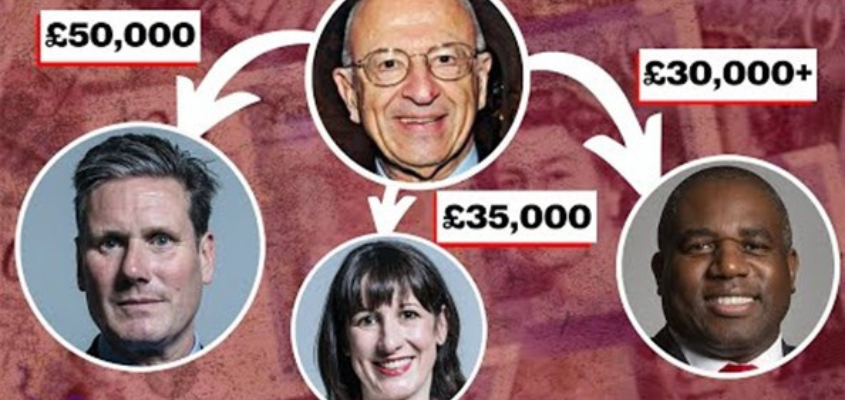
British zionist Trevor Chinn has funded the campaigns of politicians such as Prime Minister Keir Starmer, Chancellor of the Exchequer Rachel Reeves and Deputy Prime Minister David Lammy. IMAGE/Declassified UK
The state of Israel is reviled by most people in the world as a
genocidal, war criminal nation. Money, influence peddling, and brute
force ensure that international condemnation is not allowed to thwart
zionist and imperialist objectives.
“I have many jobs as [Senate] leader… and one is to fight for aid to Israel — all the aid that Israel needs,” – Charles Schumer, Democratic Party Leader in the U.S. Senate
Perhaps we should be grateful that Senator Schumer grudgingly
acknowledged that he has some responsibilities other than giving public
money to Israel. Although it must be said that he and his colleagues
display no such level of seriousness about acting on behalf of the
people of this country. They are far more interested in carrying water
for oligarchs and collaborating with the people they claim to oppose.
His recent remarks were actually rather tame when one considers the
reach of zionist influence around the world, especially in the
“collective west” of Europe, Canada, Australia, and the United States.
These nations are sometimes willing imperialist partners in crime while
also being victimized by zionist pressure campaigns. The determination
to ensure that a pariah nation, that is committing genocide, maintains
political and financial support, that millions of people don’t want to
give, requires that both political manipulation and gangsterish force be
applied at the most opportune moments.
Public approval of Israel in the U.S. has dropped significantly, with a majority of those polled, 59%,
now holding negative views of that country. These opinions may be of
some concern to the American Israel Political Action Committee (AIPAC)
and other zionist political groups, but any worries they have are eased
by following a simple and devastating playbook.
Dissenters are punished openly. When members of congress step out of
line from the accepted zionist discourse they are suddenly confronted
with well funded opponents. That’s what happened to Congressional Black
Caucus (CBC) members Cori Bush and Jamaal Bowman in 2024. And AIPAC was
not shy about dancing on their political graves.
“This year, AIPAC and our 5 million members across the country helped
defeat 11 detractors of the U.S.-Israel relationship. Being pro-Israel
is good policy and good politics!”
The newly elected progressive mayor of New York City, Zohran Mamdani,
may express solidarity with Palestine but he felt compelled to keep
the Mayor’s Office to Combat Anti-Semitism
that Eric Adams established. He is not alone in feeling the pressure
that is applied in New York, Washington, London, and the Land Down
Under.
The Donald Trump administration recently bypassed the congressional approval process to provide Israel with $6.5 billion in military aid. Joe Biden’s administration did likewise, empowering the Gaza genocide
also by going around congress. The purpose of these winks and nudges is
to give cover to members who would vote “yes” if asked, but who do not
want to be taken to task for their support of war crimes. None of them
really object to U.S. presidents making an end run around them to keep
the zionist project afloat and their careers secure.
The release of the most recent Epstein files
provides a glimpse into how this bad sausage gets made year after year.
Very wealthy and well connected zionists, like the late Jeffrey
Epstein, are Israeli state operatives using everything from sex
trafficking to compromise powerful men, to bribing the diplomats who
shaped the Oslo Accords. Israel’s concerns are always top of mind for
presidents and prime ministers who in turn dutifully follow the
directives of their benefactors and their enforcers.
Washington is not alone in facing this onslaught. The Epstein files
have also created a political crisis in the United Kingdom. Prime
Minister Keir Starmer is facing calls to resign from the leadership of
the Labour party and from his office after his chief of staff Morgan
McSweeney’s close relationship to Epstein came to light. McSweeney
is an Irishman who was long known to be a zionist operative but who
also engineered Starmer’s leadership of Labour by working with zionist
individuals and groups in the UK to undermine Jeremy Corbyn.
The Ireland-born McSweeney volunteered on an Israeli kibbutz as a
teenager and went on to become a leader in Labour where he spearheaded
the campaign to smear Corbyn as an anti-semite and to purge him and the
rest of the left out of that party.
McSweeney’s close connection with Peter Mandelson, a zionist and
friend of Epstein, put him at the top of British politics and at the
right arm of a prime minister. His connections were an open secret but
he was finally done-in when it was revealed that he recommended
Starmer’s appointment of Mandelson as ambassador to the U.S.
Mandelson’s connection with the sex trafficker Epstein was the final
straw but McSweeney has always made certain that Israel’s interests were
represented at the highest levels of government.
McSweeney and seemingly everyone in British politics owes their
position to Trevor Chinn, a wealthy man who once said, “I’ve spent my
entire life working for Israel.” Indeed he has by funding both
the Labour Friends of Israel and the Conservative Friends of Israel.
Zionists are nothing if non-sectarian, making sure that Conservatives
and Labour in the UK and Democrats and Republicans in the U.S. know
where their fortunes lie.
Pipes that carry water in and out of Google’s data centre in The Dalles, Oregon IMAGE/Google/New Scientist
Life keeps getting more complex and guilt-ridden by the day. As if the carbon footprint calculation was not enough to turn one into an off-grid hermit, now we have the water footprint to feel guilty about. I hereby declare you ‘guilty’, dear reader, of all the charges I am framing against all of us in this piece.
Ask me how much water I consume in a day, and I will start with the
few glasses I drink, then quickly move on to the litres used for washing
and bathing. Push a bit more, and I will confess to being an obsessive
car washer. Some of us would mention the ‘green patch’ in the house that
must be watered year-round. Push harder still, and we will grudgingly
divide the 3,000 to 7,000 litres of water needed to produce each pair of
denim by the period we own them to arrive at a daily average. Since I
am terrible at mental math, I will do all these calculations on my
smartphone to determine how much water each listed activity costs. In
doing so, data centres globally will consume 0.26 millilitres, about
five drops of water, for each search. Mind you, this data on water
consumption pertains to regular web searches; AI searches consume more
water.
It took a media outlet to take the Oregon city government to court to
obtain data on the water used to cool the Google data centre. In 2021,
the search giant used about 12.4 billion litres of water in the US
alone. In 2023, it used 23bn litres worldwide. WHO guidelines recommend
50 to 100 litres of water per person to meet drinking, cooking, and
hygiene needs under normal circumstances. However, in a post-disaster or
humanitarian crisis, 15 litres per person is the minimum required to
meet basic needs.
To fully grasp how much we are all contributing to water stress,
particularly owing to our web wanderlust, let us consider that Google is
not the only search engine in the world. Microsoft’s internal
projections estimate that, in 2030, the water required to cool its 100
data centres will be 28bn litres. To make things even more complex, the
data centres use water both physically and virtually. While the usage in
the physical sense, ie, water used to cool the data-processing centres
at these facilities, is one measure, virtual usage pertains to the water
used by their electricity providers to cool their production plants.
Imagine the water consumed in even a day of web searches.
Before we jump to condemn the tech billionaires for destroying the
world’s ecology in their quest for private gain, let’s consider the fact
that we are as much part of the problem as we are beneficiaries of
these technological developments. It is amusing to watch developing
countries lay all the blame for global warming at the doorstep of the
developed North. The argument goes something like this: ‘It is the North
that burned all the coal and oil in its pursuit of capitalist greed;
we, the South, are not even industrialised yet.’ To buy into this
simplistic logic, one would have to discount all the benefits of
advancements we have derived since the Industrial Revolution. While
developing countries may not have released greenhouse gases into the
atmosphere, they have benefited from everything that resulted from the
North’s ‘greed’, from jet engines to search engines to diagnosis and
treatment of all manner of diseases.
The next time you are told to work smarter and put AI to use to
complete one inane task or another, think hard if you can put your
natural intelligence to use before resorting to AI.
Trump has seriously fucked up in the Middle East this time and even
he knows it. In the first two weeks alone of Bibi and Donald’s latest
savage bombardment of the Islamic Republic of Iran, neither regime has
been able to keep their various stories straight for longer than fifteen
seconds.
First, we were supposedly doing this because the Iranian people were
just one airstrike away from returning the Shah to power in a popular
uprising but after slaughtering half of the nation’s leadership from the
Ayatollah down to the dog catcher, the Iranian people seemed more
supportive of the fundamentalist hand that barely feeds them than ever
before.
So, then the story changes to a strangely familiar narrative about
weapons of mass destruction, weapons that Trump himself insisted
repeatedly that he had heroically obliterated in the Ten-Day War last
year. And that old gem was followed rather swiftly by yet another
narrative about some inevitable plot by Iran to take over the Middle
East in a week at any given second unless we helped Israel massacre
their daughters in daring daylight raids on elementary schools. Now,
they mostly just point at the mess they made and say, “Now, you see,
with nukes that would be way worse.”
The only thing that seems to change more than Trump’s chickenshit
excuses for setting the region on fire is the timeline for when V-day is
supposed to come. Two weeks becomes four weeks becomes four months
becomes four weeks again after oil prices spike. Believe it or not. all
of these rambling narratives actually do tell the same story. The story
of a vane and ignorant empire that opened Pandora’s Box by assassinating
a nation of 90 million’s god-king and then completely lost control of
the expanding global horror show that followed.
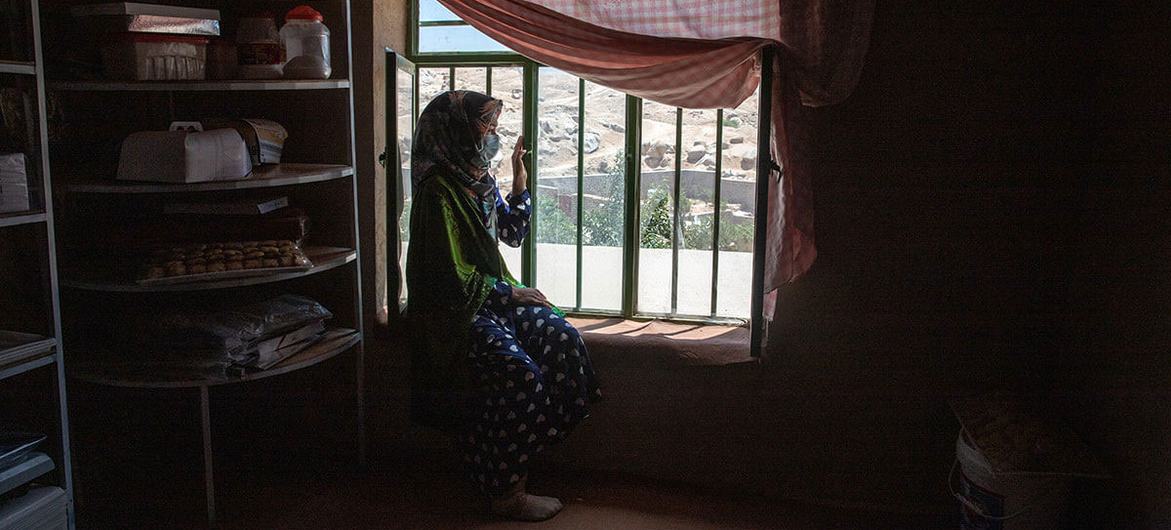
Four years after the Taliban returned to power, Afghanistan is
experiencing what many call a “great muting.” This is not just the
result of war or economic problems, but a deliberate effort by the
Taliban to erase voices. In communication theory, a group is considered “muted” when
those in power control the main ways people can express themselves,
such as language, law, and media. This leaves marginalized groups unable
to share their experiences in a way others can understand.
For Afghan journalists, women, and ethnic minorities, this is not
just a theory; it is a daily reality enforced by the Taliban. The
streets are quiet, not because there is peace, but because the Taliban
has created a culture of silence where speaking out can cost someone
their life.
Women and girls have suffered the most dramatic and visible losses under Taliban rule. UNESCO estimates that
more than 22 million girls are barred from secondary school and
university, reversing decades of educational progress. Many will never
see the classroom again. Women are prevented from working in most sectors, must travel with male guardians,
and are constantly monitored by morality police. Public spaces,
workplaces, and recreational areas have effectively been closed to them.
Observers describe watching an entire generation of girls vanish
before their eyes. The consequences extend far beyond classrooms. Hospitals operate
without female staff, businesses lose vital contributors, and families
struggle to survive. In Afghanistan today, half the population is
effectively silenced, unable to participate in shaping the society
around them.
Noor Phase III CSP Project (150 MW) in Morocco, a central tower Concentrating Solar Power project, has the largest unit capacity in the world. The Project won the 2019 China International Sustainable Infrastructure Award, the 2020 China Power Quality Project (Overseas) Award, and the Social Responsibility Award Certificate issued by the Moroccan government. IMAGE/ PowerChina
With Hormuz closed, Gulf states under attack, every importing country will do what’s needed to remove oil from its energy stack
So, baby, can’t you see
I’ve got to break free
I’ve got to break free
I want to break free, yeah
– Queen
The world cannot possibly absorb more exports from China, screamed the pundits.
After the US and Israel ignited the Middle East powder keg? Oh yes it can! And oh yes it will!
Now more than ever, the world – especially the Global South – will buy everything China has to sell.
China set off alarm bells after its 2025 trade surplus grew 20%
year-on-year to $1.2 trillion, in defiance of Trump tariffs. China’s
2025 exports increased 5.4% while its already low imports fell
marginally. The 20% collapse in exports to the US was more than offset
by growth everywhere else – particularly Global South countries with
exports to ASEAN and Africa surging 13% and 26%, respectively.
Concerns were compounded by January and February 2026 data showing
that China’s exports increased 22% in dollar terms (19% in Rmb terms).
Exports to the EU, ASEAN and Africa rocketed 25%, 27% and 47%,
respectively.