Accelerationist state: China’s biopharma revolution

by ARCHISHA MUKHERJEE

IMAGE/ GenInnov

Chinese biotechs advancing clinical programs, securing approvals and executing licensing deals at dizzying new speed

The continuous stream of drug approvals by Chinese pharmaceutical companies should be a source of awe to any global innovation investor. There are multiple reasons that have led to the current point. However, one key contributor is China’s drug approval policy transformation, which is one of the most under-discussed and massively impactful policy narratives of our era.

The history of the global pharmaceutical industry has largely been a monologue, spoken by the West and listened to by the East. For the better part of the post-war era, the United States, through the engines of the Food and Drug Administration (FDA) and the National Institutes of Health (NIH), served as the world’s laboratory.

In this established orthodoxy, which also included a handful of companies from Japan and Europe, China entered decades later, becoming the world’s factory. In the first phase, it became a massive but fundamentally replicative engine designed to produce volume rather than value.

This dynamic was underpinned by a regulatory lag so severe that it functioned as a non-tariff trade barrier; drugs invented in Cambridge or Basel would typically arrive in Beijing or Shanghai five to seven years after their Western debut.

This delay, known colloquially as the “drug lag,” effectively imposed a “China-last” penalty on the world’s largest aging demographic, rendering the Chinese patient population a secondary consideration in the global R&D calculus.

That era is demonstrably over. It did not end with a whimper, nor was it the result of a slow, organic drift of market forces. It ended with a calculated, statutory, and industrial restructuring of the Chinese state’s relationship with biology.

We are currently witnessing the results of a decade-long project of Acceleration by Design, a deliberate strategy to transform the regulatory review process from a discretionary gatekeeping function into a mandatory conveyance system for innovation. 

The data emerging from 2024 and early 2025 confirms a tectonic inversion in the global biopharmaceutical hierarchy. For the first time in history, the sheer velocity and volume of China’s regulatory apparatus have not merely caught up to Western standards but, in specific metrics of efficiency and output, have bypassed them.

In 2024, China’s NMPA approved 83 new drugs (excluding TCM), a 12% year-on-year increase—significantly outpacing the FDA’s 50 novel medicines. Of these, 46 were Class 1/1.1 innovative drugs (the regulatory classification for drugs not previously marketed anywhere), while 48 qualified as first-in-class by mechanism of action, covering high-complexity modalities including bispecific antibodies, ADCs, and novel small molecules.

Average review times collapsed from 663 days in 2017 to approximately 105 days in 2024, an 84% reduction. 

This report serves as a deep-dive forensic audit of this transformation. By verifying internal regulatory documents and synthesizing external market data, we dissect the seven structural pillars of the “Accelerationist State” and project the consequences of a world where the East no longer waits for the West’s medicine.

The Cradle for more

Stab in the back

by JOHN HELMER

President Vladimir Putin has given instructions to accept the Trump Administration’s demand that in exchange for lifting sanctions against Russia, U.S. capital must return to Russia on preferential terms as soon as possible.

For the new round of negotiations in Geneva later this week, Putin has replaced Admiral Igor Kostyukov, the military intelligence chief, as head of the Russian negotiating team with Vladimir Medinsky, a lower ranking Kremlin official. Medinsky’s instructions are that the military terms of settlement on the Ukraine battlefield, insisted on by Kostyukov at the Abu Dhabi talks, be subordinated to the terms negotiated by Kirill Dmitriev, Putin’s principal negotiator with the White House.

The change in the Kremlin line is reported in the Russian media as the “Anchorage formula” and the “Dmitriev plan”.

This has been publicly criticized by Foreign Minister Sergei Lavrov in coded attacks in media interviews and a speech last week to the State Duma, declaring “the reality is quite the opposite.” Lavrov—Moscow sources say—was reflecting the consensus of the General Staff, the Foreign and Defense Ministries.

Putin reacted through spokesman Dmitry Peskov in defence of the Anchorage formula. “The spirit of Anchorage”—Peskov told Tass—“reflects a set of mutual understandings between Russia and the United States that are capable of bringing about a breakthrough, including in the settlement between Moscow and Kiev…[and] are fundamental.”

Faction-fighting around the Kremlin over what this means has triggered dismay among those Russian businessmen who have acquired their new economic power with takeovers of foreign assets released by the exit of U.S. and European corporations since 2022. These Russian sources report resentment at the backing which Putin has given to Russian Central Bank (CBR) Governor Elvira Nabiullina’s continuing high-interest rate policy for Russian borrowers in parallel with Dmitriev’s plan for low-interest rate U.S. investors to re-enter Russia, recover their former market share, and generate the appearance of an investment stimulus in the run-up to the the State Duma elections on September 20.

Nabiullina and Dmitriev have combined to persuade Putin to allow them to make these Anchorage formula concessions to U.S. negotiators Steven Witkoff, Jared Kushner, and Joshua Gruenbaum. Their last session in Miami on January 31 also included U.S. Treasury Secretary Scott Bessent.

What makes these concessions a “fundamental breakthrough”, as Peskov calls them, has been revealed in a memorandum of conversation published on February 12 by Bloomberg. This reports a “high-level memo which was drafted this year…which was circulated among senior Russian officials”. No author, date, subject line, distribution list, or any other detail of the document has been reported by Bloomberg to authenticate it, or to indicate whether it was leaked by the Witkoff side or the Dmitriev side after the Miami talks.

The published summary has seven points, listed without quote marks. They indicate “U.S. participation in Russian manufacturing” in the Russian aviation sector; “allow American firms to recover past losses” in the Russian oil and gas sector, “including offshore and hard-to-recover reserves”; “preferential conditions for U.S. companies to return to the Russian consumer market”; “cooperation on nuclear energy, including for AI ventures”; “Russia’s return to the dollar settlement system, including possibly for Russian energy transactions”; “cooperation on raw materials such as lithium, copper, nickel and platinum”; and “working together to push fossil fuels as an alternative to climate-friendly ideology and low-emission solutions that favour China and Europe”.

There was no mention of Dmitriev in the Bloomberg report.

Monthly Review Online for more

Why The French Hate Chomsky

by DIANA JOHNSTONE

15 June, 2010
Counterpunch.org
Paris, June 12, 2010.

Dear Noam,

It was a long-awaited pleasure for your many friends and admirers to see you in Paris. I know it was tiring, but you mustn’t think you wore out your voice for nothing. I’m afraid you might get such a negative impression from certain media which seemed to have “learned nothing and forgotten nothing”. However, I think that the rude treatment you received from Le Monde in particular merely highlights the importance of your visit and the deep geopolitical significance that Chomsky has in France.

Excuse me for neglecting your primary field, linguistics, in my analysis. I am not qualified to speak about that. But I tend to believe that the animosity you have aroused in certain circles in France may have less to do with linguistics than with your role as the most prominent American critic of US foreign policy. Yes, we know there are many more, but Chomsky is by far the best-known the world over. My own opinion is that this role as virtual symbol of systematic moral criticism of American foreign policy is the fundamental cause of the campaign against you that began over thirty years ago. To my mind the uproar first over Cambodia and then over the defense of Professor Robert Faurisson’s right to express his views freely was essentially a means to the end of discrediting the leading American critic of United States imperialism.

I need to put this argument in context.

The end of the Second World War split Europe between two groups of satellites of the two major victorious powers. The political methods of the Soviet Union made the satellite status of Eastern Europe obvious to everybody, and notably to the citizens of those countries, who were aware of the coercion keeping them in the Communist bloc.

In the West, American wealth, the ready complicity of native ruling classes and the far more sophisticated methods of political persuasion, dramatizing a largely imaginary “Soviet threat”, succeeded in convincing the satellite countries that they were voluntary allies of the United States.

This worked most of the time. There were a very few temporary exceptions. Sweden, never having been conquered or liberated, had moments of fairly genuine independence, notably under Olof Palme (whose timely assassination has brought Sweden gradually into the arms of NATO). In the 1960s, Charles de Gaulle took major steps to regain political independence for France, notably by criticizing the US war in Indochina and seeking to strengthen relations with Third World countries. This drive was shattered by the events of May 1968, and after the fall of de Gaulle, a normalization process got underway to secure US hegemony in France once and for all.

Now, it is precisely because France was the scene of the strongest impulses for independence that the normalization process had to be the most vigorous.

Counter Currents for more

A glass Napoleon

by F. S. AIJAZUDDIN

British prime minister Anthony Eden IMAGE/Wikipedia

Only a man with Napoleon’s vision would have seen the potential of linking the Mediterranean with the Red Sea by digging a canal.

During his campaign in Egypt (1798-1801), Napoleon saw a commercial advantage in shortening the trade route to India. A miscalculation by his engineers caused him to abandon the project. Sixty years later, in 1869, his compatriot — engineer Ferdinand de Lesseps — fulfilled Napoleon’s aim by completing that modern marvel: the Suez Canal.

Napoleon once lamented: “If it had not been for the English, I should have been emperor of the East.” Ironically, a century later, the British and the French were co-owners of the Suez Canal. When, in 1956, Egyptian President Gamal Nasser nationalised the Suez Canal, Israel, Britain and France launched a combined military invasion. Israel occupied the Sinai peninsula. Britain and France strafed Egypt and planted boots in the Canal Zone. The US and the USSR condemned the invasion and threatened sanctions. Britain and France, humiliated, had to withdraw.

British prime minister Anthony Eden contended that his action had been “to strengthen the United Nations”. He was demolished by Aneurin Bevan’s retort: “Every burglar… could argue that he was entering the house to train the police.” (Bevan’s remark finds echoes in US President Donald Trump’s foreign policy.)

Gulf states must prepare themselves for the worst.

Since then, the criticality of the Suez Canal has increased greatly. Ships use it to transport “30 per cent of the world’s shipping container volume, 7-10pc of the world’s oil and 8pc of liquefied natural gas [LNG]”. It is as vital as the Panama Canal is, or the Strait of Hormuz has now become.

Panama Canal, like the Suez, is a manmade waterway. It connects the Caribbean Sea with the Pacific Ocean, and joins Panama and the US in an uneasy political union.

The canal remained under US control from 1914 until 1999, when it passed to Panama. In January 2025, President Trump announced America’s intention of recovering control of the Panama Canal, threatening ‘economic and military action against Panama’ to ensure American “economic security”.

On the other side of the globe, the Strait of Hormuz — a natural cul-de-sac — is inordinately vital to world trade. Before the present conflict started, tens of thousands of ships and tankers passed through it, carrying 30pc of global oil trade and 20pc of global LNG. Today, Iran has applied a political stranglehold and choked oil and gas supplies to the world.

How long will this asphyxiation last? It could be days, even years. Remember: following the Israeli-Arab war in 1967, the Suez Canal remained blocked for eight years.

Dawn for more

How Iran and China shaped the war chessboard

by PEPE ESCOBAR

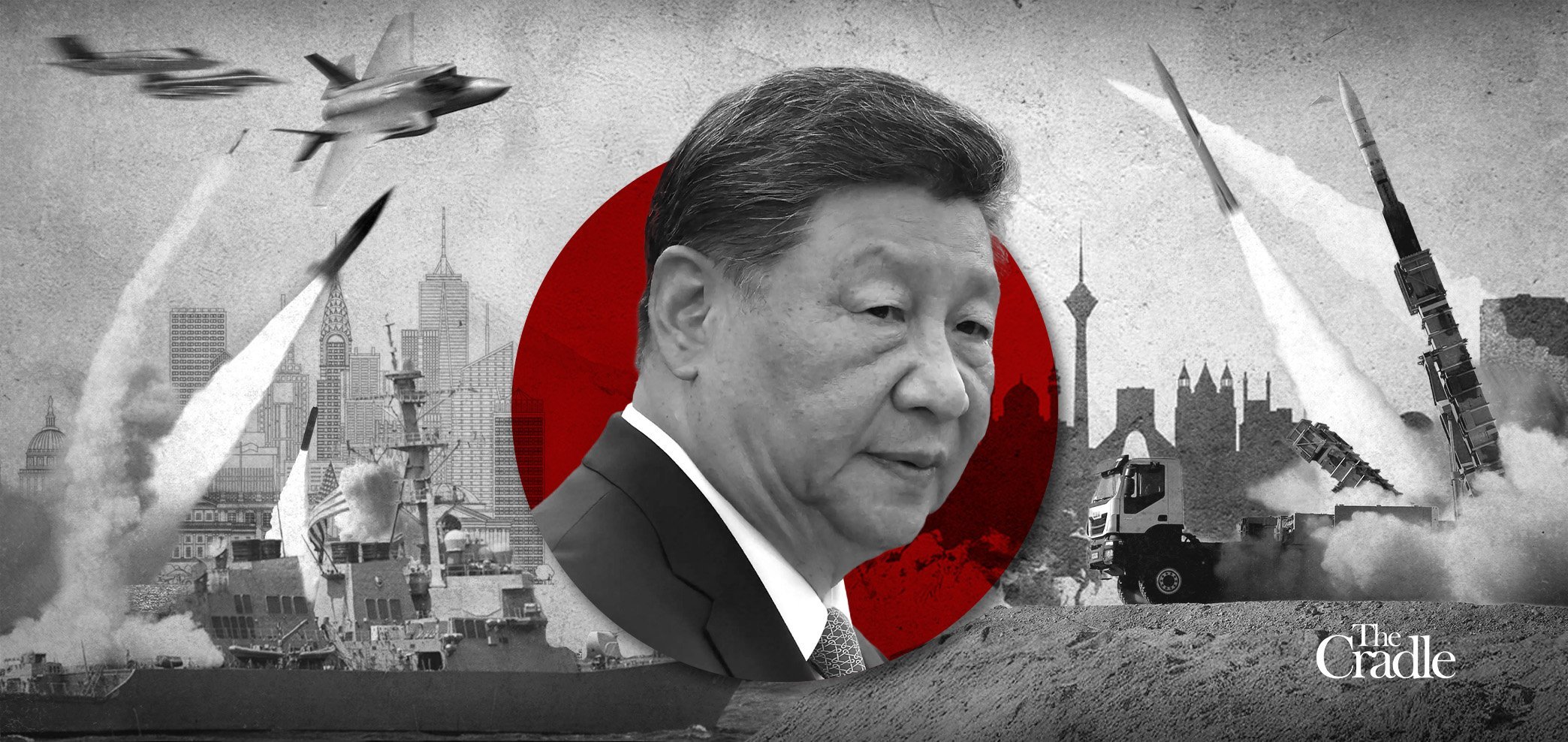
China’s dual-track response to the US–Israeli war on Iran reflects a broader geopolitical and economic strategy that stretches from the battlefield to the global financial system.

China is officially responding on two parallel tracks to the Epstein Syndicate – or US-Israeli – war on Iran via a diplomatic spokesman and a military spokesman. 

Translation: China sees the war both as an extreme political/diplomatic tension and a military threat. 

China’s military spokesman, a People’s Liberation Army (PLA) colonel, speaks with metaphors. It was he who said explicitly that the US is “addicted to war”, with only 250 years of History and only 16 years of peace. 

He clearly positions the US as a global threat. And clearly, also as a moral (italics mine) threat.

Chinese President Xi Jinping is firmly focused on establishing a long-lasting connection between Marxism and Confucianism. 

The key contribution of Confucius to political thinking is the precise use of language. Only the one who speaks with precise metaphors and moral weight is able to govern a nation.

So China is carefully developing a steady moral and ethical criticism of the American war of choice on Iran. Stressing how this is the attack of a nation that has lost its moral compass. 

The Global South totally understands the message. 

Additionally, facts on the battlefield show how China has also changed the rules of war in Iran. 

The Iranian grid is now fully connected to the BeiDou satellite system. That explains how Iran now strikes with precision, and every move by the US-Israeli combo faces a China-tech Digital Wall (over 40 BeiDou satellites in orbit). That accounts for excellent Iranian missile accuracy and increased resistance to jamming.

As part of their 25-year Comprehensive Strategic Partnership, China has also supplied Iran with long-range radars, integrated with satellite systems. The key takeaway is Iran’s now much shorter response time compared to the 12-day war.  

Russia has helped on a parallel track, allowing Iran to apply in spades what Russia learned in Ukraine about western systems such as Patriot and IRIS-T. It’s not only about mass-drone saturation tactics; it’s learning the Russian way of coordinating drone swarms with ballistic missile volleys. That’s exactly what’s in – devastating – effect in the latest stages of Operation True Promise IV.  

Playing Go: It’s all about the petroyuan 

Now let’s focus on the crucial Strait of Hormuz gambit. The key move is Iran only allowing transit for oil tankers whose cargo has been settled in petroyuan. No dollars. No euros. Only yuan. 

In fact, China had already started to end the Bretton Woods/petrodollar system in December 2022, when Beijing invited the Gulf Cooperation Council (GCC) petro-monarchies to trade oil and gas on the Shanghai Stock Exchange. 

Now, couple all of the above with the Chinese 15th Five-Year-Plan, just discussed and approved in Beijing. 

Talk about an in-depth systemic vision. 

In a quite holistic way, Beijing planners set GDP growth at four percent; the digital economy advancing to 12.5 percent of GDP; green energy solutions at 25 percent; surface water quality at 85 percent; an avalanche of high-value patents; all that and more, equally tabled, with hard targets to be achieved and binding indicators all the way to 2030. 

This means the Chinese are treating economy, energy security, ecology, education, and health care as if they are organs of the same fit body. That is how urbanization fuels productivity: a lot of investment in R&D fuels more and more patents; patents fuel the digital economy; and green energy solutions fuel strategic independence. 

The Cradle for more

Naheed Akhtar’s beautifully sung ghazal

by B. R. GOWANI

VIDEO/Lollywood Classics/Youtube

The ghazal beautifully sung by Naheed Akhtar is from the 1988 Pakistani film Kalay Badal (Black Clouds). It is set to music by Rabbani. The titles of the film listed three poets: Saeed Gilani, Mahsoor, and Mansoor Gohar.

shab-e-gham mujh se mil kar aese royi

shab-e-gham mujh se mil kar aese royi
milA ho jese sadiyoN bAd koi

hameiN apni samajh Ati nahiN khud
hameiN kyA khAk samjhAyegA koi

qareeN manzil pe A ke dam hai TuTA
kahAN A kar meri taqdeer soyi

kuchh aese Aj un ki yAd Ayi
mili ho jese daulat aik khoi

sajA rakhA kafas hai khoonoN par se
ke ab to bijliyAN le Aye koi

shab-e-gham mujh se mil kar aese royi
milA ho jese sadiyoN bAd koi

Translation with notes by B. R. Gowani

The night of grief

meeting me, the night of grief wept
as if someone had met me after centuries <1>

I can’t understand my own self
how could anyone explain me

near my destination I breathed my last
what a place for my fate to fall asleep! <2>

the way he entered my memory today
it was as if I had found lost wealth

the cage is adorned with blood and feathers
now somebody should bring the lightning <3>

meeting me, the night of grief wept
as if someone had met me after centuries

Notes

<1> For the poet, grief is her prevalent state and hence the sarcasm. It’s like friends who met yesterday, are meeting again today in such a way as if yesterday was a long time ago.

<2> It is as if a person forced to leave his country, that was messed up by the IMF and US government, in hope of making his life better, reaches the US border but is killed by Border Patrol, or the case of the tens of thousands of lives lost at sea, before reaching shore. The person seemingly about to achieve his goal, and reach his destiny, departs this world, for the ultimate sleep of the dreamworld.

<3> The bird in the cage struggling to set itself free has bloodied itself with feathers scattered all over. The bird has strived so long for liberty that, now, it is tired. In other words, the poet is done with the world and wants lightning to electrocute his place, including himself, which has become a prison for him, because he couldn’t get from life what he had desired.

B. R. Gowani can be reached brgowani@hotmail.com

Paradise lost: Kashmir, orientalism, and the politics of belonging

by MAHEEN AZMAT

Colonial travelogues and Hindu nationalist narratives have long cast Kashmiri Muslims as perpetual outsiders in their own land.

Kashmir has long occupied a curious space in the European imagination. For centuries, travellers, merchants, and colonial administrators produced narratives that constructed this Himalayan valley as a mythical ‘Paradise of the Indies’ — a land of extraordinary beauty whose inhabitants, strangely, were deemed unworthy of it.

This paradox, celebrating the land while denigrating its people, did not die with colonialism. It found new life in the ideological project of Hindu nationalism, which has weaponised these orientalist tropes to justify the ongoing colonisation of India-Kashmir and the systematic othering of its Muslim majority.

The question of who belongs in Kashmir, and who gets to define it, has never been merely academic. It is a question written in blood, displacement, and the language of competing nationalisms.

Annexed by India in 1947 through the contested Instrument of Accession, Jammu and Kashmir was granted ‘special status’ under Article 370 of the Indian Constitution, a status effectively dismantled in 2019 amid heavily militarised conditions.

Today, as New Delhi strips Indian Illegally Occupied Jammu and Kashmir of its autonomy and Bollywood produces films that either sanitise or demonise Kashmiri Muslims, tracing the genealogy of these representations becomes an urgent political task.

The colonial gaze and the ‘paradise’ myth

European fascination with Kashmir began with travellers like François Bernier, a French physician who accompanied Aurangzeb’s entourage to the valley in the 17th century. Bernier likened Kashmir’s mountains to Mount Olympus and its meadows to European gardens, “enamelled with our European flowers and plants, and covered with our apple, pear, plum”. The language of possession — ‘our’ fruits in ‘their’ land — reveals the European impulse to claim Kashmir as a distant reflection of itself, a space of familiarity amid the strangeness of the Orient.

This fascination with places and people perceived as similar to Europe created a substantial readership for travel writing as a genre. The European identity was affirmed through encounters with distant lands that could be made familiar, comprehensible, and available for appropriation.

Dawn for more

Bhutan’s crypto experiment shows how hard digital money is in the real world

by ANANYA BHATTACHARYA

IMAGE/ Paula Bronstein/Lumix/Getty Images

Nearly a year after launching a nationwide crypto payment system for tourists, merchants say hardly anyone is using it — raising questions about who the experiment really serves.

  • Bhutan launched a nationwide crypto payment system for tourists in May 2024, allowing payments in 100+ cryptocurrencies via Binance.
  • Over 1,000 merchants signed up initially, but actual usage has been minimal nearly a year later.
  • Many merchants say no customers have paid in crypto and that tourists often don’t know it’s an option.

Nine months into its big push for cryptocurrency payments, Bhutan isn’t finding many takers for its plans.

Last May, Bhutan became the first country to launch a nationwide crypto payment network for tourists. Visitors to the Himalayan kingdom could pay for their visas, flights, hotels, and meals in more than 100 cryptocurrencies via Binance. Within the first month of its launch, over 1,000 merchants signed up to receive payments in crypto.

Almost a year on, though, nothing much has changed on the ground.

In Thimphu, the QR codes displayed by local businesses to receive crypto payments gather dust. Several merchants have never had any customers opt for them.

“It has been four to five months, but no customer has used it until now,” Sonam Dorji, who works at Lotus Peak Enterprise, a handicraft store on the premises of the Le Meridien hotel, told Rest of World. “No one knows that we accept cryptocurrency and Binance Pay.”

Experts and locals said the government’s push for cryptocurrency is driven by its own massive bitcoin reserves, and doesn’t account for structural hurdles like power shortage and low literacy, which make the transition unlikely.

“Mining bitcoin gives [Bhutan] a currency to purchase imports that it didn’t have before, so I understand why the political establishment in the country wants to go for digital payments,” Jay Zagorsky, a professor at Boston University’s Questrom School of Business, told Rest of World. “However, just because the central bank is pushing Bhutan society toward digital payments does not make it sensible.”

Zagorsky is the author of The Power of Cash: Why Using Paper Money is Good For You and Society. The book argues that preserving physical money is essential to protect individual privacy, curb overspending, and prevent the economic exclusion of the world’s most vulnerable populations.

Rest of world for more

“We Are the Ones We’ve Been Waiting For”

by MACKENZIE SCOTT

IMAGE/Wumaniti

Lately I’ve been thinking about murmurations of starlings. The direction of these flights of millions of birds is not determined by any single leader or delegation, but by the responses of each bird to the needs and movements of the birds around it. In this way, they are constantly creating their direction together, and no bird among them can know what shape it will take or where they will land.

There is a prophecy written by Hopi elders in the year 2000. It encourages us to recognize and celebrate our role as active participants in the co-creation of our communities.    

It’s easy to focus on the methods of civic participation that make news, and hard to imagine the importance of the things we do each day with our own minds and hearts. Who nurtured a child in the kitchen; who was kind to a stranger in line at a grocery store; who gave fifty dollars to a local food shelter: these are not news stories. But all of it matters.

Since my post last December, I’ve given $7,166,000,000 to organizations doing work all over the world. This dollar total will likely be reported in the news, but any dollar amount is a vanishingly tiny fraction of the personal expressions of care being shared into communities this year. To use just one year in the United States as an example, the total donated to US charities of all kinds in 2020 was $471 billion, nearly a third of it in increments of less than $5,000. There was also $68 billion in reported financial support sent to family members living in other countries, tens of billions in crowdfunding, $200 billion in volunteer labor at service organizations, and nearly $700 billion in wages for the paid employees who chose to take jobs delivering those services over jobs where they might have earned more. Over 70% of Americans reported giving both labor and money to people they know, and half reported doing the same for strangers. That’s well over a trillion dollars worth of individual humanitarian action that we don’t read about online or hear about on the nightly news. To begin to imagine how much more there must be, just consider how many people take time out of their income-producing activities every day to listen with compassion, or to speak up for someone.  

And the multiplier effect on the social value of every one of these forms of benevolent contribution is huge.

Generosity and kindness engage the same pleasure centers in the brain as sex, food, and receiving gifts, and they improve our health and long-term happiness as well. The peace-fostering byproducts of one unexpected act of kindness toward a stranger of different background or beliefs might inspire a beneficial chain reaction that goes on for years. Respect, understanding, insight, empathy, forgiveness, inspiration – all of these are meaningful contributions to others.

It is these ripple effects that make imagining the power of any of our own acts of kindness impossible. Whose generosity did I think of every time I made every one of the thousands of gifts I’ve been able to give? It was the local dentist who offered me free dental work when he saw me securing a broken tooth with denture glue in college. It was the college roommate who found me crying, and acted on her urge to loan me a thousand dollars to keep me from having to drop out in my sophomore year. And after she saw the difference she made in my life, what was she inspired to do, twenty years later? Start a company that offers loans to low-income students without a co-signer. And how quickly did I jump at the chance to be one of the people who supported her dream of supporting students just as she had once supported me? And to whom will each of the thousands of students thriving on those generosity- and gratitude-powered student loans go on to give? None of us has any idea.

The potential of peaceful, non-transactional contribution has long been underestimated, often on the basis that it is not financially self-sustaining, or that some of its benefits are hard to track. But what if these imagined liabilities are actually assets? What if these so-called weaknesses foster the strengths upon which the thriving (or even survival) of our civilization depends? What if the fact that some of our organizations are vulnerable can itself be a powerful engine for our generosity? What if acts of service that we can feel but can’t always measure expand our capacity for connection and trust? What if care is a way for all of us to make a difference in leading and shaping our countries? Votes are not the only way to show what we’d like to see more of in our societies. There are many ways to influence how we move through the world, and where we land.


Hopi Prophecy,

(The Hopi Prophecy translated from Hopi Elder Chief Dan Evehema, June 2000)

You have been telling people that this is the Eleventh Hour, now you must go back and tell the people that this is the Hour. And there are things to be considered…

Where are you living?
What are you doing?
What are your relationships?
Are you in right relation?
Where is your water?

Know your garden.
It is time to speak your truth.
Create your community.
Be good to each other.
And do not look outside yourself for your leader.

Then he clasped his hands together, smiled, and said, “This could be a good time! There is a river flowing now very fast. It is so great and swift that there are those who will be afraid. They will try to hold on to the shore. They will feel they are being torn apart and will suffer greatly. Know the river has its destination. The elders say we must let go of the shore, push off into the middle of the river, keep our eyes open, and our heads above the water.

And I say, see who is in there with you and celebrate. At this time in history, we are to take nothing personally, least of all ourselves. For the moment that we do, our spiritual growth and journey come to a halt.

The time of the lone wolf is over. Gather yourselves! Banish the word ‘struggle’ from your attitude and your vocabulary. All that we do now must be done in a sacred manner and in celebration.

We are the ones we’ve been waiting for.

Yield Giving for more