VIDEO/Studio Canal/Youtube Poster for Jacques Rivette’s Suzanne Simonin, La Religieuse de Diderot.
We think of France as being more liberated
culturally and sexually than the US. And perhaps it is, today. But in
the 1960s, post-war/pre-Mai ’68 France was still in the grip of the
Catholic Church and right-wing Gaullist politicians.
In 1965, France banned the showing of Jacques Rivette’s film of Denis Diderot’s 1792 novel, La Religieuse
(The Nun). Not only did they ban the film, they also banned the radio
and television press from reporting that they had banned the film.
Although Voltaire and Rousseau grabbed the headlines as philosophers
of the Revolution, it was Diderot the Encyclopedist whose “seditious”
words put him under constant surveillance, led to the confiscation of
his manuscripts and eventually landed him in the dungeons of the king’s
prison at Vincennes, where the Marquis de Sade was later locked in a
dark cell for seven years. (The last straw for the enforcers of imperial
obedience was his heretical “Letter on the Blind,” which not only
advocated reason over religious superstition but advanced a theory of
natural selection 100 years before Darwin.)
Diderot’s novel, which wasn’t published until a decade after his
death, was a scathing assault on the corrupt and incestuous ties between
the Church and the Ancient Regime. Rivette’s film, which is remarkably
faithful to the novel, targeted the modern reincarnation of that
repressive alliance.
Simone is the illegitimate daughter of an aristocratic family in
financial ruin. Her severe mother tells her she is a daily reminder of
her sin, a child who will never have the status to be married. Against
her will, she is placed in a convent. The convent is a prison, a
sanctified Bastille, where the nuns are kept in cells, the windows are
barred and all interactions with the secular world take place behind
curtains or grill-like barriers.
Every act of rebellion is punished with increasing severity: she was
placed in isolation, deprived of food and books, whipped and forced to
kneel or prostrate herself (stress positions) on stone floors for hours.
The basic techniques of torture haven’t changed all that much across
the centuries.
Planning and development expert Arif Hasan has spent more than five decades working with poor communities across Pakistan and development practitioners and institutes around the world.
Over the last 50-plus years, I have sat through numerous
presentations on government, NGO, masters and PhD students’ development
projects, in various countries, both in what is now known as the global
North and global South.
In addition, international financial institutions (IFIs), such as the
World Bank and the Asian Development Bank, have also sought my
assistance. I have also been a member of various United Nations
committees on physical and social development, and a consultant to them.
As the chief adviser and the chairperson of the Orangi Pilot Project
(OPP) and the Urban Resource Centre (URC), I have challenged the
structure of thinking of many such projects and documented my concerns
regularly.
The most important thing I have learned in the process is that most
of these projects have a very strong anti-poor bias and are primarily
concerned with brick and mortar aspects of problems.
ANTI-POOR BIAS
As far as academia is concerned, almost all teachers and supervisors
bring their class prejudices with them, and the literature search that
students have to undertake strengthens these prejudices.
The poor are portrayed as helpless and incapable of taking decisions
regarding their own lives. The students are asked to observe and pass
judgements on their observations. The poor are almost never asked their
own definition of poverty. Judgements are passed in surveys on the basis
of very small numbers. And once these numbers are cited, they become
the “truth” for other students and consultants to follow.
Planning and development expert Arif Hasan has spent more than five
decades working with poor communities across Pakistan and development
practitioners and institutes around the world. He reflects on the major
lessons he has learnt from that experience and his personal observations
on what is wrong with Pakistan’s development paradigm…
In addition, studies by IFIs have an interest in portraying
conditions to be much worse than they really are, so as to increase
their loan packages for the project or policy under consideration. In
addition, much of the loans Pakistan takes are for paying off previous
loans, something that is seldom taken into consideration by the authors
of the plans.
DOUBLE STANDARDS
The anti-poor bias expresses itself in other ways as well. Building
standards developed for poor and rich settlements vary considerably. The
poor settlements have much lower standards, the contractor is badly
supervised, and the element of corruption is much higher in percentage
terms. Much of the roads, sewage trunks and water pipes constructed for
them collapse in a short period of time and, in the absence of
well-planned drainage, low-income settlements are completely flooded.
It is not of much satisfaction that middle-income settlements today
suffer the same fate as well. Even the workmen employed for the
low-income settlement projects are not skilled, paid less per day, and
the savings that are generated are taken over for politicians,
bureaucrats and the contractor himself.
Many decisions that are taken for low-income settlements are a
violation of common sense. Much of the professionals employed on these
projects are barely trained, and many do not possess a qualification and
are seldom present on site.
HEALTH
Health is a major issue in low-income settlements. Disease deprives a
family of income and, to get well, one has to spend money, which the
family cannot afford. The location of hospitals or medical facilities
are not where they are needed, but in locations where amenity plots had
been located in formal and informal planning.
In addition, in academic training, a lot of emphasis is put on
curative rather than preventive medicine. That determines the location
and design of health-related infrastructure, and the relation between
disease and architecture simply does not exist in planning concepts.
The cost of curative medicine has become so high that many families
are now heavily in debt because of it. Surveys show that people have
shifted to hakeems [traditional healers] and homeopathic systems, so as
to make medicine affordable.
PARKS AND PLAYGROUNDS
If you look at the location of parks and playgrounds, the main
municipal parks are eight to 10 km away from most low-income
settlements. Amenity plots in low-income settlements have been
encroached upon, and those that have not been encroached upon have not
been developed. Many of them have become garbage dumps and sorting yards
for solid waste, promoting disease and environmental degradation of the
settlements around them.
New York City mayor-elect Zohran Mamdani reacts as visits a mosque in San Juan, Puerto Rico on 7 November, 2025 IMAGE/Reuters
The genocide exposed not only Israel’s violence, but also the system that had guarded it. Mamdani’s win is the first electoral articulation of that awakening
Something shifted in New York.
In a city where financial power and media consensus ordinarily define
the limits of political possibility, a young Muslim democratic
socialist defeated a former governor backed by US President Donald Trump and the donor networks accustomed to pre-deciding electoral outcomes.
He did so against a joint establishment effort. Trump publicly endorsed former governor Andrew Cuomo. Major Democratic Party figures withheld support from Mamdani until the final days – and even then, gave it reluctantly.
The race became a confrontation not only with the Republican right,
but with the centrist leadership of the Democratic Party that has
dominated its direction for decades.
Weakening the Trump project
Mamdani’s win marks the breakthrough of the true left inside a party long disciplined by donor politics and triangulation.
From hope and hunger strikes to City Hall: The rise of Zohran Mamdani
Read More »
These were local elections – centred on transit, housing, and public
services – not presidential contests. Yet in New York, local elections
signal national direction. They reveal where the current is moving
before it becomes visible.
And the current has shifted.
In Virginia, Abigail Spanberger captured the governorship after four years of Republican rule. In New Jersey, Mikie Sherrill defeated Jack Ciattarelli decisively.
In California, nearly two-thirds of voters supported Proposition 50, reversing Republican-style redistricting strategies imported from Texas.
Taken together, these results signal a weakening of the Trumpian project – a formation built on anti-immigrant fear, Islamophobia, managed grievance, and the political power of concentrated wealth.
Its forward momentum has stalled. It is now being confronted by a new
political subject: younger, migrant, multi-racial and working-class.
Mamdani’s campaign was not built through elite patronage. It was
organised horizontally: students, tenants, working-class youth,
undocumented organisers, Black and brown families, white youth
disillusioned with managerial liberalism.
And Mamdani won more than a third of Jewish votes – dissolving, in electoral fact rather than argument, the claim that solidarity with Palestine is antisemitic.
In the United Kingdom, the Green Party’s membership surged past 150,000 because it named the genocide in Gaza clearly – with its young Jewish leader, Zack Polanski, speaking with a clarity that the Labour Party refused.
Legitimacy test
In Wales, Plaid Cymru party condemned the genocide without hesitation, demanded an arms embargo, backed Palestinian statehood in the Senedd, and joined demonstrations publicly – and its support held.
Moral clarity on Gaza has become the new measure of political legitimacy and hesitation now reads as weakness
Ireland’s prominent nationalist party Sinn Féin’s unwavering language
on Gaza restored its position as the party of anti-colonial solidarity,
strengthening its support across working-class, youth, and older
Republican communities alike.
And in Ireland again, Catherine Connolly’s landslide
on 24 October 2025 – 63.4 percent of the vote and 914,143
first-preference ballots, the largest since the presidency was created –
confirmed that voters are rewarding moral clarity.
In France, La France Insoumise surged to become the principal opposition force, drawing especially strong support from young voters, Muslims, and working-class neighbourhoods.
Across these contexts, the pattern is clear: moral clarity on Gaza
has become the new measure of political legitimacy and hesitation now
reads as weakness. Euphemism now reads as complicity.
The reason is simple: Gaza shattered the machinery of silence.
The genocide exposed not only the violence of the Israeli state –
the bombardment, the siege, the forced displacement– but also the system
that had guarded it: media discipline, donor intimidation, and the
strategic use of antisemitism to suppress dissent.
The taboo collapsed
For nearly a decade, right-wing populism defined the horizon of
political possibility. The centre-right shifted right. The centre-left
followed.
There is a providential link between AI development and the falling global birthrate
AI may be somehow providential. In about 150 years, the world’s
population went from 800 million to 8 billion but the feat is unlikely
to be repeated in the next 150 years.
That is, the world won’t be home to 80 billion people in 2170. All
data show that birth rates are dropping and the global population will
stabilize sometime between late this century and early next century at
10 to 14 billion people. After that, it might actually decline.
This is happening because there was not simply a change in health
care and technology, cutting early deaths and extending life expectancy,
but also an unprecedented historical change in the quality of life.
For all of human history, children have been a capital and a force.
Families with many children had more manpower and thus more income,
influence and social clout. In the past 50 years, for the first time,
children have become a burden where more children meant more expenses.
The quality change is that, on average, parents are caring for
children as never before and that children no longer serve the needs of
parents and the family – rather, it’s the other way around.
Children are not expected to become herders at the age of six or toil
in a mine or on a boat. At that age, they need to go to school for
10-20 years. This was a rare privilege until mass education became the
norm after the end of the 19th century.
The world came to believe that investing in mass education had much
higher returns than sending most of its children to work at 5 or 6. Mass
education also meant better health care for children; they can’t study
if they are unwell.
With fewer children, parents’ affection and dedication are more
concentrated: if you have a couple of kids, it’s different from having
half a dozen or more. It has changed everything in the parent-child
relationship. Children are an expensive and risky investment for
families and society.
Therefore, a family or even a society can’t have too many children.
There are still many children in places where there’s a strong religious
drive or where they do not need investment.
For the rest of the people, children are a costly concentration of
affection, which (because of their nature) cannot be wasted, and thus
one cannot have too many of them. Even wars, a constant drain of blood
and lives throughout human history, now need, in general, fewer people –
with less carnage fewer children are sacrificed at the altar of death
and glory.
Short of a nuclear apocalypse, wars now aim at destroying a country’s
infrastructure and crippling its economy, with warfare flying on the
blades of AI-driven drones or cyberattacks.
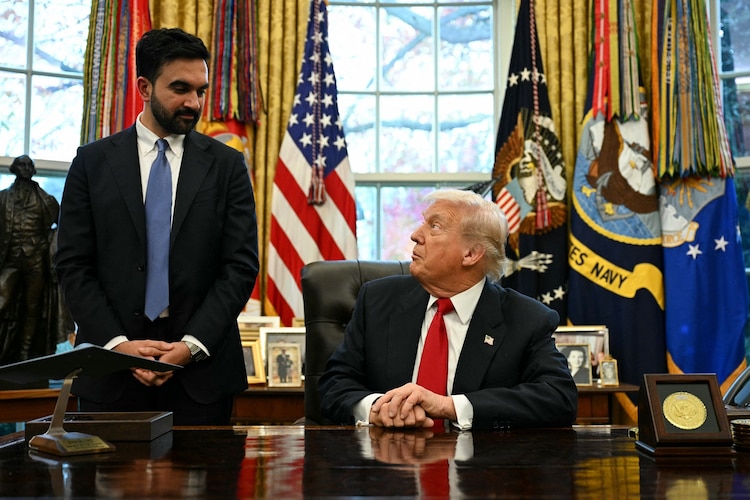
President Donald Trump meets with New York Mayor-elect Zohran Mamdani in the Oval Office at the White House in Washington, November 21, 2025. IMAGE/Jim Watson/AFP via Getty Images/ABC News
Mamdani, Trump, and socialist strategy
It was the most anticipated meeting at
the White House since Donald Trump’s confrontation with Ukrainian
President Volodymyr Zelensky. Would Trump dress down and insult New York
City Mayor Elect Zohran Mamdani? Would Mamdani give as good as got and
humiliate Trump as effectively as he did Andrew Cuomo in their Mayoral
debates?
But it was neither a battle royale nor a celebrity death match. It
was a surreal, chummy meeting where the two embraced over their
supposedly shared agenda of addressing the U.S. capitalism’s spiraling affordability crisis. The surprisingly affable nature of the meeting evoked a wide range of responses, from praise for Mamdani’s tactic of preemptively disarming Trump to condemnation of the Mayor Elect as a sellout.
In reality, Mamdani’s decision to avoid conflict and Trump’s embrace
of the affordability agenda are both born out of a shared political
weakness that drove them toward accommodating one another. Even worse,
in the aftermath of their meeting, Mamdani, despite reaffirming his
denunciation of Trump as a despot and fascist, persisted in saying
he would work with Trump to make New York more affordable. But this
friendly state of affairs will only be temporary; the knives will
inevitably come out. To prepare for the confrontation, we must double
down on building mass class and social struggle to win the demands and
secure the rhetorical promises of Mamdani’s campaign and defend
ourselves against the Trump regime.
Boxed in office
First, we must grasp the reasons behind Mamdani’s non-confrontational
approach to the meeting. Remember, he is in a weak position. He won
just over 50 percent of the vote, squeaking out a narrow victory against
two far-right candidates, Cuomo (supported by Trump!) and Sliwa, who
amassed together almost 49 percent of the vote.
Moreover, his office, while seemingly powerful, is dependent on the
City Council, the state government controlled by Kathy Hochul and the
Democratic Party establishment, and the federal government imperiously
wielded by Trump against any and all enemies real and perceived. And,
beyond these political obstacles, Mamdani’s ability to deliver anything
from his office in the capitalist state depends on the growth and
profitability of corporations, especially finance capital whose
international headquarters is in New York, for tax revenue to fund
reform.
Despite his nods to popular struggle, Mamdani is a reformist. He
believes that holding office is the route to delivering social change.
Given this, he has little room to maneuver and therefore every reason to
cut deals in the hopes of ingratiating himself to the real power
brokers in the state and capitalist economy so that they will let him
enact reforms. That explains why he has met with the Democratic Party
establishment, sought their endorsement, attempted to defang the
opposition of the real estate bosses by meeting with them, and even reappointed the dreaded billionaire police commissioner Jessica Tisch.
All of this also explains why Mamdani (like AOC) has chosen to oppose
the primary challenge by a fellow DSA member, Chi Ossé, to dethrone
neoliberal Zionist and House Minority Leader Hakeem Jeffries. Mamdani
went further, telling NBC
that he wants Jeffries to remain the Democratic Leader and become the
Speaker if Democrats retake the House. The logic of reformism,
especially without mass class struggle from below, is one of adaptation
to the capitalist class and its politicians, at best delivering
milquetoast liberal reform and at worst simply managing the existing
system (remember Francois Mitterrand, the “Red Margaret Thatcher?”).
Diplomacy not confrontation
Mamdani’s objective weaknesses and his reformist strategy shaped his
tactical approach to the meeting with Trump. He abandoned any pretense
of confrontation with the head of a regime that is carrying out a
bigoted class war at home. Trump has abolished the union rights of over a
million government workers and is carrying out state terror against
migrants and transactional, unilateral imperialism abroad—from murderous
gunboat diplomacy in Latin America to imposing imperialist “peace
deals” in Palestine and Ukraine that reward Israel and Russia as
colonial aggressors. Mamdani raised none of this. Out the window went
turning up the volume to denounce Trump as a despot, fascist, and
genocidal war criminal.
Instead, Mamdani stuck like a broken record on appealing to Trump to
join him in a partnership for affordability. He was intent on charming
and, in his own mind, disarming Trump in the hopes of seducing him to
sustain the flow of federal dollars into New York City’s coffers. Now,
many of Mamdani’s advisers will argue that he’s playing three- or
four-dimensional chess and can outfox Trump. Such arguments justify
reformism’s logic of accommodation, not resistance, to someone that they readily and openly call a fascist.
Only . . . mass struggle can win reform, not glad-handing a monster in the White House.
This strategy will not work to stop Trump. He’s already waging war on
New York. ICE is sweeping up people in the city, those dependent on
Obamacare are about to lose their subsidies, Medicaid cuts are ravaging
the working class, trans people are under federal siege, and on and on.
And if, under pressure from below, Mamdani does stand up on any of these
issues of class exploitation and social oppression, Trump will come
down on the city and its people like a ton of bricks. This may happen
anyway.
The high price of accommodation
Thus, the strategy of reformist accommodation comes at a high cost to
workers and the oppressed. We can already see it happening. In the
meeting, Mamdani underscored his commitment to keeping the police
commissioner and her gestapo of 35,000 officers that enforce the brutal
racist class inequalities of NYC. He didn’t blink an eye when Trump said
they shared a tough on crime agenda. This is just one of many
high-priced concessions to come, unless workers and the oppressed fight
for the campaign’s demands and the fulfillment of its rhetorical
promises.
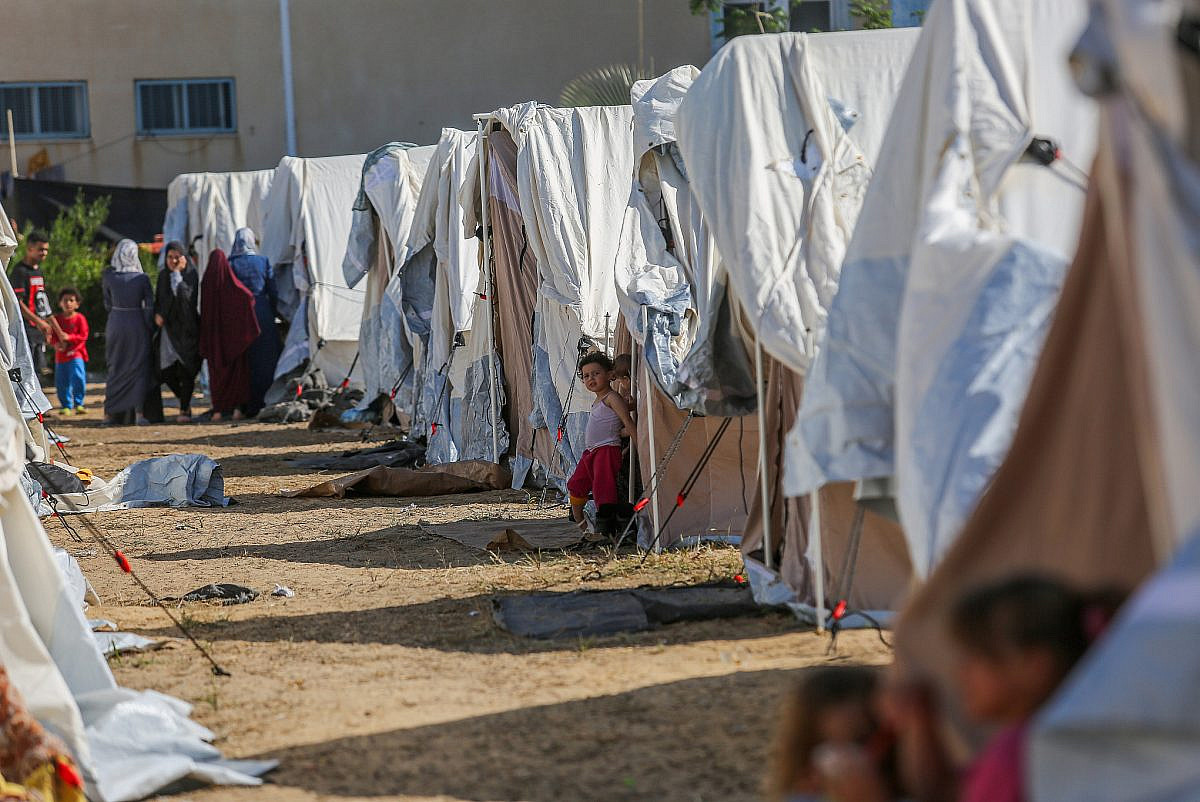
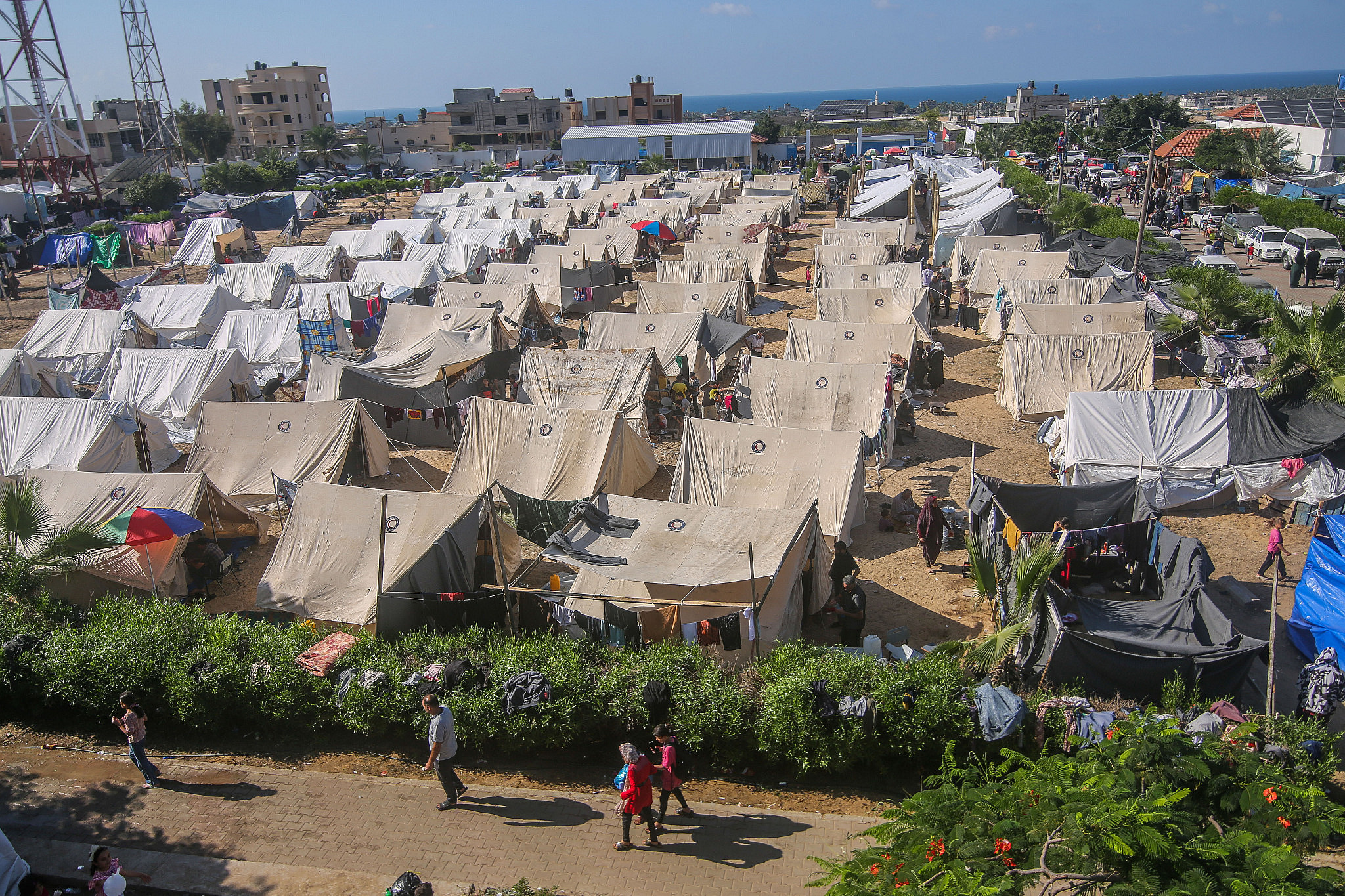
Palestinians shelter at a temporary tent camp set up for those who were displaced from their homes by Israel’s evacuation orders and airstrikes, Khan Younis, southern Gaza Strip, October 19, 2023. IMAGE/Abed Rahim Khatib/Flash90
Hundreds of Palestinians are sheltering in a makeshift encampment in Khan Younis, surviving on limited provisions amid Israel’s ongoing assault.
In scenes eerily reminiscent of the
conditions of Palestinian refugees following the Nakba of 1948, a tent
city has sprung up in recent days in the western part of Khan Younis, in
the southern Gaza Strip. More than 100 UN tents have been set up in
what used to be a city square, providing temporary shelter for around
800 people who were displaced from their homes amid Israel’s bombardment
of Gaza in the wake of Hamas’ Oct. 7 attack.
While everyone in Gaza is facing
severe shortages of food, water, and electricity, those living in the
tents are among the worst affected by Israel’s attacks and intensifying
siege. Residents of the encampment are surviving on the limited aid
provided by locals and a few civil society organizations.
It is not altogether clear how the
tent city came into being. Salama Marouf, the head of Hamas’ media
office, admitted in a press conference last week that Hamas was
surprised when the encampment sprung up, which he criticized as an echo
of the refugee camps of 1948. Taking aim at the UN Relief and Works
Agency (UNRWA), which has handled the humanitarian affairs of
Palestinian refugees throughout the region since the Nakba, Marouf
declared: “UNRWA’s role is not to set up tents for those who are
displaced inside Gaza in preparation for their displacement outside the strip.”
But while confirming that the tents
are theirs, the UN agency has denied setting up a new refugee camp.
“UNRWA has distributed the tents to displaced families in Khan Younis to
protect them from the rain and provide dignity and privacy,” Juliette
Touma, UNRWA’s director of communications, told +972. “We wish to
confirm that UNRWA has not established any new camps in the Gaza
Strip.”
Fadwa Al-Najjar arrived at the
encampment on Friday. Standing in front of her tent, close to some carts
selling canned food and cooking utensils, the 40-year-old mother of
seven recounted the horrors of her journey from the north of the strip
to Khan Younis following Israel’s orders to evacuate.
Palestinians at a temporary tent camp set up for people who evacuated from their homes, on the grounds of an UNRWA school in Khan Yunis, in the southern Gaza Strip, October 19, 2023. IMAGE/Abed Rahim Khatib/Flash90
Palestinians at a temporary tent camp set
up for people who evacuated from their homes, on the grounds of an
UNRWA school in Khan Yunis, in the southern Gaza Strip, October 19,
2023. (Abed Rahim Khatib/Flash90)
Al-Najjar was displaced along with 90
of her relatives, all of whom lived together in one residential
building in northern Gaza. The 30 kilometer journey south took 10 hours
by foot. “We tried to rest on the way, but the bombing was intense, so
we had to keep moving,” she recalled. “Israel bombed cars in front of us
that were carrying displaced people. We saw bodies and limbs
everywhere. It was like doomsday. We recited the Shahada because we were
scared we’d be killed. I’ll never forget it.”
Sherine Al-Dabaa, 36, is living in a
tent in the encampment with more than 15 family members, after they fled
their home in Shujaiya, eastern Gaza City, on Oct. 15. “We couldn’t
find a place to stay, so we gathered here,” she said. “This place is not
safe, and the sounds of bombing day and night terrify the children. We
feel like we could die at any moment.”
Mother Earth- we have only one. However, the capitalist fundamentalists are busy minting money at the expense of the environment; this is doing great damage to our planet at such speed and ferocity, that it will be difficult to reverse the course.
Of course, there are other planets about which billionaires like Elon Musk are thinking of making their home. That is a far away dream, and if it ever becomes a possibility, it will be for the extremely wealthy people. They’ll need some human workers to take care of their daily chores. But, that is doubtful, as they’ll probably take their robots there. The rest of the common folks will stay on this planet to produce luxury goods for the Martians and the dollar store items for Earthlings.
All of the above have gained some recognition for their dedicated efforts to save our environment.
But then there is a group of people, I call them the silent minority, who may have helped the environment, inadvertently. These are leaders of countries. Mind you, it was not a conscious effort on part of these leaders but their actions did result in a bit of help in saving the environment.
The following is a small attempt to recognize some of these leaders’ contribution:
Armenia’s Prime Minister Nikol Pashinyan and Azerbaijan’s President Ilham Aliyevnominated US President Donald Trump for the Nobel Peace Prize.
Armenia’s Pashinyan in an address to his nation said:
“Peace has been established between Armenia and Azerbaijan. The contribution of US President Donald Trump and his administration has been crucial. For this reason, together with the President of Azerbaijan, we have decided to submit a joint application to the Norwegian Nobel Committee.”
Cambodia’s Prime Minister Hun Manet‘s office issued the following statement to nominate Trump for the Nobel Peace Prize citing the decision taken as a result of Trump’s intervention in July 2025 asking both Thailand’s acting Prime Minister Phumtham Wechayachai and Cambodia’s Manet to stop border clashes:
“President Trump’s extraordinary statesmanship-marked by his commitment to resolving conflicts and preventing catastrophic wars through visionary and innovative diplomacy-was most recently demonstrated in his decisive role in brokering an immediate and unconditional ceasefire between Cambodia and Thailand.”
“This timely intervention, which averted a potentially devastating conflict, was vital in preventing great loss of lives and paved the way towards the restoration of peace between the two countries.”
“He brought peace back to a region where that was never possible, He deserves a Nobel Peace Prize.”
Israel’s Prime Minister Benjamin Netanyahu nominated Trump for Nobel Peace Prize. Interesting nomination, for the person most people consider a “genocidal maniac.” Netanyahu got tens of billions of dollars in aid and arms, to kill Palestinians.
“He’s [President Donald Trump] forging peace, as we speak, in one country, in one region after the other., so I [Benjamin Netanyahu] want to present to you, Mr President, the letter I sent to the Nobel Prize Committee. It’s nominating you for the Peace Prize, which is well deserved, and you should get it.”
“The biggest bombs that we’ve ever dropped on anybody, when you think non-nuclear.”
“I don’t want to say what it reminded me of [i.e., atomic bombing of Hiroshima and Nagasaki], but if you go back a long time ago, it reminded people of a certain other event, and Harry Truman’s picture is now in the lobby.”
President Franklin Delano Roosevelt’s death on April 1, 1945 elevated his Vice President Harry Truman to the top post. Japan was ready to surrender bringing the Second World War to an end, but the US was not ready. Truman wanted to try the new weapon, the atom bomb, on Japanese people while giving a message to the world, particularly USSR’s Joseph Stalin, that the US is the new globo-cop because the previous cop Britain was finished. Between 150,000 to 246,000 Japanese were killed and many more died later, or suffered, and became disabled over long period of time due to the effects of radiation .
Pakistan’s “hybrid” military/civilian governmentnominated Trump for Nobel Peace Prize:
The Government of Pakistan has decided to formally recommend President Donald J. Trump for the 2026 Nobel Peace Prize, in recognition of his decisive diplomatic intervention and pivotal leadership during the recent India-Pakistan crisis.
…
At a moment of heightened regional turbulence, President Trump demonstrated great strategic foresight and stellar statesmanship through robust diplomatic engagement with both Islamabad and New Delhi which de-escalated a rapidly deteriorating situation, ultimately securing a ceasefire and averting a broader conflict between the two nuclear states that would have had catastrophic consequences for millions of people in the region and beyond. This intervention stands as a testament to his role as a genuine peacemaker and his commitment to conflict resolution through dialogue. The Government of Pakistan also acknowledges and greatly admires President Trump’s sincere offers to help resolve the longstanding dispute of Jammu and Kashmir between India and Pakistan—an issue that lies at the heart of regional instability. Durable peace in South Asia would remain elusive until the implementation of United Nations Security Council resolutions concerning Jammu and Kashmir. President Trump’s leadership during the 2025 Pakistan India crisis manifestly showcases the continuation of his legacy of pragmatic diplomacy and effective peace-building. Pakistan remains hopeful that his earnest efforts will continue to contribute towards regional and global stability, particularly in the context of ongoing crises in the Middle East, including the humanitarian tragedy unfolding in Gaza and the deteriorating escalation involving Iran.
Rwanda’s foreign Minister Olivier Nduhungirehe told Breitbart News:
“This conflict in eastern DRC is one of the longest conflicts on the continent — 30 years. We have had a genocidal movement that has been destabilizing our country during this whole period. Anyone, including President Trump, who would help sizably to bring this conflict to an end deserves the Nobel Peace Prize. Absolutely.”
South Korea’s President Lee Jae Myung bestowed Trump, who was visiting South Korea, with a replica of an ancient golden crown worn by Silla Kings whose rule lasted almost a millennium, from 57 BCE to 935 CE. Trump was informed that it was “the largest and most extravagant of the existing gold crowns” and symbolizes “the divine connection between heavenly and earthly leadership.” Trump was also awarded the Grand Order of Mugunghwa. Trump was gracious enough to try the crown right away rather than maybe having to return it back from the US, because of it being the wrong size.
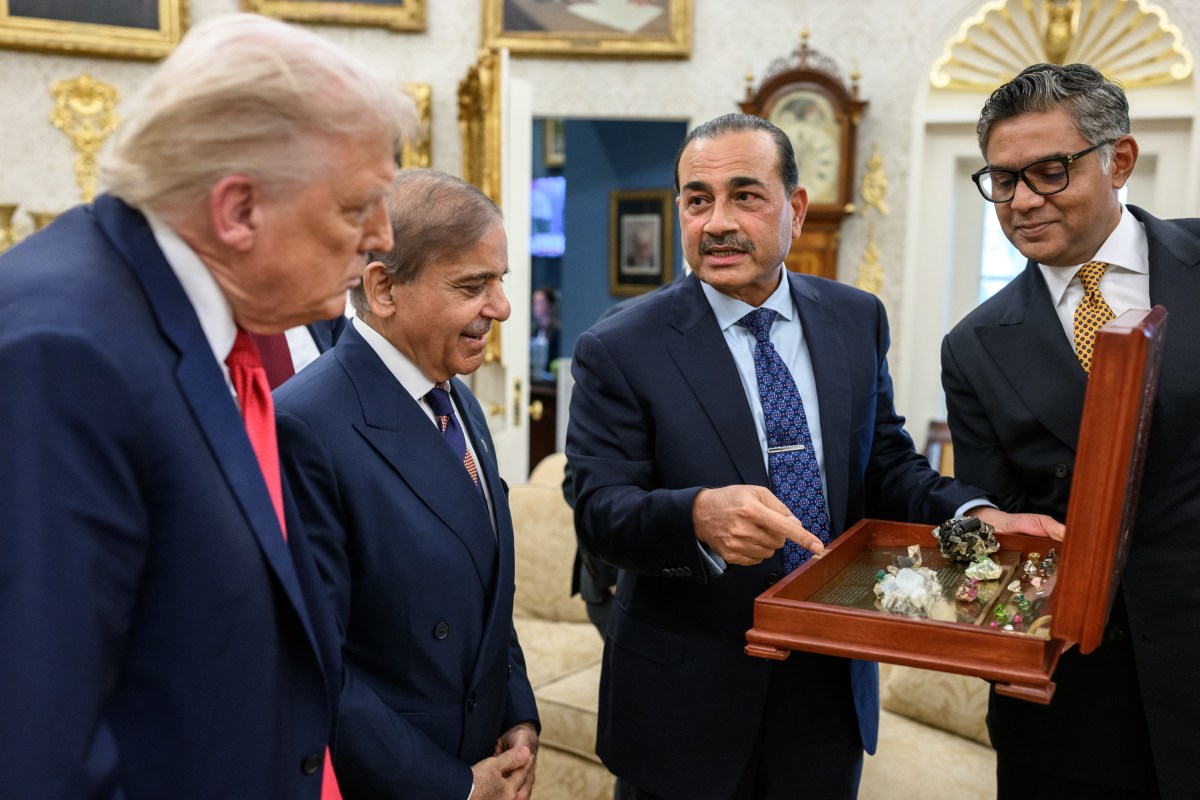
Environment-Friendly Leader Award goes to Pakistan’s “hybrid” leaders: Chief of the Army Staff (COAS) and first Chief of Defense Forces (CDF) Field Marshal Syed Asim Munir Ahmed Shah and Prime Minister Mian Muhammad Shehbaz Sharif.
Please watch and listen to Sharif’s entire speech in the above video and you’ll understand why he and Munir won the award.
How the environment was saved?
The White House announced that toilet paper order for one year was cancelled because the high praise words of these leaders eliminated the need for it for an entire year. The words of Pakistani leaders have saved toilet paper: much more than the words of all the leaders combined.
Note:
Indian Prime Minister Narendra Modi had always been nice, full of praise, and hugging buddy of Trump, except in 2025; he’s missing.
B. R. Gowani can be reached at brgowani@hotmail.com
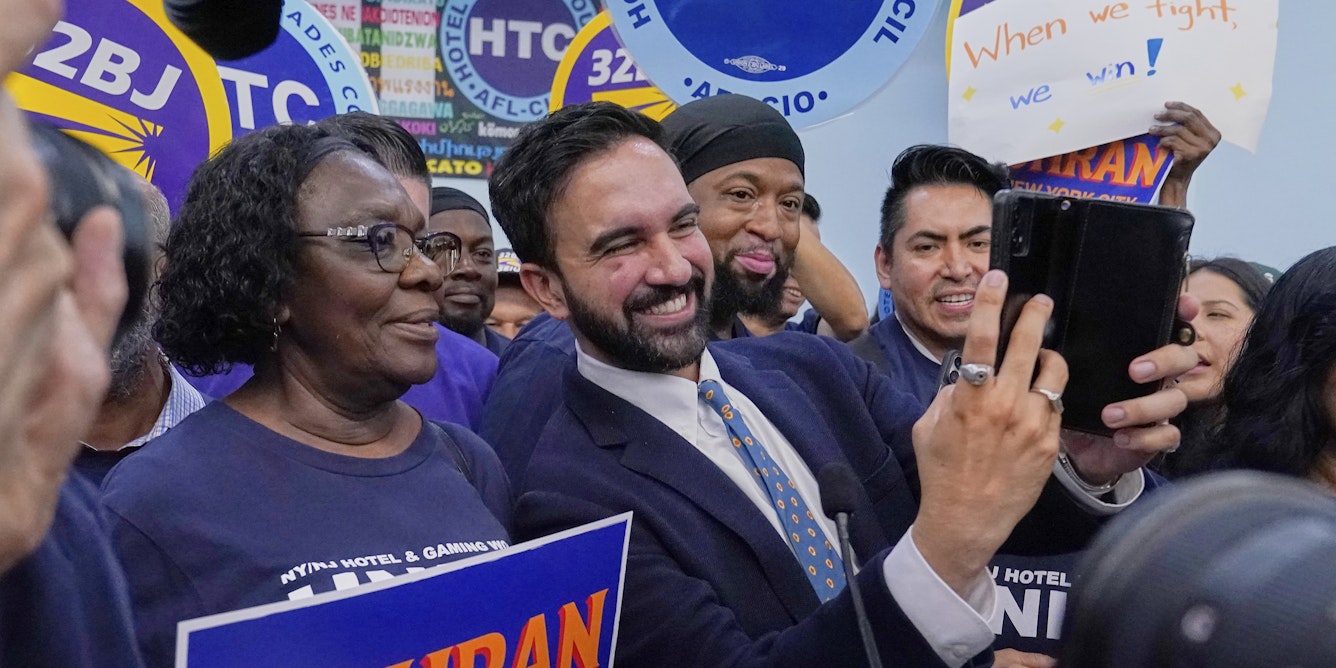
Zohran Mamdani takes photos with union members during a campaign rally at the Hotel and Gaming Trades Council headquarters in New York on July 2, 2025.IMAGE/AP Photo/Richard Drew
By the time Zohran Mamdani became the next mayor-elect of New York City on Nov. 4, 2025, many Americans were familiar with his progressive platform
and legislative record. But understanding the Democratic candidate’s
background requires examining the rich cultural tapestry woven into his
surname: Mamdani.
He takes the name from his father, Mahmood Mamdani, a prominent
academic who was raised in Uganda and whose work focuses on postcolonial
Uganda. I studied the history
of the Khoja community for my doctoral work and have helped develop
Khoja studies as an academic discipline. The Mamdani surname tells a
story of migration, resilience and community-building that spans
centuries and continents.
The Khoja history
Mamdanis in Uganda belong to the Khoja community, a South Asian Muslim merchant caste, that shaped economic development across the western Indian Ocean for centuries.
The name originates from greater Sindh, a region in South Asia that
today includes southeastern Pakistan and Kachchh in western India.
Its etymology is twofold. Mam is an honorific title in Kachchhi and Gujarati languages, meaning kindness, courage and pride. Mamado is a local version of the name Muhammad that often appeared in surnames in Hindu castes that converted to Islam, such as the Memons.
The Khoja were categorized by the British in the early 19th century as “Hindoo Mussalman” because their traditions spanned both religions.
Over time, the Khoja came to be identified only as Muslim and then primarily as Shiite Muslim. Today, the majority of Khoja are Ismaili: a branch of Shiite Islam that follows the Aga Khan as their living imam.
The Mamdani family, however, is part of the Twelver community of Khoja, whose Twelfth Imam is believed to be hidden from the world and only emerges in times of crisis. Twelvers believe he will help usher in an age of peace during end times.
Around the late 18th century, the Khoja helped export textiles,
manufactured goods, spices and gems from the Indian subcontinent to
Arabia and East Africa. Through this Western Indian Ocean trading
network, they imported timber, ivory, minerals and cloves, among other goods.
Khoja family firms were built on kinship networks
and trust. They built networks of shops, communal housing and
warehouses, and extended credit for thousands of miles, from Zanzibar in
Tanzania to Bombay – now Mumbai – on the western coast of India.
Cousins and brothers would send money and goods across the ocean with
only a letter. The precarious nature of trade in this period meant that
families also served as insurance for each other. In times of wealth, it was shared; in times of disaster, help was available.
Khoja contributions in Africa
The Khoja became instrumental in building the commercial infrastructure of eastern, central and southern Africa. But the Khoja contribution to the development of Africa extended far beyond trade.
In the absence of colonial investment in public infrastructure, they helped build institutions
that formed the foundation of the modern nation-states that emerged
after colonization. The institutions both facilitated trade and
established permanent communities.
For example, the first dispensary and public school in Zanzibar were constructed by a Khoja magnate, Tharia Topan,
who made his wealth through the ivory and clove trades. Topan
eventually became so prominent that he was knighted by Queen Victoria in
1890 for his service to the British Empire in helping to end slavery in
East Africa.
The Khoja community continues to invest in East Africa. The most famous example is the Aga Khan Development Network,
whose hospitals and schools operate in 30 countries. In places such as
Kenya, Uganda and Tanzania, they are considered the best.
Khoja in Uganda
Like in other parts of Africa, the Khoja settled in Uganda as a
liaison business community to develop a market to serve both African and
European needs. The linguistic and cultural knowledge, developed over
centuries, helped facilitate business despite the challenges of
colonization.
Francesca Albanese’s visit to South Africa exposed a truth we prefer not to face: that our moral witness has hardened into ritual. We watch, we clap, we call it solidarity.
There is a particular theater to South African political life: we
know how to gather, how to convene, how to fill auditoriums when history
arrives clothed in urgency. We clap when we should clap. We nod with
seriousness. We ask familiar questions with grave voices. And then we go
home feeling as though participation is enough. Our gestures are
precise, our cadences rehearsed. We have mastered the choreography of
conscience.
On Sunday, October 26, as Francesca Albanese spoke, something in the
room felt deeply familiar—a choreography of solidarity, ritualistic and
almost liturgical. Albanese, the UN Special Rapporteur on human rights
in the Palestinian territories, had just delivered the Nelson Mandela
Annual Lecture in Johannesburg before coming to Cape Town’s Groote Kerk,
where around 1,000 people packed the pews and overflowed onto the
streets outside to listen. She praised South Africa’s decision to take
Israel to the International Court of Justice but called on the
country—and on individuals—to go further: to end trade with Israel, to
suspend all military and diplomatic ties, to stop consuming products
from companies complicit in occupation. “Are you still drinking Coke?”
she asked the audience. “Stop drinking Coca-Cola first and then blame
the government.”
The applause was thunderous. It had the atmosphere of a revival
meeting—righteous, moved, rehearsed. People repeated what we already
know: that BDS matters, that sanctions work, that we must “raise
awareness.” The question that always arrives, as predictably as
applause, was asked again: What can we do? There was earnestness in the
room, yes, and a beating heart. But there was also performance—an
economy of optics that governs public conscience like a currency traded
at a premium.
South Africans have built an identity on moral memory. We invoke ’94
like scripture, rehearsing the vocabulary of liberation as if reciting a
catechism. We remember Sharpeville and Soweto with disciplined
reverence. Yet too often, the memory becomes a mask. It is easy to say
“Not in our name” when the world already expects it. It is far harder to
move from memory to material action, to recognize that being
anti-apartheid in 2025 is not radical but merely the minimum entry
requirement for dignity. We mistake repetition for conviction. We
confuse moral nostalgia with moral duty.
Sitting in that room, listening to Albanese, I realized the questions
rarely change, not because we lack information, but because we cling to
the comfort of asking them. We have turned inquiry itself into ritual.
To ask What can we do? is safer than doing; it preserves our innocence,
our distance, our sense of virtue. This is the seduction of
optics—solidarity as ritual, not responsibility.