Gold and mercenaries: The price of the massacre in Sudan

by CHARLOTTE TOUATI

IMAGE/Bloomsbury

On October 26, 2025, the Rapid Support Forces (RSF) militia took the city of El Fasher after an 18-month siege. The capital of North Darfur State and the economic heart of Darfur, El Fasher had served as a refuge for hundreds of thousands of displaced people fleeing the fighting since April 2023. It was the last humanitarian access point for the UN until its fall. Under siege, the information reaching us consists mainly of videos of abuses filmed by the RSF militiamen themselves. Testimonies are beginning to emerge, reporting mass ethnic crimes against black populations by Arab militias.

The open conflict began on April 15, 2023, when the paramilitary RSF clashed with the Sudan Armed Forces (SAF) for political and military control of the country. The RSF is led by Mohamed Hamdan Dogolo, known as “Hemedti,” while the SAF answer to Abdel Fattah al-Burhan and form the regular army. The two generals were allies for a time and were supposed to share power, but the breakup now raises fears of an east-west partition of Sudan.

Hemedti is originally from Darfur. Initially known as a “businessman,” he built an empire thanks to the gold mines in his native region. As an Arab, he rallied the Janjaweed, who were then armed by Omar al-Bashir to quell the rebellion in Darfur. From 2004 onwards, Hemedti led several hundred Janjaweed fighters and collaborated directly with the Sudanese intelligence services (the NISS) and the army. The Janjaweed are guilty of crimes against humanity, war crimes, and genocide according to the ICC, documented by the UN as mass murders, rape as a weapon of war, systematic destruction of villages, looting of property and livestock, burning of crops, poisoning of wells, and forced displacement.

In 2009, Hemedti created Al Junaid for gold mining in Darfur. But in 2013, under international pressure, the Sudanese government wanted to integrate the Janjaweed into the country’s security architecture. They became the famous RSF, with Al Junaid as their economic arm.

In April 2019, Sudan entered a decisive phase in its history. After several months of popular protests triggered by soaring prices and economic crisis, the unrest took a political turn and openly called for the departure of President Omar al-Bashir, who had been in power for 30 years. Faced with pressure from the streets and internal divisions within the regime, the army finally ousted al-Bashir on April 11, 2019. This overthrow ushered in a period of uncertainty: a Transitional Military Council initially took power, before a fragile compromise was reached with the civilian forces of the revolutionary movement. It was in this context that General Abdel Fattah al-Burhan became president of the Sovereign Council, while Hemedti became its vice-president. This alliance between the army, the paramilitaries, and some of the civilians was supposed to pave the way for democratic elections, but it quickly proved unstable: the competing ambitions of military leaders, the impunity of the RSF, and the difficulties faced by civilian institutions plunged the country back into a power struggle that would erupt into open war in 2023.

But external players must also be considered. Darfur’s strategic position and mineral wealth have placed it at the crossroads of trafficking routes, with Hemedti at its centre.

The Russian connection

Following the capture of Jebel Amer (North Darfur) in 2017, a mountainous area extremely rich in gold, the RSF gained real autonomy from Omar al-Bashir. This victory coincided with significant support from the late Evgeni Prigozhin, then leader of the Russian SMP Wagner. This can be explained by the type of business in which the two men are involved (gold, weapons, mercenaries) and the geographical position of Hemedti’s stronghold, Darfur. Darfur borders the Central African Republic (CAR), Wagner’s strongest bastion, which has been the praetorian guard of President Faustin-Archange Touadéra since 2017. According to its usual pattern, Wagner pays itself in mineral resources from the country. Convoys travel between the CAR and Sudan via Darfur.

African Arguments for more

3D-printable concrete alternative hardens in three days, not four weeks

by BEN COXWORTH

According to the scientists, the new material “surpasses 17 megapascals, the strength required of residential structural concrete, in just three days, compared to as long as 28 days for traditional cement-based concrete” IMAGE/Oregon State University

Although we’ve heard a lot about how 3D-printing concrete homes speeds up the construction process, you still have to wait up to 28 days for the concrete to sufficiently cure. A new printable substitute, however, is ready to go in just three days.

Concrete consists of three parts: water, an aggregate such as sand or gravel, and a cement which binds everything together. The cement is the part that typically takes about a month to cure after being poured. And a slow curing time isn’t cement’s only problem.

Traditional Portland-style cement is made by grinding up limestone and other raw materials, then heating the resulting powder to temperatures of up to 1,450 ºC (2,642 ºF). Unfortunately, the processes by which that heat is generated produce a lot of carbon dioxide.

What’s more, as the heated limestone forms into cement via a process known as calcination, it releases trapped carbon dioxide as a byproduct. The combination of that CO2 and the CO2 produced in the heat-generating process is estimated to be responsible for 5% to 8% of all human-caused greenhouse gas emissions.

That’s where the new 3D-printable material comes in.

Created by Asst. Prof. Devin Roach, doctoral student Nicolas Gonsalves and colleagues at Oregon State University, it’s composed mainly of clay soil infused with hemp fibers, sand and biochar. The latter is a charcoal-like material produced via a process called pyrolysis, in which heat is used to decompose wood chips and other organic material in the absence of oxygen.

Importantly, instead of Portland cement, the new material utilizes a thermally-triggered acrylamide-based binding agent. In a chemical reaction known as frontal polymerization, that agent initiates the curing process as soon as the mixture is extruded from the printing nozzle. This makes it strong enough to be printed over unsupported gaps, such as the tops of window openings.

New Atlas for more

Let’s shift federal subsidies to loans after 1 year, starting with oil/gas industry?

by BARBARA G. ELLIS

It’ll Reimburse Tax Revenue

The origin of federal subsidies—to businesses, industries, farmers, national infrastructure—began with our country’s first Congress (1789) approving startup financing that banks and other sources couldn’t or wouldn’t provide. The idea then (and now) was that if these investments were successful, they would trigger other enterprises. Subsequent jobs would follow, feeding consumer spending, and, ultimately, federal tax revenues to run this new government.

Subsidies did rapidly build our country and, eventually, make us a world power. As a 1958 Congressional report said:

America’s infant industry, without the aid of subsidy laws in the early years after the formation of this independent Nation, would have been slow to develop and the emergence of the United States as a world power could have been retarded for many years…. Subsidy has had a substantial and beneficial role in the Nation’s overall industrial development. It has been important in aiding the economy and the people—especially in times of depression. It has been essential in stimulating vital production in wartime. It has financed scientific development. It has been used in efforts to balance the economic positions of vast segments of our total society.

The report cited examples of initially subsidizing our merchant fleet, to build canals, make river improvements, create railroads, air travel and military aircraft, as well as underpin agriculture’s costs/prices to sustain food production.

However those early lawmakers could scarcely conceive of, say, a much-troubled 133-year-old company like General Electric receiving $1,658,411,718 in federal subsidies from 2000-2025. Worse, in 2010 alone, GE hid its $14.2 billion profits offshore to avoid federal taxes.

So it’s one thing for taxpayers to cover initial expenses of a company to thrive, but quite another for the recipient to be at the federal teat after profits show it can stand alone. There’s a strong case for limiting government subsidies to one year. Pioneers like my Minnesota ancestors got only two years to plant and improve their “free” government land. Newly subsidized railroads needed crop cargos to survive.

After that one-year trial period today, why not shift subsidies to regular loans with interest (currently 6.6 percent) so that the U.S. Treasury is reimbursed by business taxes thereafter for a successful company.

Now, collectively, recipients’ “gifts” from the U.S. Treasury add up to big-time sums..

This year’s total federal subsidies are $34.8 billionplus the $4 billion in Trump’s One Big Beautiful Bill Act, according to Oil Change International. That’s nearly $40 billion as hard times approach most Americans: significant unemployment (7.4 million), vast social services cuts (Medicaid/CHIP: $863.4 billion), rising costs of living (3% in September).

Further, we taxpayers are never told who gets subsidies, aside from farmers. For decades, the public anger has fallen upon them for taking its money forever and never giving it back.

(Somehow, producing the nation’s food supply apparently doesn’t count.) But what if Treasury snail-mailed an annual list of subsidy recipients and amounts to every taxpayer? For one thing, screening applicants might deny subsidies to those whose products are likely to cause death and destruction domestically and/or abroad. For another, political favoritism would be revealed. So would profitable subsidy “repeaters” crowding out s promising enterprises.

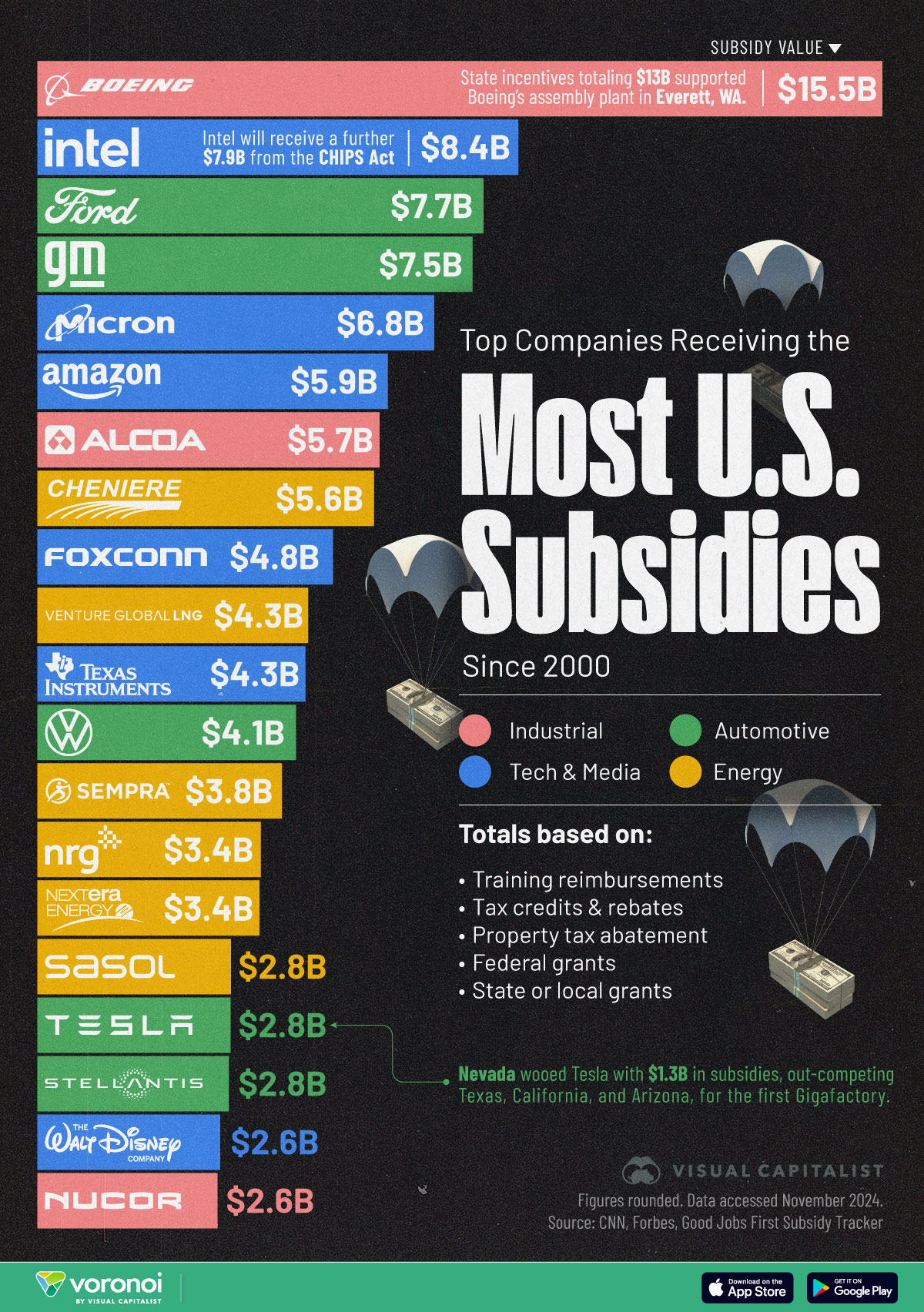
If that list had ever been done like online’s Subsidy Tracker, taxpayers would have learned that Boeing, for instance, has received 868 federal subsidies totaling $15,609,962,422 from 2000-2025. Its annual profits in those 25 years could easily do without continuing subsidies. Before its 2024 troubles, growing profits in 2022 were $3.53 billion; in 2023, $ 7.724 billion.

Perhaps the federal government should also prohibit subsidies and/or loans to companies whose products could cause death and destruction—like the top three gun and ammunition makers: Remington ($68.9 million), Sturm, Ruger ($12.6 million), Smith & Wesson ($105.1 million) up to 2019 .

Then, there’s the U.S. fossil-fuel industry polluting the air we breathe and being the principal cause of global warming. Our top four oil/gas corporations have been receiving significant annual federal subsidies during that 2000-25 period. Subsidies from 2000-25 and 2024 profits were:

Company 2000-25 Subsidies 2024 Profits

Shell $2,214,111,308 $23,700,000,000

Exxon Mobil 1,955,436,318 33,000,000,000

Chevron 619,839,444 17,700,000,000

Conoco Phillips 31,512,318 9,200,000,000

Interestingly, since President Trump’s inauguration, he has conducted an all-out war on wind and solar energy, issuing at least 23 actions —executive orders, agency rules, administration decisions— to strangle this cheaper, renewable, clean, non-harmful, and growing popular system. Ongoing projects have been cancelled, finances hobbled, starts prevented, farmlands restricted, and blocked Solar for All grants. Forget subsidies for the small, promising companies involved in this clean energy source, thousands of jobs scuttled, lower utility bills, and increase in public and business power needs.

Dozens of other firms are on the federal dole, according to Subsidy Tracker ‘s list of the first 100. To those started from scratch to become today’s billion-dollar corporations, subsidies are “chicken-feed,” yet income they count on year after year. Remington, the gun and ammunition maker, used its $68.9 million subsidy one year to move from its New York birthplace to Alabama, a much friendlier atmosphere.

Oil/gas interests are a monumental case in point. Their startup subsidies have led to demanding the government furnish financial and military support to seize reserves of countries like Iraq. That country played no role in the 9/11 attack on New York’s World Trade Center. But its immense oil reserves (2025:145 billion barrels ) provided an excuse for President George W. Bush’s administration to invade and especially to “secure” its oil fields.

Dissident Voice for more

Anand Giridharadas on the Elite Network Around Epstein

While much of the recent interest in Jeffrey Epstein has focused on the late sexual predator’s relationship with President Donald Trump, his emails also reveal his close relationships with other powerful figures from the worlds of politics, finance, academia and beyond. The thousands of files released by the House Oversight Committee earlier this month include his correspondence from April 2011 through January 2019, after he was already a registered sex offender for abusing underage girls in Florida. The fact that so many prominent and influential people could ignore those crimes is indicative of their membership in a “borderless network of people who are more loyal to each other” than anything else, says journalist Anand Giridharadas. “He had chosen this particular kind of social network, this American power elite, because he could be sure that it would be able to look away.”

Giridharadas is author of Winners Take All: The Elite Charade of Changing the World and recently wrote about the Epstein emails for The New York Times opinion section.

Youtube for more

Palestine envoy in Philippines after UN vote on Trump Gaza plan

by JASON GUTIERREZ

MANILA – Visiting Palestinian Foreign Minister Varsen Aghabekian Shahin (left) addresses reporters while her Filipino counterpart, Foreign Affairs Secretary Theresa Lazaro listens, November 18, 2025 in Manila, the Philippines. IMAGE/ Jason Gutierrez / Asia Times

Palestine Foreign Minister notches diplomatic deal with Philippines on eve of Manila’s assumption of ASEAN’s rotating chair

MANILA – Palestine is on a diplomatic mission in the region and on Tuesday forged an agreement for regular consultations with the Philippines, the incoming chairman of the 10-nation Association of Southeast Asian Nations (ASEAN) bloc.

Foreign Minister Varsen Aghabekian Shahin’s visit to Manila came a day after the UN Security Council passed a resolution drafted by the United States Monday that is seen to move the fragile ceasefire in Gaza towards more meaningful reconstruction in the ruined enclave.

Thirteen of the council’s 15 members voted in favor of the resolution, while China and Russia abstained, but did not veto the measure. While Palestine and Israel have already agreed to the first phase of a 20-point plan in Gaza, this resolution is seen as a key to legitimizing a transitional government that could bring more stability.

“This high-level visit is reflective of our growing partnership and our mutual commitment to further strengthen our cooperation,” Filipino Foreign Affairs Secretary Theresa Lazaro told a joint news conference with Shahin after bilateral talks.

“We both agreed that it is high time for our countries to forge more robust and practical cooperation in areas of mutual interest,” Lazaro said. Shahin is the highest Palestinian Authority official to have visited the Philippines since diplomatic ties were forged  36 years ago.

The two sides signed a memorandum of understanding to establish a regular “structured bilateral mechanism of consultations,” Lazaro said.

“This will allow us to take stock of our bilateral relations, identify areas of cooperation and promote our common interests,” she said. “In connection with this, we hope to convene the inaugural political consultations next year.”

As incoming ASEAN chair, the Philippines will “continue to uphold international law,” Lazaro said, as she stressed the country’s “unwavering support to the two-state solution which the Philippines regards as the only viable path towards peace and stability in the Middle East.”

Asia Times for more

Why many Bosnian genocide scholars remain silent on Gaza

by SAMIR BEHARIC & EMINA ZOLETIC

Bosnian women hold photos of Palestinians killed in Gaza during a solidarity march in Sarajevo, Bosnia and Herzegovina, on October 12, 2025 IMAGE/Amel Emric/Reuters

Their refusal to speak out undermines scholarly integrity and the field of genocide studies.

This year marks three decades since the end of the war in Bosnia and Herzegovina, in which an estimated 100,000 people lost their lives. The war culminated in the Srebrenica genocide in July 1995, in which the Bosnian Serb forces, led by General Ratko Mladi?, known as the “Butcher of Bosnia”, massacred more than 8,000 men and boys in a United Nations-designated “safe area”.

In the following decades, the International Criminal Tribunal for the Former Yugoslavia heard hundreds of witnesses and sentenced dozens of high-ranking Bosnian Serb political and military leaders, including those convicted of genocide. Meanwhile, the state of Bosnia and Herzegovina and foreign donors put significant funds into the study, victim recovery and remembrance of the genocide.

When the genocide in Gaza began, many Bosnians who survived the 1992-1995 war saw striking parallels between their own experiences and the suffering of Palestinians. Many took to the streets and spoke out against the genocidal war in Palestine.

However, many Bosnian intellectuals, especially those researching war crimes and genocide, have remained silent. Their refusal to speak out harms not just efforts to deliver justice for Gaza but also undermines the field of genocide studies.

Voices of conscience

Before we explore why Gaza has become such a taboo topic for Bosnian genocide scholars, it is important to point out that not all have remained silent. A relatively small group of Bosnian scholars who are not only academics but also active advocates for Palestine and human rights have chosen to speak up. Advertisement

University professors and researchers, such as Lejla Kreševljakovi?, Sanela ?eki? Baši?, Gorana Mlinarevi?, Jasna Fetahovi?, and Sanela Kapetanovi? have underscored that there is moral responsibility not to remain silent. They have led by example, participating in protests and speaking out in public.

Belma Buljubaši?, a professor at the Faculty of Political Science at the University of Sarajevo, has criticised European and other political leaders who express sympathy for Srebrenica while justifying Israel’s actions in Gaza as acts of “self-defence”. Such double standards, she has argued, reveal a troubling pragmatism that undermines both solidarity and accountability.

In a recent interview, Edina Be?irevi?, a genocide scholar at the University of Sarajevo’s Faculty of Criminalistics, Criminology and Security Studies, said the genocide in Gaza clearly mirrors the dynamics seen in Srebrenica, defined by dehumanisation, ideological mobilisation and international complicity.

Ahmet Alibaši?, the director of the Center for Advanced Studies and professor at the Faculty of Islamic Studies at the University of Sarajevo, has also been outspoken. Last year, he co-organised a seminar called From the Balkans to Gaza: A Critical Analysis of Genocide, which examined contemporary dynamics of mass violence through a “comparison between the Srebrenica genocide, the Sarajevo siege and the unfolding genocide in Gaza”.

Nidžara Ahmetaševi?, a Sarajevo-based journalist and media scholar, has also not hesitated to draw parallels between Gaza and the experiences of Bosnian survivors from besieged Sarajevo and Srebrenica.

Al Jazeera for more

Empire of gold: The UAE’s expanding grip on Africa’s mineral wealth

by MAWADDA ISKANDAR

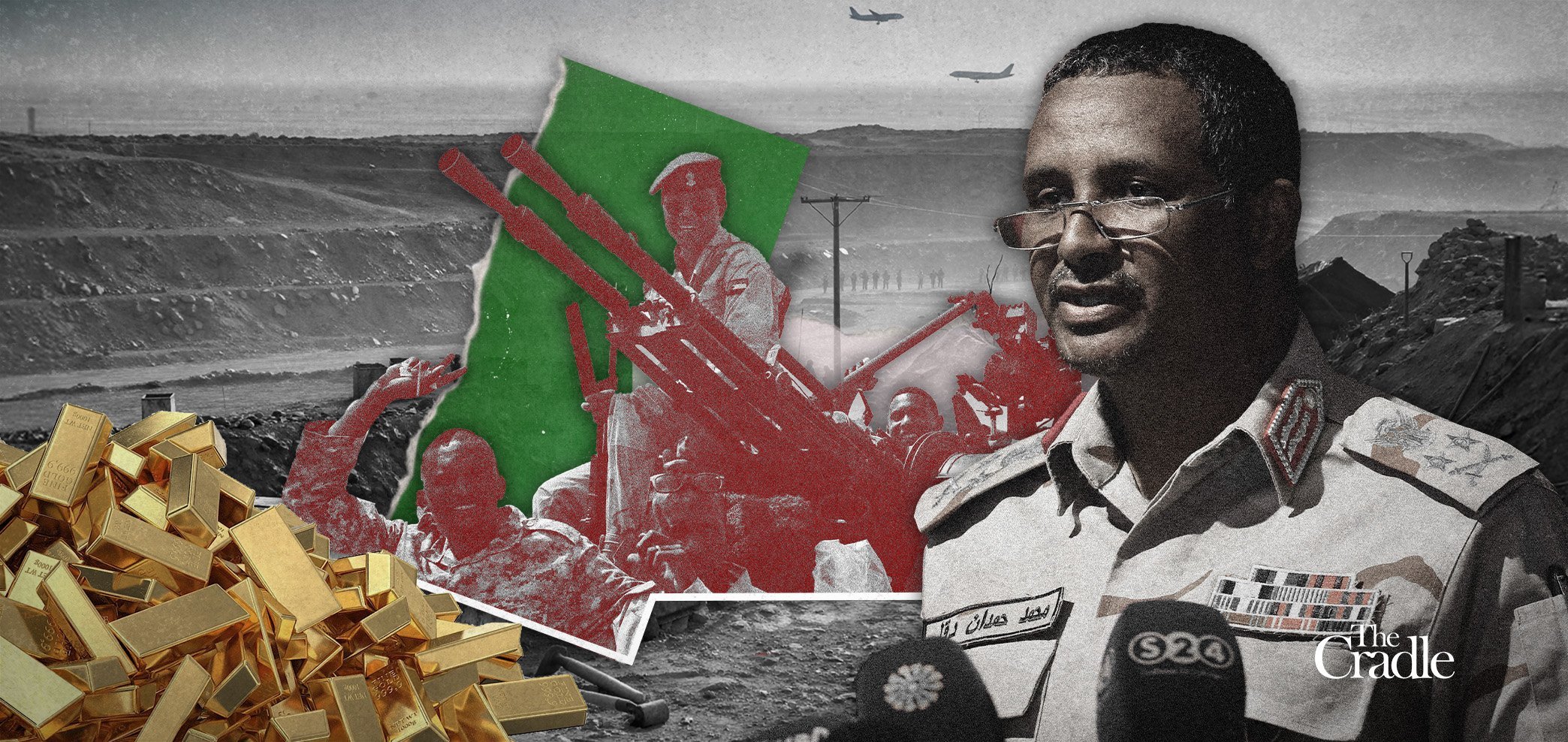
IMAGE/ The Cradle

Gold pulled from Sudan’s war zones moves along hidden routes – passed between smugglers, militias, and middlemen – before reaching Dubai, where it is converted into money and influence. This trade, rooted in state collapse and empowered by armed groups, now binds the Persian Gulf to some of Africa’s most fragile fronts.

Before the guns piled up on the blood-soaked sands of Darfur, the story began in mid-2012 with three young men scanning the earth near Jeli using simple metal detectors. A faint signal drew them westward for 20 kilometers, until they stood at the foot of Jebel Amer – a mountain that would later be known as Sudan’s “Mountain of Gold.”

Their find proved fateful. Within days, word raced across the region: dirt roads thickened with travelers, tents and pumps multiplied across the hills, and thousands of prospectors poured in. What started as a lucky strike quickly altered Darfur’s balance, unleashing rival claims, sudden fortunes, and the violence that shadowed them.

The mountain that ignited Darfur

Jebel Amer sits in the Al-Sarif locality north of El-Fasher in North Darfur. It produces an estimated 50 tonnes of gold each year – one of the largest deposits on the continent – and holds other minerals, including iron, aluminium, and platinum. 

After South Sudan’s secession in 2011 stripped Khartoum of roughly three-quarters of its oil revenue, the government pushed citizens toward artisanal mining as an economic lifeline. Instead, the rush for gold deepened instability and drew armed groups into an already-fractured region.

When major deposits surfaced in April 2012, the area became a magnet for wealth and influence – and a battlefield. Janjaweed militias moved to seize the mines, displacing local communities and igniting conflict.

By the end of the year, violence had spread across the region, and in January 2013, open fighting killed hundreds while mine shafts collapsed on dozens of workers. Truces came and went, but each collapse and clash made clear that the conflict was no longer just a tribal one but a struggle for control of one of Sudan’s most valuable assets.

By 2017, almost complete control of Jebel Amer had been settled in the hands of the Rapid Support Forces (RSF) through the Mohamed Hamdan Dagalo-owned Al Junaid Holding Company, and gold became their main source of financial power, directly linked to their ability to finance their military activities and control the area.

The gold did not stop there. Its shine carried far beyond Sudan, drawing the interest of the UAE, whose ambitions in Africa were rising. From Darfur, the metal moved along smuggling routes, through commercial flights, and via corporate parcels into Dubai’s markets and refineries – feeding a network in which Sudan’s conflict became someone else’s gain.

Sudan: The Arab world’s gold giant

Sudan is the largest Arab gold producer, with more than 40,000 exploration sites and 60 refining companies spread across 13 states, with its focus on the Nile, the North, and the Red Sea. 

The UAE quickly became Sudan’s primary export destination. Deals flowed through companies linked to Dagalo (Hemedti) and his relatives, gold moved by land and air into Dubai, and the RSF used the profits to procure weapons.

Global Witness estimates that Sudan exports around $16 billion in gold to the UAE each year. Official production in 2024 reached 64 tonnes, yet only 31 tonnes were recorded as legal exports. Nearly half simply vanished into parallel channels.

Export documents reveal the involvement of Emirati firms such as Kaloti, which purchased 57 tonnes from Sudan in 2012 – far above the country’s official output. In 2018, Al Junaid Group, a business front of the RSF, partnered with Dubai-based Rosella, complete with accounts at First Abu Dhabi Bank.

When war erupted in 2023, the gold trade shifted from an economic pillar to a war chest. The US sanctioned 11 companies – many registered in the UAE – for facilitating RSF financing through gold.

The RSF’s gold highways to Dubai

Before the war expanded, Darfur’s gold traveled quietly from Jebel Amer to Chad via land, then onward to Dubai through commercial shipments and corporate parcels, becoming part of a smuggling network linking the conflict’s mines to Persian Gulf markets. The RSF rapidly became the dominant player in this network, relying on front companies, routes that stretched through Chad, South Sudan, Libya, and new routes to Egypt.

The Chadian corridor remains the most lucrative: gold leaves Jebel Amer and Sango via secret pathways, crosses into N’Djamena, and is then exported as “Chadian” gold. Al Junaid’s front companies, along with previously documented ties to Dubai-based firms, operate at the heart of this system.

After Khartoum airport was destroyed and Port Sudan slipped beyond RSF control, the militia adopted new tactics. Motorcycles ferry gold across borders. Air shipments depart from Nyala in containers labeled as agricultural goods and livestock. Night flights – less than 90 minutes long – avoid detection.

A UN panel of experts exposed an African logistical chain linking gold shipments and weapons deliveries: arms arriving from Um Girass airport, traveling overland to RSF positions, supported by money raised from the sale of Sudanese gold in Dubai. An integrated war economy now spans from Darfur’s mines to Emirati refineries.

Abu Dhabi’s continental appetite

Talk of the UAE’s ambitions in Africa starts with Sudan, the continent’s third-largest gold producer and the second-largest proven reserve of about 1,550 tonnes. But Sudan is not an isolated case, as the picture extends to the entire continent. 

The Cradle for more

Thanksgiving: A story of celebration and pain, in maps

by ALIA CHUGHTAI

It’s a day to give thanks. But for millions of Indigenous Americans, it also serves as a reminder of loss.

Across the United States, November is synonymous with preparations for Thanksgiving. Classrooms and public areas are decorated with warm-, earthy-toned cutouts of turkeys; English settlers – the Pilgrims, as they are known – who made a new home in a country new to them; and “Indians” with colourful feather headdresses and vests made of construction paper.

Families come together from all over the country for a feast. And some arguments.

America’s pop culture dominance has meant that songs and movies have introduced these cultural staples to the rest of the world, even among those who don’t celebrate Thanksgiving or fully understand it.

But to millions of Indigenous Americans, the story of Thanksgiving is also closely intertwined with their history of invasion, occupation, displacement, death and devastation that their communities faced as waves of settlers arrived and took over what is today the US.

Here’s a look at what the historical journey of the US has meant to its Native American communities through maps showing where they once lived, how they had to move and the reservations they are now largely ghettoised in.

When did Thanksgiving become a national holiday?

In 1863, a proclamation by President Abraham Lincoln turned the last Thursday of every November into a national holiday for giving thanks.

This occurred in the middle of the Civil War in the United States between the Union, or northern part of the country, against the Confederacy, the southern states that wanted to preserve a system of slavery. The Civil War spanned from 1861 to 1865, and nearly 700,000 soldiers were killed.

The proclamation for the national holiday came about after a campaign led by Sarah Hale, a poet, editor and activist, that began in 1846. She’s most commonly known as the author of Mary Had a Little Lamb.

But long before Lincoln’s proclamation or even Hale’s campaign, the tradition that was formalised as Thanksgiving was common in the original settler communities of New England.

When and where was the first Thanksgiving?

In 1606, England’s King James I divided the east coast of what is now the US into the London Company, which later became the Virginia Company of London, and the Plymouth Company. Both were joint-stock trading companies, much like the British East India Company, which was set up in India in 1608.

This was still more than a century and a half before the US was born.

The goals of these British trading companies were to find gold, search for trade routes and compete with other European powers.

The first settlement by the English in the New World was in 1607 when the Jamestown colony was established on the banks of the James River in present day Virginia. This was the ancestral home of the Powhatan Indigenous people.

AlJazeera for more

Does Trump’s Gaza plan stop Israel’s agenda for the Palestinians?

Trump’s Gaza plan is in danger of going the way of the Oslo Accords, argues US journalist Chris Hedges: Never to be implemented beyond the first phase.

Hedges tells host Steve Clemons that there are no guarantees that the US-brokered deal “will actually thwart the genocidal project that Israel is intending to carry out in Gaza and … the West Bank”.

While a parade of US officials visited Israel to signify commitment to the ceasefire, Israel continued to restrict food and medicine to millions of Palestinians, and Israeli forces continued to occupy more than half of the Gaza Strip.

Youtube for more (Thanks to reader)

In praise of ‘difficult’ cinema

by JINOY JOSE P.

Dear reader,

“This is so cool, like a Guy Ritchie film,” the boy told me.

“You sure? The whole movie?” I asked.

“Yeah, look at how it begins; the long shots, camera movements, the story with many ‘sides’, the many perspectives; it’s so Ritchie.” The 15-year-old was trying to explain a film he watched that week, and it was an unusual film for his age. It was Amma Ariyan, Malayalam cinema’s cult avant-garde film that had reminded him of modern pop cinema.

This was last year. The boy, an anime addict and Netflix native, fluent in Marvel timelines and Percy Jackson arcs, was decoding a black-and-white film made four decades ago by a director who despised categories. He saw in John Abraham’s restless, orderless frames the same energy he found in Ritchie’s slick narratives. That was a surprise for me. And what he said next stayed with me: “Everyone assumes we won’t like it.”

That sentence told me something about how we treat what’s often dismissed as “award cinema”, “art cinema”, or, in the Indian pejorative, budhijeevi cinema. Many assume it belongs to the elite, to scholars and festival audiences. But “difficult” cinema isn’t an indulgence of the few; it’s a cultural necessity. It moulds imagination in ways that commercial cinema later inherits, distils, and distributes.

November 4 ?is the centenary of Ritwik Ghatak, one of cinema’s most intense visionaries. His work—tragic, rough, political, lyrical—was never made for comfort. It was meant to puncture the complacency of viewing itself. Meghe Dhaka Tara and Subarnarekha turned personal grief and the trauma of Partition into poetic fury. John Abraham, his student, translated that spiritinto a South Indianidiom where collective anguish met existential playfulness. These films rejected smoothness. They demanded time, silence, thought, and patience. They were difficult because they were honest, raw.

To mark Ghatak’s centenary, Frontline released a beautifully curated e-book—essays and reflections from critics and filmmakers revisiting the master through today’s lens. While preparing its promotion, a younger friend asked, genuinely, “Do people care these days about such ‘difficult’ cinema? Why do they even exist anymore?” It’s a fair question in an age splintered by platforms, when we scroll faster than we breathe. Why care about slow, ambiguous films that refuse instant gratification?

The phrase “difficult cinema” hides an irony. What makes such films difficult is confrontation, not comprehension. They ask viewers to pause, to think and feel without tidy resolution. Bergman’s Persona, Tarkovsky’s Stalker, Kiarostami’s Taste of Cherry, Ceylan’s Once Upon a Time in Anatolia, Teshigahara’s Woman in the Dunes, Adoor’s Elippathayam—all unfold like long meditations. They invite you to wrestle with your own interiority. Their beauty lies in what they withhold.

Take Tarkovsky. His films are long and abstract, not for difficulty’s sake, but because they demand moral patience. In Solaris, when the planet reflects the buried guilt of scientists, we watch the fall of rational man before memory and time. In Kiarostami’s Close-Up, a man impersonates a filmmaker to find meaning in a world that ignores him—a blend of documentary, fiction, and plea for recognition. These works slow us to the pace of consciousness itself.

Frontline for more