
by FABIANA FRAYSSINET
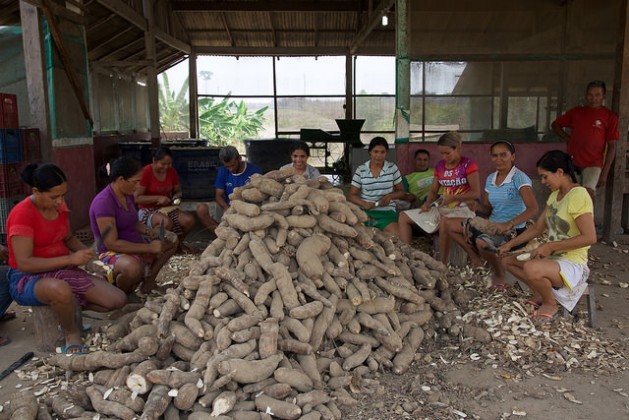 Members of the São Raimundo do Fe em Deus cooperative in the rural municipality of Belterra in Brazil’s Amazon rainforest peel manioc, to make flour. The associations of small farmers help them defend themselves from the negative effects of the expansion of soy in this region on the banks of the Tapajós River. PHOTO/Fabiana Frayssinet/IPS
In the northern Brazilian state of Pará, the construction of a port terminal for shipping soy out of the Amazon region has displaced thousands of small farmers from their land, which is now dedicated to monoculture.
The BR-163 highway, along the 100-km route from Santarém, the capital of the municipality of that name, to Belterra runs through an endless stretch of plowed fields, with only a few isolated pockets of the lush rainforest that used to cover this entire area.
State-of-the-art tractors and other farm machinery, a far cry from the rudimentary tools used by the local small farmers in the surrounding fields, are plowing the soil this month, ahead of the planting of soy in January.
José de Souza, a small farmer who owns nine hectares in the rural municipality of Belterra, sighs.
“Soy benefits the big producers, but it hurts small farmers because the deforestation has brought drought,” he tells IPS. “The temperatures here were pleasant before, but now it’s so hot, you can’t stand it.”
The effects are visible in his fields of banana plants, which have been burnt by the hot sun.
Resigned, De Souza waters a few sad rows of straggling cabbages and scallions.
Like other farmers, he has been hemmed in by the expansion of soy in the municipalities of Santarém and the nearby Belterra and Mojuí dos Campos.
According to the Santarém municipal government, of the 740,000 cultivable hectares in this region, soy now covers 60,000.
But Raimunda Nogueira, rector of the Federal University of Western Pará, offers a much higher figure. “Land-use change has involved 112,000 to 120,000 hectares, which have been turned into soy plantations,” she tells IPS.
And with the soy came the spraying.
“The soy fields bring a lot of pests because the poison they use to fight them drives them off their plantations onto our small fields,” laments De Souza.
The agrochemicals have polluted the soil and poisoned crops and animals, local farmers complain.
“The crops die, and as a result the property becomes completely unproductive – and the solution is to sell,” Jefferson Correa, a representative of the local non-governmental organisation Fase Amazonia, tells IPS.
There are no epidemiological data. But in these rural municipalities, the widespread perception is that health problems like respiratory and skin ailments have become more common.
According to Selma da Costa with the Rural Workers Union of Belterra, the threats to their health and the temptation to sell their land have led 65 percent of local small farmers to leave the municipality, which had a population of 16,500.
“They end up leaving, because who is going to put up with the stench of the pesticides? No one. People are getting sick. Pregnant women often feel ill and they don’t know why,” she tells IPS.
Inter Press Service for more