China premier warns of potential dollar collapse

By Patrick Martin

In a public statement raising questions about the solvency of the US government, Chinese Premier Wen Jiabao said Friday that China, the largest holder of US treasury debt, was “concerned about the security of our assets.”

Wen’s remarks came at a news conference following the annual session of China’s parliament, where he commented on the economic policies of the new US administration. “President Obama and his new government have adopted a series of measures to deal with the financial crisis,” Wen said. “We have expectations as to the effects of these measures. We have lent a huge amount of money to the US. Of course we are concerned about the safety of our assets. To be honest, I am definitely a little worried.”

He called on the United States to “maintain its good credit, to honor its promises and to guarantee the safety of China’s assets.”

Chinese officials fear that the huge borrowing in world credit markets required to finance the US government’s budget deficits—a projected $5 trillion over the next four years according to an estimate released by the Obama administration last month—will lead to a decline in the value of the dollar.

Since Beijing now holds about $1 trillion in dollar-denominated assets, including nearly $700 billion in US Treasury debt, a decline in the value of the US currency would hit China hard.

Wen added that while concerned about the safety of its dollar holdings, Beijing would “at the same time also take international financial stability into consideration, because the two are inter-related.” This underscores the conservative role of the Chinese regime, which places the defense of world capitalism at the center of its policy.

US officials reacted with repeated reassurances about the value of the dollar and the safety of the dollar-denominated assets held by Chinese and other overseas investors.

White House economic adviser Lawrence Summers defended the record of US Treasury borrowing, saying Friday that dollar holders would suffer much more if full-scale deflation sets in and US gross domestic product collapses.

A Treasury spokeswoman declared, “The US Treasury market remains the deepest and most liquid market in the world.” White House Press Secretary Robert Gibbs added, “There’s no safer investment in the world than in the United States.”

President Obama followed up Saturday, during a joint media appearance with visiting Brazilian President Luiz Inacio Lula da Silva at the White House, declaring that, “Not just the Chinese government, but every investor can have absolute confidence in the soundness of investments in the United States.”

Obama depicted the influx of dollars into the United States as an endorsement of the future prospects of American capitalism. “There is a reason why even in the midst of this economic crisis you have seen actual increases in investment flows here in the US,” he said. “I think it is a recognition that the stability not only of our economic system but also our political system is extraordinary.”

The driving force of this influx of capital is fear rather than confidence, however. Investors are pulling out of weaker regions like eastern Europe and southeast Asia, as well as Africa and Latin America. They are also shifting from the purchase of stocks and bonds issued by American banks and corporations, now regarded with great distrust, in favor of government-issued debt instruments.
The US fiscal deficit has mushroomed. During the first five months of fiscal 2009 (October 2008 through February 2009), the federal budget deficit tripled compared to the same period the previous fiscal year, growing from $265 billion to $764.5 billion, the largest ever. The five-month deficit is already nearly 70 percent larger than the full-year deficit of $459 billion for fiscal 2008.

Writing in the Financial Times on March 12, Paul Kennedy, Yale University professor and author of The Rise and Fall of the Great Powers, argued that the Obama stimulus program would have a destabilizing effect on world financial markets: “no one is asking who will purchase the $1,750bn of US Treasuries to be offered to the market this year – will it be the east Asian quartet, China, Japan, Taiwan and South Korea (all with their own catastrophic collapses in production), the uneasy Arab states (yes, but to perhaps one-tenth of what is needed), or the near-bankrupt European and South American states? Good luck! If that colossal amount of paper is bought this year, who will have ready funds to purchase the Treasury flotations of 2010, then 2011, as the US plunges into levels of indebtedness that could make Philip II of Spain’s record seem austere by comparison?”

According to an estimate by Merrill Lynch, US Treasury notes have produced Chinese investors a 2.7 percent loss this year in terms of the Chinese currency, the yuan. Beijing is in a bind, however, since any effort to unload a significant part of its massive dollar holdings could flood the market and trigger a financial panic, with devastating effects on the value of all dollar-denominated securities, including its own investments.

Objective processes are undermining the longstanding symbiotic relationship between Beijing and Washington, however. The US slump has produced a massive drop in purchases of Chinese goods. Chinese exports plunged 25.7 percent in February, slashing the country’s trade surplus from $39.1 billion to $4.8 billion. Continuation of this trend means China will earn correspondingly fewer dollars to invest in US government bonds.

Read More

Howard Zinn: Obama “Is Going to Need Demonstrations and Protest and Letters and Petitions” to Do the Right Things

By Liliana Segura

Last month in San Francisco, I had the opportunity to attend a performance of Voices of a People’s History, the groundbreaking show conceived by historian Howard Zinn, author of A People’s History of the United States, and Anthony Arnove, co-editor of Voices of a People’s History and author of books including Iraq: The Logic of Withdrawal (New Press). Blending historical narrative with spoken word — and some spunky bluegrass performed by the San Francisco-based Stairwell Sisters — it was an event that, in one brisk hour, celebrated the power of protest and made manifest the best traditions of radical American thought, creativity, and dissent.

The show is brilliant for its simplicity: Take a handful of famous American texts (and several more obscure ones), some movies stars with radical politics (and a few non-actors), mix in some rabble-rousing music, and make sure the audience includes students, activists, and people who believed in hope and change before Obama came along. In San Francisco, the result was Diane Lane, playing writer and activist Mary Ellen Lease, crying, “We want the foreclosure system wiped out!” to thunderous applause, while reciting a speech called “Wall Street Owns the Country” (circa 1890). It was Kerry Washington deliver Sojourner Truth’s “Ain’t I a Woman?” — first spoken in 1851 at the Women’s Convention in Akron, Ohio — with ferocity and sass. It was “W” star Josh Brolin play the socialist Eugene Debs, hip-hop artist Boots Riley give Muhammad Ali’s speech against the Vietnam War, Benjamin Bratt, as Sgt. Camilo Mejia deliver his 2005 statement on GI resistance to the war in Iraq. The non-actors in the cast were equally impressive; Civil rights attorney Renee Maria Saucedo paid homage to the Latino youth of the country — and of Mission High School, where the show took place — as she delivered Chicana activist and writer Elizabeth “Betita” Martinez’s “Be Down With the Brown!” (Martinez herself was in the audience and got a standing ovation.) And union organizer Clarence Thomas, who powerfully embodied the spirit and wisdom of Martin Luther King Jr. in “Beyond Vietnam,” also tapped into the urgency of people’s hope in Barack Obama — and what’s at stake — when he delivered Langston Hughes’s poem, “The Ballad of Roosevelt.” (“I am tired of waiting on Roosevelt, Roosevelt, Roosevelt. Damned tired of waiting on Roosevelt. And a lot of other folks was hungry and cold, done stopped believing what they had been told by Roosevelt, Roosevelt, Roosevelt. Because the pot is still empty and the cupboard is still bare and you cannot build a bungalow out of air.”)

Howard Zinn, himself an icon of radical history at 86, kicked off the evening with humor and warmth, explaining that, as a historian and an academic, he never wanted to retreat into the past. “I wanted the voices of the past to come to the present,” he explained. “You go into the past and get lost. I want to get out of the past.” Zinn’s own rebellion has been to reimagine the conventions of his chosen profession. Alternate histories may seem less remarkable in an age where it is possible to buy books that tell the story of everything from coffee to cod. But A People’s History of the United States, which sold its one millionth copy in 2003 and has now hit the 2 million mark, first told the stories of American rebels past and present when the present included recent memories of segregation, Vietnam, and the murder of MLK. Voices has taken the documents of that and other eras of rebellion — the speeches, the poems, the songs — and breathed life into them.

I recently spoke to Howard Zinn over the phone from New York. He shared his thoughts on President Obama’s domestic and foreign policy, the best parts of the New Deal, what he hopes Voices will help accomplish, and why he believes Obama must face mass protest in order to steer the country in the right direction.

Liliana Segura: How did you decide to do Voices From a People’s History?

Howard Zinn: It really started way back … I wrote A People’s History with the idea of bypassing and ignoring the usual from-the-top-down treatment of American history. I wanted not to see American history from the viewpoint of people in authority — presidents and congressmen, generals and so on. I wanted to see American history from the standpoint of people who had been ommitted from textbooks.

I wrote the book in the late 1970s, and it came out of the movmenets of the 60s and 70s and my participation in those movements. I had spent years in the South involved in the civil rights movement and I was very conscious when I was there — I was teaching at a black college in Atlanta, Spellman College, and I was going around with SNICK (The Student Nonviolent Coordinating Committee). And as I was going around participating in various things, whether in Atlanta, or demonstrations in Albany, Georgia, or Selma, Alabama, or various towns in Mississippi, I was very much aware that all sorts of very fascinating things were going on. Fascinating figures were on the scene. And none of this was going to be reported in the mainstream media, because the mainstream media is only interested in big events and big people — even with movements they conventrate on the big events and big people.

Of course, having studied history, I knew how history was so often told from the standpoint of “this is the age of Jackson, this is the age of Roosevelt, this is the age of Wilson.” So I wanted to present the point of view of people ommitted from history, and the point of view of dissenters, of people who resisted, people who had to struggle for their rights and people who were not happy with the present situation — antiwar protesters and socialists and Native Americans who were resisting encroachment on their land. That was behind my writing of A People’s History.

We had our first public reading of these documents — I think I may have said something in San Francisco about the fact that my publishers at Harper Collins wanted to celebrate a million copies sold, and they wanted to do it by putting some historians on stage. And I said, no, please, don’t do that. Let’s have real history on the stage, presented by actors who will dramatize documents — and not the usual documents. You know, when I went to graduate school I was given a huge book called “Documents of American History” and it was all presidential speeches and legislative enactments.

So, we had this thing at the 92nd Street Y [in New York]. It was just before the beginning of the war in Iraq, in February 2003. We wanted to make the event relevant to what was going on. So when we had Kurt Vonnegut read Eugene Debs’s speech against World War I, it was also a speech against war in general.

LS: Watching Voices, one of the major impressions that stuck with me was how prescient some of these speeches are — it feels like we are dealing with some of the exact same challenges today — but also how much joy and energy there was in the perfomances. Has that surprised you at all?

Howard Zinn: It was a revelation. We didn’t know how people would react, didn’t know how audiences would react to the reading of documents, didn’t know how the actors would react themselves. And what has happened is that the audiences have been energized and I think, in many cases, inspired. We’ve had people come away from these readings saying, ‘it makes me want to get active and do things.’ And the actors themselves, they have been inspired. They’ve been coming back again and again.

When these actors do these performances, inevitibly they say, “Hey please, call us again.” And that’s why Kerry Washington, Josh Brolin, Viggo Mortenson, Danny Glover — they keep coming back again and again because they love to do this. And what is apparent is that people in the world of Hollywood and entertainment very often — most of the time, in fact — don’t get an opportunity to express what they really believe. And, you know, these are people with social consciences. So this is an opportunity for them to do that.

Read More

(Submitted by Shahabuddin Haji)

ILLUSION OF AN EPOCH

Victor Kiernan (1913-2009): historian and India’s friend

By RUDRANGSHU MUKHERJEE

Rowing on the Cam, circa 1931

The death of Victor Kiernan at the age of 95 a few days ago probably represents the passing of an era. This is not because he lived well beyond the biblical three score and ten, but because he was among the few survivors from a group of intellectuals who formed the Historians Group of the Communist Party of Great Britain. Most members of that group believed that he was the most erudite and widely read among them all.

Born in 1913, he came to Trinity College, Cambridge from Manchester Grammar School. In Trinity, he took a double starred first in history and won the research fellowship of the college. It was in Cambridge that Kiernan turned to Marxism and joined the communist party in 1934. He left the party in the aftermath of the Soviet invasion of Hungary in 1956. Kiernan was part of a large exodus from the CPGB that included Christopher Hill, Rodney Hilton, John Saville and the two Thompsons, Edward and Dorothy. The only historian from that group who retained his party card was Eric Hobsbawm.

Kiernan’s conversion to communism is not difficult to comprehend. To many of his generation, the Depression made the collapse of capitalism imminent, and Nazism seemed the ultimate menace to civilization. Communism and Soviet Russia appeared as alternatives to many, from historians to scientists, from Hill to Haldane. Men like Kiernan believed then, mistakenly as history showed, that communism and Soviet Russia offered a more humane prospect. In defence of a more humane and civilized society, young men like John Cornford, Kiernan’s friend from Trinity and the hero of his generation, went out to fight in Spain and die. A few days before he died in battle — he was only 21 — Cornford wrote in a poem from Spain: “And history forming in our hands/ Not plasticine but roaring sands….We are the future….’’ Similar sentiments inspired an entire generation. The call of communism was part romantic, part rational. Above all, there was the certainty that time and history were on their side, and the confidence that the world could be correctly interpreted and changed.

Kiernan’s political and intellectual interests did not remain confined to Europe and the West. In Cambridge in the Thirties, he acted as friend, philosopher and guide to many Indians who went up to that university, among whom were Renu Chakrabarty, Mohan Kumaramangalam and Arun Bose. It was perhaps such friendships and his interest in the world outside Europe that made Kiernan decide in 1938 to spend one year of his six-year fellowship in India. His original intention was to stay in India and see the political situation for himself. He stayed till 1946, teaching in Lahore and working closely with the Communist Party of India, which was then headed by P.C. Joshi whose friend Kiernan became.

The visit in 1938, however, was not entirely innocent. Kiernan carried with him, no doubt at the behest of Rajani Palme Dutt (known as RPD, the leader of the CPGB who ran the CPI by remote control from London with orders from Moscow), a Comintern document. This is an interesting sidelight on how the CPI functioned. Just as Kiernan’s academic trip was used by the Comintern to send a secret message to the Indian party, in 1948 when Mohit Sen went up to Cambridge as a student, he was given by the CPI the basic documents of its new understanding and a coded letter to RPD — both typed on very thin paper and placed under the bottom layer of a matchbox. The party asked Mohit to take up smoking so that his carrying a matchbox would not appear incongruous. The poor man coughed and spluttered all the way from Bombay to London.

Kiernan was later to recall his joy when he heard in Bombay of the liberation of Paris from the Nazis. He, in fact, wrote a tribute on the occasion, “an attempt to explain to Indians something of what Paris meant to Europe”. This was to have been read over the radio by Kumaramangalam who arrived at the radio station late and Kiernan’s declamation went unheard.

Back in Britain, Kiernan failed to get elected to a fellowship of an Oxbridge college as his referee denounced his ideology and politics. He settled for a job at Edinburgh University, where he remained professor of history for his entire working life. Kiernan’s intellectual interests were vast — he translated Iqbal and Faiz from Urdu; his passion was Shakespeare and late in life he wrote two books on the bard, and another on Horace. He had a fine monograph on the duel in European history and another on absolutism. He wrote on Spain and China. The book for which he is best remembered is The Lords of Human Kind: European Attitudes to the Outside World in the Imperial Age. The title — taken from Oliver Goldsmith’s “Pride in their port, defiance in their eye,/ I see the lords of humankind pass by” — reflected Kiernan’s immersion in literature. The book was an extraordinary tour d’horizon of a large theme and revealed Kiernan’s enviable capacity to store away bits and pieces of information picked up from his wide-ranging reading. Sherlock Holmes called such a mind an attic but it made for very attractive history writing.

Perhaps because of his many interests, Kiernan never produced the magnum opus he was capable of. He did not quite become the historian of the stature of Thompson and Hill. When the latter dedicated a book to Kiernan, the dedication read, “Wit, provocateur and generous friend of fifty years.” The choice of words is not without significance.

Throughout his life, Kiernan retained an abiding love and interest for India (including Pakistan). In spite of this, like many Anglo-Saxons of his generation, he failed to appreciate the cultural differences between India and the West. I remember one leisurely morning at St Antony’s College, Oxford (Kiernan had come to speak at Tapan Raychaudhuri’s South Asia History seminar), when we argued about Wajid Ali Shah. He had just seen Shatranj ke Khiladi and kept saying that Ray had depicted the king too sympathetically. Wajid Ali Shah, he said, was a hopeless king. I tried to explain to him that he was judging the Awadh ruler by Western standards of governance and thus making the same mistake as Dalhousie and Outram. Victor winced at being compared to imperialists but refused to see the point. He was always affectionate and friendly and had an impish sense of humour. He was chairing a seminar in Oxford and spotted me in the back row. When the discussion veered round to 1857, he surprised me and others by saying, “Dr Mukherjee, who is fielding way out in the country, should at this point be called up to field close in.” I was flattered and charmed by the unexpected recognition from a very senior historian.

He could also be devastatingly honest about himself. When the Soviet Union was tottering to its fall in the late Eighties, Kiernan announced to a seminar audience in the UCLA, “All my life I have chased an illusion” or words to this effect. This makes one wonder what kind of relationship he had with his self-confessed acolyte, a Malayali young man whom he taught in Edinburgh in the late Sixties. Did that young man learn from Kiernan to be honest, to be open-minded about his Marxism, to question and to doubt? The name of that man is Prakash Karat. What did Karat tell Kiernan about his party’s performance in West Bengal and in India? Was his history-telling honest to his historian-mentor? Above all, if comrade Karat had read with care The Lords of Human Kind, he would not look at the world with pride in his port and defiance in his eye.

I would have loved to have asked Victor what he thought of his Indian acolyte. The answer would have been witty, provocative and not less than honest.

Read More
(Submitted by Feroz Mehdi of http://www.insafbulletin.net/)

Towards theocracy?

By Pervez Amirali Hoodbhoy

State and society in Pakistan today

FOR 20 years or more, a few of us in Pakistan have been desperately sending out SOS messages, warning of terrible times to come. Nevertheless, none anticipated how quickly and accurately our dire predictions would come true. It is a small matter that the flames of terrorism set Mumbai on fire and, more recently, destroyed Pakistan’s cricketing future. A much more important and brutal fight lies ahead as Pakistan, a nation of 175 million, struggles for its very survival. The implications for the future of South Asia are enormous.

Today a full-scale war is being fought in FATA (Federally Administered Tribal Areas), Swat and other “wild” areas of Pakistan, with thousands dying and hundreds of thousands of IDPs (internally displaced people) streaming into cities and towns. In February 2009, with the writ of the Pakistani state in tatters, the government gave in to the demand of the TTP (Tehrik-e-Taliban Pakistan, the Pakistani Taliban Movement) to implement the Islamic Sharia in Malakand, a region of FATA. It also announced the suspension of a military offensive in Swat, which has been almost totally taken over by the TTP. But the respite that it brought was short-lived and started breaking down only hours later.

The fighting is now inexorably migrating towards Peshawar where, fearing the Taliban, video shop owners have shut shop, banners have been placed in bazaars declaring them closed for women, musicians are out of business, and kidnapping for ransom is the best business in town. Islamabad has already seen Lal Masjid and the Marriot bombing, and has had its police personnel repeatedly blown up by suicide bombers. Today, its barricaded streets give a picture of a city under siege. In Karachi, the Muttahida Quami Movement (MQM), an ethnic but secular party well known for strong-arm tactics, has issued a call for arms to prevent the Taliban from making further inroads into the city. Lahore once appeared relatively safe and different but, after the attack on the Sri Lankan cricket team, has rejoined Pakistan.

The suicide bomber and the masked abductor have crippled Pakistan’s urban life and shattered its national economy. Soldiers, policemen, factory and hospital workers, mourners at funerals, and ordinary people praying in mosques have been reduced to hideous masses of flesh and fragments of bones. The bearded ones, many operating out of madrassas, are hitting targets across the country. Although a substantial part of the Pakistani public insists upon lionising them as “standing up to the Americans”, they are neither seeking to evict a foreign occupier nor fighting for a homeland. They want nothing less than to seize power and to turn Pakistan into their version of the ideal Islamic state. In their incoherent, ill-formed vision, this would include restoring the caliphate as well as doing away with all forms of western influence and elements of modernity. The AK-47 and the Internet, of course, would stay.

But, perhaps paradoxically, in spite of the fact that the dead bodies and shattered lives are almost all Muslim ones, few Pakistanis speak out against these atrocities. Nor do they approve of military action against the cruel perpetrators, choosing to believe that they are fighting for Islam and against an imagined American occupation. Political leaders like Qazi Husain Ahmed and Imran Khan have no words of kindness for those who have suffered from Islamic extremists. Their tears are reserved for the victims of predator drones, whether innocent or otherwise. By definition, for them terrorism is an act that only Americans can commit.

Why the Denial?

To understand Pakistan’s collective masochism, one needs to study the drastic social and cultural transformations that have made this country so utterly different from what it was in earlier times. For three decades, deep tectonic forces have been silently tearing Pakistan away from the Indian subcontinent and driving it towards the Arabian peninsula.

This continental drift is not physical but cultural, driven by a belief that Pakistan must exchange its South Asian identity for an Arab-Muslim one. Grain by grain, the desert sands of Saudi Arabia are replacing the rich soil that had nurtured a rich Muslim culture in India for a thousand years. This culture produced Mughal architecture, the Taj Mahal, the poetry of Asadullah Ghalib, and much more. Now a stern, unyielding version of Islam – Wahabism – is replacing the kinder, gentler Islam of the sufis and saints who had walked on this land for hundreds of years.

This change is by design. Twenty-five years ago, under the approving gaze of Ronald Reagan’s America, the Pakistani state pushed Islam on to its people. Prayers in government departments were deemed compulsory, floggings were carried out publicly, punishments were meted out to those who did not fast in Ramadan, selection for university academic posts required that the candidate demonstrate knowledge of Islamic teachings, and jehad was declared essential for every Muslim.

Villages have changed drastically, driven in part by Pakistani workers returning from Arab countries. Many village mosques are now giant madrassas that propagate hard-line Salafi and Deobandi beliefs through oversized loudspeakers. They are bitterly opposed to Barelvis, Shias and other Muslims, who they do not consider to be proper Muslims. Punjabis, who were far more liberal towards women than Pashtuns, are now also beginning to take a line resembling the Taliban. Hanafi law has begun to prevail over tradition and civil law, as is evident from recent decisions in the Lahore High Court.

K.M. CHAUDHRY/AP

Pakistan’s Ministry of Education estimates that 1.5 million students are getting religious education in 13,000 madrassas. These figures could be quite off the mark. Commonly quoted figures range between 18,000 and 22,000 such schools. Here, students at the Jamia Manzoorul Islam, a madrassa in Lahore.

In the Pakistani lower-middle and middle-middle classes lurks a grim and humourless Saudi-inspired revivalist movement which frowns on every expression of joy and pleasurable pastime. Lacking any positive connection to history, culture and knowledge, it seeks to eliminate “corruption” by regulating cultural life and seizing control of the education system.

“Classical music is on its last legs in Pakistan; the sarangi and vichtarveena are completely dead,” laments Mohammad Shehzad, a music aficionado. Indeed, teaching music in public universities is violently opposed by students of the Islami Jamaat-e-Talaba at Punjab University. Religious fundamentalists consider music haram. Kathak dancing, once popular with the Muslim elite of India, has no teachers left. Pakistan produces no feature films of any consequence.
As a part of General Zia-ul-Haq’s cultural offensive, Hindi words were expunged from daily use and replaced with heavy-sounding Arabic ones. Persian, the language of Mughal India, had once been taught as a second or third language in many Pakistani schools. But, because of its association with Shiite Iran, it too was dropped and replaced with Arabic. The morphing of the traditional “khuda hafiz” (Persian for “God be with you”) into “allah hafiz” (Arabic for “God be with you”) took two decades to complete. The Arab import sounded odd and contrived, but ultimately the Arabic God won and the Persian God lost.

Genesis of Jehad

One can squarely place the genesis of religious militancy in Pakistan to the Soviet invasion of Afghanistan in 1979 and the subsequent efforts of the U.S.-Pakistan-Saudi grand alliance to create and support the Great Global Jehad of the 20th century. A toxic mix of imperial might, religious fundamentalism, and local interests ultimately defeated the Soviets. But the network of Islamic militant organisations did not disappear after it achieved success. By now the Pakistani Army establishment had realised the power of jehad as an instrument of foreign policy, and so the network grew from strength to strength.

The amazing success of the state is now turning out to be its own undoing. Today the Pakistan Army and establishment are under attack from religious militants, and rival Islamic groups battle each other with heavy weapons. Ironically, the same Army – whose men were recruited under the banner of jehad, and which saw itself as the fighting arm of Islam – today stands accused of betrayal and is almost daily targeted by Islamist suicide bombers. Over 1,800 soldiers have died as of February 2009 in encounters with religious militants, and many have been tortured before decapitation. Nevertheless, the Army is still ambivalent in its relationship with the jehadists and largely focusses upon India.


Read More

Woman blinded by acid wants same fate for attacker

By Reza Sayah

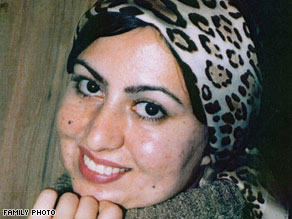
TEHRAN, Iran (CNN) — Ameneh Bahrami is certain that one day she’ll meet someone, fall in love and get married. But when her wedding day comes, her husband won’t see her eyes, and she won’t see her husband. Bahrami is blind, the victim of an acid attack by a spurned suitor.

Ameneh Bahrami said her attacker pestered her with marriage demands.

If she gets her way, her attacker will suffer the same fate. The 31-year-old Iranian is demanding the ancient punishment of “an eye for an eye,” and, in accordance with Islamic law, she wants to blind Majid Movahedi, the man who blinded her.
“I don’t want to blind him for revenge,” Bahrami said in her parents’ Tehran apartment. “I’m doing this to prevent it from happening to someone else.”

Bahrami says she first crossed paths with Movahedi in 2002, when they attended the same university.
She was a 24-year-old electronics student. He was 19. She never noticed him until they shared a class. He sat next to her one day and brushed up against her. Bahrami says she knew it wasn’t an accident.
“I moved away from him,” she said, “but he brushed up against me again.”
Read More

(Submitted by a reader)

Also watch

Iranian Woman Blinded by Acid Wants Same Fate for Attacker

Chance of political settlement open

by Shelley Walia

Interview with Noam Chomsky on the situation in West Asia following the Israeli assault on Gaza.

THE HINDU PHOTO LIBRARY

Noam Chomsky, a file picture.

ISRAEL continues to terrorise and bomb at will. West Asia waits for a malicious twist to the already dead road map. A viable Palestinian state now seems to be like something in the distant future. A bloody retribution, a tit-for-tat flare-up; that is all that is left after the terrible Christmas massacre in Gaza. While young children played soccer and families slept in residential neighbourhoods, the Israeli Defence Forces (IDF) unleashed one of the severest attacks on Gaza in the last month of 2008, this time determined to enforce a military solution to the daily skirmishes on the border, thereby deterring the incorrigible Hamas belligerence.

In truth, it was Israel that first broke the ceasefire on November 1, 2008, and justified its air and ground attacks on Gaza as the final move to end the daily nuisance of missiles from across the border. It is a fact that in spite of the siege of the past two months no missiles were fired by Hamas. Israel has thrown to the wind the rules laid by the Fourth Geneva Convention, of the Nuremberg Principles, of all of the laws of war generated in the 20th century.
The West Asia problem is now the concern of the global community and is no longer singularly within American turf. In the past, the United States had always, without fail, rejected any such international intervention. However, Prof. Noam Chomsky argues, with no provision of an international vigilance force to oversee the implementation of any peace plan, Israel has the option to do what it pleases and has support from the U.S. for its incorrigible stance of “rejectionism”.

Sadly, the United Nations Security Council has been rendered ineffective by the U.S. veto, though more than 150 members in the General Assembly have voted for the Palestinians’ right to self-determination. There is no doubt that without the authorisation of the U.S. government and its support of Israel not a single military attack on Palestine can take place. Israel is a military base and complies with U.S. foreign policy. Military confrontation, control of gas wells on the borders of Gaza, as well as motives of expansionism have been the apparent interests of the two partners. Since the 1973 encroachment into the Egyptian Sinai, any diplomatic resolution to end the impasse between the two nations has been consistently elusive. With the recent destruction of Gaza, the solution has become all the more protean.

Public opinion in Israel calls for giving up land in Palestine in exchange for peace, but the country’s leaders look on. Their convictions as “Christian Zionists” seem to bestow on them the theological right to continue doing what they do despite what happens to a few million Palestinian “terrorists”. In the meantime, the two nations sink neck deep into uncontrolled violence, leaving behind an unsolvable conundrum.

If Washington was sincere and committed to move West Asia towards peace, there should have been some sign of a reprimand to Israel for its recent attack on Gaza. In the light of the recent history of peace initiatives and unrestrained violence, there seems to be only one way out: an international solution on the lines of what took place in East Timor through the pressure exerted by international opinion. One cannot change the nature of the West Asia problem through war or bloodshed, and democracy cannot come on the wings of a bomber.

Then where does the solution lie? While it cannot come from the Right in Israel, the Left remains unelectable. In Palestine, on the other hand, there is no check on militant agitation. Peace can never come from top down; it is the people at the bottom who can put an end to violence and terrorism.

Will the new President in the White House invest his full powers to bring the two antagonists to the table and negotiate for a solution to one of the most serious political issues of our time? Or will he continue to put forward the American propensity to befriend Israel as a priority that would supersede an objectivity that his presidency promises to the world? The Clinton plan of bringing durable peace by returning to the 1967 boundaries, of sharing Jerusalem and permitting Palestinian refugees to return to their homes remains a viable model for President Barack Obama to follow unless he reinvents a road map that will anticipate the end of hostility.
At the end of the day, it will depend on the pro-Israel lobby in the U.S. to persuade the American leadership to either initiate peace or escalate conflict in West Asia. Obama will scarcely be left with a choice against such a formidable force from within his own fortress. The world waits to see whether he succeeds in introducing a comprehensive diplomatic initiative towards Iran along with the prioritising of the Arab-Israeli peacemaking.

In the light of the West Asia “ulcer”, Prof. Shelley Walia asked Prof. Noam Chomsky for his views on this conundrum. Chomsky, as is well known, has probably been the single most important voice in international politics for several decades. His main works, from Manufacturing Consent: The Political Economy of the Mass Media (with Edward S. Herman) to Hegemony or Survival: America’s Quest for Global Dominance, from Failed States: The Abuse of Power and the Assault on Democracy to Perilous Powers: The Middle East & U.S. Foreign Policy: Dialogues on Terror, Democracy, War, and Justice (with Gilbert Achcar and Stephen R. Shalom [editor]), along with his daily interventions, have challenged the deceptions of media reportage and of the devious agendas of Western regimes. As Edward Said emphasised some years ago, “Noam Chomsky is one of the most significant challengers of unjust power and delusions; he goes against every assumption about American altruism and humanitarianism.”

Chomsky was kind enough to take time off from his busy schedule and answer a number of questions on the Arab-Israel conflict. His invigorating zeal remains unabated, as is visible from his remarkable consistency of involvement with issues of human rights and peace. Excerpts from the interview:
Coming directly to the reasons for the Israeli attack on Gaza, do you believe that there could be a larger plan at work that has as its planner the U.S. aiming to finally provoke Iran to enter the ongoing conflict?

I doubt it. It would have been highly unlikely for Iran to respond more than verbally to the attack. There is a straightforward reason, I believe. Israel wants to take over the valuable parts of the West Bank and to leave the remnants of Palestinian society barely viable. And it, of course, wants to do so without disruption. It has succeeded, by violence, to suppress resistance within the West Bank. But the other part of occupied Palestine, Gaza, is still not completely under control. For other reasons, Israel has refused to abide by any of the ceasefires that have been reached and intends to maintain the siege that is suffocating Gaza. Invasion was a means to suppress resistance to its ongoing (U.S.-backed) crimes in the occupied territories.

The fertile part of Gaza represents about a third of the Gaza Strip, this being the part Israel has always wanted to retain owing to its economic productivity and sale of produce to Europe. How would you then react to Israel’s withdrawal from Gaza a few years ago? Is it because the maintenance and protection of Israeli settlers was proving rather costly for the Israeli government or because the U.S. nudged [then Prime Minister Ariel] Sharon in that direction, or because Sharon had his own agenda?

The motives do not seem obscure. Gaza has been turned into a disaster area under Israeli military occupation of 38 years. A few thousand Israeli settlers take a substantial part of the scarce land and resources and have to be protected by a large part of the Israeli army. Sane Israeli hawks understand that it makes no sense to continue with these arrangements. The settlers, who were subsidised to establish themselves there, are now being subsidised to settle elsewhere, leaving the population of Gaza to rot in a virtual prison. The few scattered West Bank outposts that are being abandoned are also simply an annoyance for Israel.

The “disengagement plan” is in reality an expansion plan, as was made plain at once. The presentation of the plan was coupled with an announcement of tens of millions of dollars for West Bank settlements and infrastructure development, a further expansion of the programmes designed to ensure that valuable land and resources will be incorporated within Israel, while Palestinians will be left in scarcely viable cantons. The shameful “separation wall” is one particularly ugly feature of these programmes. The actions are gross violations of international law and elementary human rights but can continue as long as they are supported by the reigning superpower. American citizens are the only ones who can put an end to these continuing and very severe crimes.

The operation was a complete scam, a repeat of “Operation National Trauma ’82” as the press called it at the time, carefully orchestrated, a media triumph, intended to convey the message: “Never again must Jews suffer so; the West Bank is ours.”

Read More

Speaking out: Marriage rights

By Sharmila Dhal and Zahar Bitar, Staff Reporters for Gulf News

© XPRESS
Avantika Hari, left, and Wedad Lootah.

Avantika Hari and Wedad Lootah are two women who use their talents to help people understand social realities. While Avantika finds fame in her work, Wedad copes with infamy.
AVANTIKA HARI, FILMMAKER

There’s an uneasy silence as defence lawyers Timothy James and Farah Siddiqui, sitting in a café, talk about the sensitive case before them.

“He doesn’t seem unstable. Hardly seems to have a temper. No matter what I think, all we’ve got is religion and culture,” says James, referring to Nazir Khan, head of a family in Birmingham in the spotlight over the killing of his daughter Saira.

“If we defend him on those grounds, we’re branding the whole community. Leave religion and culture out of it,” urges Siddiqui. “I don’t think I can,” says James to which Siddiqui retorts, “Look, I’m a British Asian Muslim. Nowhere in the Quran does it say you can kill your daughter if she doesn’t listen to you.”

And so the conflict in Land Gold Women begs for resolution. An emphatic statement on the little known but shockingly pervasive practice of honour killing, the unconventional film by Dubai-based filmmaker Avantika Hari explores the rationale behind such incidents and seeks to dispel the misconception that this is a religious issue.

Liberal environment

“Growing up in a liberal environment like Dubai makes one very tolerant and I felt a sense of responsibility to clear the Muslim world’s name where honour killings are concerned,” says 28-year-old Hari, who has written, directed and co-produced the film along with Vivek Agrawal from India.

The film, which premiered at Birmingham and had a special screening at the House of Commons in the UK last month – has already set viewers thinking. “There was shock and disbelief and the Muslims who watched it were thankful,” claims Hari, looking forward to the March 25 Dubai premiere of the film at The Scene Club launched last November by Emirati filmmaker Nayla Al Khaja. At first, Hari too couldn’t fathom how honour killings could still be perpetrated. She recalls how she chanced upon a newspaper article on one such incident when she was a student at the London Film School in 2004. But as she researched the subject, a whole new perspective emerged.

Tribal Honour

“Honour crimes – murders committed to protect the image of the family – affect women all over the world, irrespective of their religious, social and economic backgrounds,” says Hari, adding that thousands of women across cultures are victimised in the UK alone each year.

Determined to do something about it, she thought of making a film where she could dwell on one of the three elements of land, gold and women used generally to preserve tribal honour.

It took her four years to complete the project. While friends from television, films and theatre comprised the cast, the funding, all of $1.1 million (Dh4 million), came from her family.

“Avantika has always had a strong sense of right and wrong,” says her father Hari Padmanabhan, Strategic Adviser at 3i Infotech, Dubai. Even at school – she is an alumna of Dubai Modern High School and Emirates International School – she took part in service-oriented activities. Going beyond the self, she learnt early on, was essential for one’s development.

Three years ago, her first film Hat Day focused on a London preschool where each child was assigned a Commonwealth nation hat. It topped the Commonwealth Vision Awards because of its powerful message: identity mattered little for toddlers. In Land Gold Women too, it’s a question of image at the fore – potent but far more complex.

Profile

Born in India, brought up in the Middle East and educated in the West, Avantika Hari wrote the story of Land Gold Women while doing her MA in Filmmaking at the London Film School in 2004.

Hari graduated with a double major in Visual Arts and Economics from Stetson University, Florida, USA in 2002. She also authored a paper that involved using interactive education as a means to alleviate poverty in India.

WEDAD LOOTAH, FAMILY COUNSELOR

A family counsellor at Dubai Courts, who is facing death threats for writing a book in Arabic on sex within marriage, has lashed out at her detractors in an interview with XPRESS – her first to an English-language publication.

“These people have no idea about the reality of our society,” said Wedad Lootah, whose book Serri Lel Ghayah (Top Secret) has caused an uproar in the Arab world because of its explosive content. The 221-page book gives an explicit insight into issues related to sex and married life – subjects hitherto considered taboo in the region.

Wedad has been accused of being an Israeli agent and is routinely subjected to threats – the most recent of which was by a caller who wanted to kill her.

But the 45-year-old woman, who wears a niqab (face cover) to her workplace, remains unfazed and stands by her book.
Bedroom lapses

“It should be read by every man and woman planning to get married as sex is the pillar of a stable and healthy family. Lapses in bedroom relations lead to marital strife,” said Wedad, backing her claim with statistics dug out from Dubai Courts. “Out of the 2,401 cases of family disputes we dealt with last year, 1,305 were a result of lack of sexual harmony.

“A husband and wife cannot be sexually satisfied unless they both enjoy it,” she said, adding that she was sure a man wouldn’t commit adultery if he was sexually fulfilled by his wife and vice versa.

Sensuality and communication between the husband and wife are key essentials to a happy married life as they heighten the pleasure of the act, said Wedad, who recommends that every man and woman should enjoy sex to the fullest “by being participatory, not anticipatory”.

Wedad said she has used Quran and Sunnah referrals in her book to prove that oral sex, which many think is forbidden, is actually allowed in Islam.

“What is haram [forbidden] is anal sex,” she added.

Sex education

“Lack of sex education is the main reason behind marital break-ups among Emiratis,” she said. Wedad reckons starting sex education in schools would create awareness, break taboos and dispel certain myths associated with the subject.

“Young people are often exposed to a wide range of notions about sex. A good sex education programme could lower the risks of negative outcomes from sexual behaviour and develop their ability to make decisions when they are adults,” she said.

Death threats

Wedad said she had been getting death threats even before the book was published. “In fact I was threatened in 2006 when the book was just a study. What infuriated my detractors more than anything else was the fact that the cause of sex education was being championed by a woman who wore a niqab.

“They said I was an Israeli agent who wanted to corrupt Arab youth by making them sex-oriented. I have received threats from GCC and Arab countries…, but I am not afraid.”

Wedad said she found great support from her family, especially her broad-minded husband and her 20-year-old daughter, who designed the book’s cover.

“My sons have read the book and are also very proud of me.”
When the Ministry of Justice refused to publish her book, Wedad got it published on her own.

The 221-page book is in Arabic and is priced at Dh34.

Profile

Wedad Lootah did her Bachelors in Islamic Studies from the Islamic College in UAE University in 1986. In 1996, she joined the Department of Islamic Affairs and Charitable Works as head of Dawat (call for Islam) for women. She joined Dubai Courts in 2001 and has since been working there as a family counsellor. Serri Lel Ghayah, which loosely translates into Top Secret in English is her first book. Published in November last year, it uses three case studies to illustrate how lack of sexual harmony could lead to marital discord.
Read More

Ballad to the Dead, Tr?nh Công S?n

Tr?nh Công S?n was a writer, musician, and painter. Singer Joan Baez called him “Bob Dylan of Veitnam.” The following song is about the Vietnam War which US waged against Vietnam. In Vietnam, the war is known as American War.”

Bài ca dành cho nh?ng xác ng??i by Tr?nh Công S?n

The Song in Vietnamese and the translation:

Bài ca dành cho nh?ng xác ng??i

Author: Tr?nh Công S?n

Xác ng??i n?m trôi sông,
ph?i trên ru?ng ??ng
trên nóc nhà thành ph?
trên nh?ng ???ng quanh co

Xác ng??i n?m b? v?
d??i mái hiên chùa
trong giáo ???ng thành ph?
trên th?m nhà hoang vu

Mùa xuân ?i, xác nuôi th?m cho ??t ru?ng c?y
Vi?t Nam ?i, xác thêm h?i cho ??t ngày mai
Ð??ng ?i t?i, dù chông gai
vì quanh ?ây ?ã có ng??i

Xác ng??i n?m quanh ?ây
trong m?a l?nh này
bên xác ng??i già y?u
có xác còn th? ngây

Xác nào là em tôi
d??i h? h?m này
trong nh?ng vùng l?a cháy
bên nh?ng v?ng ngô khoai

(Repeat all)

Xác nào là em tôi
d??i h? h?m này
trong nh?ng vùng l?a cháy
bên nh?ng v?ng ngô khoai

The above lyric is taken down from Khanh Ly’s performance. Really sorry for any mistake and many thanks for your correction.

Ballad to the Dead (Hue 1968)

(Translated by Frank Duong)

The bodies of the dead lie floating in the river
They lie in the field,
On the rooftops of the city
And in the winding streets
The bodies of the dead lie lost

Under the eaves of the pagodas
In the churches of the city
At the doorsteps of the deserted houses

Oh Spring – the bodies of the dead bring a scent to the rice paddies
Oh Vietnam – the bodies of the dead add breath to tomorrow’s soil
The way there, though full of obstacles (literally – spikes)
Because around here – here were humans

The bodies of the dead lied all around here
In this cold rain
Near the bodies of the old and weak
Lie the bodies of the young and innocent

Which body is the body of my brother
In this cave
In those burnt out areas
Next to the maize and sweet potato field

(Repeat all)

Which body is the body of my brother
In this cave
In those burnt out areas
Next to the maize and sweet potato field

Translation #2

Author: Tr?nh Công S?n
Album: Ca khúc Da vàng 1 (1970)

(Translated by Nguy?n V? Thành, 28.9.2003)
Corpses float on rivers
lie in the fields
on roofs in the city
on the tortuous roads

Corpses lie lonely
under pagoda eaves
in churches of the city
on a wild veranda

Oh Spring, corpses nourish the paddy-fields
Oh Viet Nam, corpses give strength to future soil
The way we go, though with thorns
Then hereabouts, there’re people

Corpses lie about here
in this cold rain
near corpses of the aged (old and weak)
are corpses of the naive

Which corpse is my younger (brother and sister)
in this cave
in fire-and-smoke areas
near beds of maize, (sweet) potato

(Repeat all)

Which corpse is my younger
in this cave
in fire-and-smoke areas
near beds of maize, potato

http://www.comp.nus.edu.sg/~nguyenvu/Artists/TC_Son/Songs/TCSon_songs—Bai_ca_danh_cho_xac_nguoi.htm

Also see a site dedicated to his music

Latinos are stuck in racial limbo

By Ruben Navarrette

Laura Gomez has a funny, and yet terribly perceptive, term to describe the sort of racial holding pattern in which America’s largest minority finds itself.

“Latinos have been in this limbo between white and nonwhite – or what I call ‘off-white’ – for more than 165 years,” Gomez told me.
Off-white works for me.

Gomez, a professor of law and American studies at the University of New Mexico, might be onto something here. Latinos are neither black nor white, and yet there are black Latinos and white Latinos. There is no Latino race, yet what many Latinos were subjected to in the 20th century – including being barred from hotels, restaurants and public swimming pools – and continue to be subjected to today in subtler forms would have to be called racism. Still, in America’s great racial debate, Latinos have been consigned to the sidelines.

There is a lot that Gomez, who holds a Ph.D. in sociology from Stanford, could teach U.S. Attorney General Eric Holder. The AG isn’t a sociologist, but he played one during Black History Month. Spelling out how far we still have to go to achieve racial nirvana, Holder called the United States “a nation of cowards” who are reluctant to talk about race.

President Barack Obama recently critiqued the nation’s top law enforcement officer for his choice of words.
“I think it’s fair to say that if I had been advising my attorney general, we would have used different language,” Obama told a reporter. “I think the point that he was making is that we’re oftentimes uncomfortable with talking about race until there’s some sort of racial flare-up or conflict.”

As an Obama supporter, Gomez didn’t have any problem with the main thrust of Holder’s comments. What bothered her was that his narrative was so incomplete as to be irrelevant.
“Holder’s speech is very much in black-and-white terms,” she said. “Almost everywhere he mentions specifics, he’s talking about blacks and whites.” Like when Holder said: “The study of black history is important to everyone – black or white,” or when he rattled off a list of African-American civil rights figures as “people to whom all of us, black and white, owe such a debt of gratitude.”
It wasn’t exactly the inclusive and multiracial tone that Obama struck in his poetic speech on race in Philadelphia during the presidential campaign.

Gomez understands the context of Holder’s remarks. “Granted, this (was) Black History Month,” she said, “and there’s an important reason to talk in those terms . . . but I think it does raise a question: Where are Latinos in this?”
For Gomez, it’s a familiar story.
“We’re presumed invisible from the racial past of the United States,” she said.

Gomez mined that past in her book, “Manifest Destinies: The Making of the Mexican American Race,” which traces the origins of Mexican-Americans as a racial group in this country.

Today, stuck somewhere in between whites and nonwhites, Latinos are often ignored – in entertainment, politics, media, business, etc. Television networks will do a series on race or ethnicity in America, and still sketch out the storyboard in black and white. When Latinos are noticed, they’re usually a footnote, an afterthought, or an accessory – as when a well-meaning politician is talking about race relations, equal opportunity or civil rights, and mentions “blacks and whites . . . and browns.”

Another concern for Gomez is that, even when other Americans do see Latinos, a lot of people aren’t always sure what they’re seeing. Consider the immigration debate.

“There’s this almost hyper-visibility of Latinos,” she said. “But it’s a narrow and often wrong kind of hyper-visibility because it is the ‘illegal alien.’ Every Latino is presumed to be an immigrant and secondly to be an undocumented Mexican.”

Read More