Judge Hanen Orders Condemnation and Possession of Tamez Family Lands

“I am captive in my own land,” Eloisa Tamez tells audience at Western Social Sciences Association scholarly community, in Albuquerque, New Mexico, April 16, 2009.

Press Release: Eloisa Tamez’ Land condemned for Border Wall
April 16, 2009

Albuquerque, New Mexico–A federal judge in Brownsville, TX issued an order today granting the federal government’s request to condemn the ancestral land of the Tamez Family, who are Lipan Apaches. Although this land has been in the Tamez family prior to the Spanish colonization, and also designated to them through Spanish Crown law (1767, as of today, it is in the possession of the United States Department of Homeland Security.

The landowner, Eloisa Tamez, heard about Judge Hanen’s order while participating in the Western Social Sciences Association Conference in Albuquerque, where she was participating in a Three part panel: “Indigenous People’s and the U.S.-Mexico Border: Militarization, Resistance, and Rights.” She is with a group of colleagues from several bi-national Indigenous Border communities and experts on militarization and the impact of the border wall.

The Tamez family reports that this is an urgent situation which needs international attention and wide press coverage.

Read More
(Submitted by Michelle Cook)

The dark side of Dubai

Dubai was meant to be a Middle-Eastern Shangri-La, a glittering monument to Arab enterprise and western capitalism. But as hard times arrive in the city state that rose from the desert sands, an uglier story is emerging. Johann Hari reports


Getty

Construction workers in their distinctive blue overalls building the upper floors a new Dubai tower, with the distinctive Burj al-Arab hotel in the background

The wide, smiling face of Sheikh Mohammed – the absolute ruler of Dubai – beams down on his creation. His image is displayed on every other building, sandwiched between the more familiar corporate rictuses of Ronald McDonald and Colonel Sanders. This man has sold Dubai to the world as the city of One Thousand and One Arabian Lights, a Shangri-La in the Middle East insulated from the dust-storms blasting across the region. He dominates the Manhattan-manqué skyline, beaming out from row after row of glass pyramids and hotels smelted into the shape of piles of golden coins. And there he stands on the tallest building in the world – a skinny spike, jabbing farther into the sky than any other human construction in history.

But something has flickered in Sheikh Mohammed’s smile. The ubiquitous cranes have paused on the skyline, as if stuck in time. There are countless buildings half-finished, seemingly abandoned. In the swankiest new constructions – like the vast Atlantis hotel, a giant pink castle built in 1,000 days for $1.5bn on its own artificial island – where rainwater is leaking from the ceilings and the tiles are falling off the roof. This Neverland was built on the Never-Never – and now the cracks are beginning to show. Suddenly it looks less like Manhattan in the sun than Iceland in the desert.

Once the manic burst of building has stopped and the whirlwind has slowed, the secrets of Dubai are slowly seeping out. This is a city built from nothing in just a few wild decades on credit and ecocide, suppression and slavery. Dubai is a living metal metaphor for the neo-liberal globalised world that may be crashing – at last – into history.

I. An Adult Disneyland
Karen Andrews can’t speak. Every time she starts to tell her story, she puts her head down and crumples. She is slim and angular and has the faded radiance of the once-rich, even though her clothes are as creased as her forehead. I find her in the car park of one of Dubai’s finest international hotels, where she is living, in her Range Rover. She has been sleeping here for months, thanks to the kindness of the Bangladeshi car park attendants who don’t have the heart to move her on. This is not where she thought her Dubai dream would end.
Read more

(Submitted by Shahabuddin Haji)

Brain Gain – the underground world of “neuroenhancing” drugs

by Margaret Talbot


Every era has its defining drug. Neuroenhancers are perfectly suited for our efficiency-obsessed, BlackBerry-equipped office culture.
A young man I’ll call Alex recently graduated from Harvard. As a history major, Alex wrote about a dozen papers a semester. He also ran a student organization, for which he often worked more than forty hours a week; when he wasn’t on the job, he had classes.

Weeknights were devoted to all the schoolwork that he couldn’t finish during the day, and weekend nights were spent drinking with friends and going to dance parties. “Trite as it sounds,” he told me, it seemed important to “maybe appreciate my own youth.” Since, in essence, this life was impossible, Alex began taking Adderall to make it possible.

Adderall, a stimulant composed of mixed amphetamine salts, is commonly prescribed for children and adults who have been given a diagnosis of attention-deficit hyperactivity disorder. But in recent years Adderall and Ritalin, another stimulant, have been adopted as cognitive enhancers: drugs that high-functioning, overcommitted people take to become higher-functioning and more overcommitted. (Such use is “off label,” meaning that it does not have the approval of either the drug’s manufacturer or the Food and Drug Administration.)

College campuses have become laboratories for experimentation with neuroenhancement, and Alex was an ingenious experimenter. His brother had received a diagnosis of A.D.H.D., and in his freshman year Alex obtained an Adderall prescription for himself by describing to a doctor symptoms that he knew were typical of the disorder. During his college years, Alex took fifteen milligrams of Adderall most evenings, usually after dinner, guaranteeing that he would maintain intense focus while losing “any ability to sleep for approximately eight to ten hours.” In his sophomore year, he persuaded the doctor to add a thirty-milligram “extended release” capsule to his daily regimen.

Alex recalled one week during his junior year when he had four term papers due. Minutes after waking on Monday morning, around seven-thirty, he swallowed some “immediate release” Adderall. The drug, along with a steady stream of caffeine, helped him to concentrate during classes and meetings, but he noticed some odd effects; at a morning tutorial, he explained to me in an e-mail, “I alternated between speaking too quickly and thoroughly on some subjects and feeling awkwardly quiet during other points of the discussion.” Lunch was a blur: “It’s always hard to eat much when on Adderall.” That afternoon, he went to the library, where he spent “too much time researching a paper rather than actually writing it—a problem, I can assure you, that is common to all intellectually curious students on stimulants.” At eight, he attended a two-hour meeting “with a group focussed on student mental-health issues.” Alex then “took an extended-release Adderall” and worked productively on the paper all night. At eight the next morning, he attended a meeting of his organization; he felt like “a zombie,” but “was there to insure that the semester’s work didn’t go to waste.” After that, Alex explained, “I went back to my room to take advantage of my tired body.” He fell asleep until noon, waking “in time to polish my first paper and hand it in.”
Read more

Afghanistan: Key to women’s rights belongs to nation’s men

New law that gives a husband the right to demand sex every four days sparks protest; activists say empowering females in patriarchal society requires males

By Heidi Vogt | Associated Press

KABUL—There are a handful of them at every women’s rights gathering in Afghanistan: men.

Crowds of men threw stones and shouted insults at women last week protesting a restrictive marriage law that critics say legalizes marital rape in Afghanistan, but a few men marched and chanted alongside the women.

These are the men—many of them prominent male politicians and intellectuals—who are taking up the battle for women’s rights and calling for change in this patriarchal society. The act of solidarity is more than just a bright spot; activists say men’s support for women’s rights is vital in a country where men hold sway in government and in families.

Many people working on women’s issues agree: To empower the women, you first need to enlist the men.
Sherwali Wardak, who runs women’s literacy and small-business training programs in rural Afghanistan, said the key to getting women involved is to persuade the men in their lives to allow it.

“The most important factor of working with women is to encourage the men to allow their women to enroll in the rehabilitation or development project,” Wardak said.

When he doesn’t get permission from the men, Wardak says, they often don’t let their wives or daughters leave the house to travel to the centers he sets up. He says he’s received threats because of the work he does.

“They write, ‘Close this project because it is working for Christianity,’ ” he said. It’s a common accusation of those who support women’s rights in Afghanistan—that the advocates are stooges of the Christian West.

Crowds that swamped a group of women protesting a law Wednesday that they say legalizes marital rape were full of similar vitriol. The law gives a husband the right to demand sex every four days and regulates when a woman can leave the house. The law is not being enforced pending a judicial review ordered by Afghanistan’s president after the legislation sparked an international uproar.
Read More
(Submitted by Rohila Pritam)

Announcement – South Asian Peoples Forum

The South Asian Peoples Forum is holding a 4 day conference from April 23-26, 2009, to address the crises facing our respective countries and how we can build unity across borders to jointly tackle the problems of sub-nationalism, militarism, conflict, and poverty. Speakers and activists from India, Pakistan, Bangladesh, Sri Lanka and Nepal as well as from Canada, the US and the UK will discuss people’s common struggles against poverty, militarism, insecurity, and racism, and the women’s movements in the region.

The Opening will be on Thursday, April 23rd, at 6:30 pm at the University of Toronto, Law school, 78 Queens Park.
Abid Hassan Minto, Senior Advocate, Supreme Court of Pakistan, and President of the National Workers Party, Pakistan will be the Featured Speaker, along with Dr Sherene Razack, Professor at OISE. There will be music and a reception that follows the lectures. The registration fee for the conference is $15 including the Opening Reception.

The panels from the 23-26th will cover Imperialism and South Asia, Violence and the South Asian State, a special discussion on the conflict in Sri Lanka, and Neo-liberalism and Resistance. The question we want to raise through this conference is, how can we, South Asian people, collectively join to develop an alternative view of our region which reflects our minds and hearts – for a region without conflict, wars, borders, insecurity, violence and poverty. We have brought together valuable thinkers and activists from the region and the diaspora to lead us in this discussion. We also recognize that the peoples of South Asia include a large number of progressive and Left-leaning people in the diaspora who left our countries for political and economic and sometimes family reasons but are deeply concerned with the political and economic situation of South Asia.

We intend that the impact of the conference will encourage isolated people to join our movement, create space for further South Asian Left ideas in the diaspora amongst multiple generations, and will strengthen our ability to counteract the existing religious and right wing networks that are bringing our region to destruction. The conference will generate a space for this multi-faceted dialogue.
There will also be a special international literary session on Sunday 26th at the Port Credit School, 70 Mineola Road East, Mississauga at 2:30 pm.

The conference will conclude on April 26th night with the 2nd annual Faiz Peace Festival held in coordination with the first International Festival of Poetry of Resistance, Toronto. This will be at 7:00 pm at the Port Credit School.

This conference is organized jointly by the South Asian Peoples Forum, the Ghadar Heritage Foundation, the Association of Indian Progressive Study Groups (AIPSG), and is co-sponsored by the United Food and Commercial Workers Union, Canada, and the South Asia Programs at York University and the University of Toronto, and with the support of many donors.

Please contact sara.abraham@sympatico.ca for a full program of the conference. Please contact 416-399-7602, or 416-856-7212 or bashani2000@yahoo.com for tickets for the Faiz Mela.

The Body Beautiful

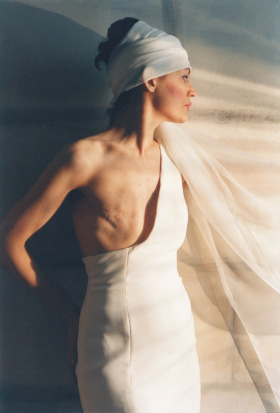
Matuschka is a New York based artist of many talents who recently gave an interview to MAMM. Her personal website is http://www.matuschka.net/

My 1993 self-portrait became a worldwide sensation
The picture is taken from her website.
The interview

The Body Beautiful

In her famous self-portrait, photographer Matuschka gave the world its first look at mastectomy. Now she explains how she turned herself into a work of art.

By Matuschka
I never wanted a tattoo. Not even by the time I’d booked the session. It was the summer of 1968, and my friend, Nona, and I were two unruly nymphets hanging out with a motorcycle club whose rite of initiation involved engraving your man’s name on your belly. I was only 13, so I needed a fake ID and Nona to chauffeur me across state lines, since tattoos were illegal in New Jersey at the time.
We went to a guy named “Danny” who operated a tattoo parlor out of his parents’ garage. His needles were the size of hypodermic syringes, and the ink he would use on my body looked like a mixture of soot, cigarette ash and motor oil.

Seven years later I was a fashion model going by only my last name. In the ’70s and ’80s, it was rare for a model to have either breasts or tattoos. I had both. I knew there was no intrinsic beauty in this tattoo, and the modeling agents and photographers thought the same way, but I couldn’t afford the laser surgery to remove it.

By 1980 I discovered another way to make a living off my body and became a photographer specializing in nudes. I didn’t have to worry about modeling fees—I just employed myself. Sometimes I became annoyed seeing that little black blob in the photos, but finding ways to get around it led to a highly successful series sold in galleries and published in magazines.

Soon enough I’d have bigger concerns than Joanne splayed upon my belly: In 1991, I underwent a lumpectomy for a tiny tumor in my voluptuous right breast. Then my surgeon misread the pathology report, leading to what I call a “mistake-to-me,” and sliced my right breast off. [Matuschka won a malpractice suit against her surgeon for the unnecessary mastectomy.]

Back then, a one-breasted woman had three options to transform her asymmetry into something society might find acceptable: prosthesis, implants or a prophylactic mastectomy of the other breast. None seemed suitable, comfortable or right for me.

Read more

Afghan Women Protest Marital Rape Law; Men Spit and Stone Them


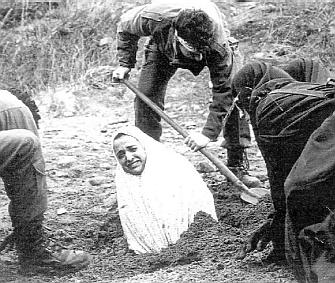
2005 Stoning

The US government and Mr. Karzai mostly rely on Northern Alliance criminal leaders who are as brutal and misogynist as the Taliban.”
Rady Ananda

Last month, the new Afghanistan parliament passed the “Shia Family Law” which legitimates marital rape and child marriage for Shia Muslims who make up ~15% of the population. At least 300 women protested the law, with their faces exposed. Nearly 1,000 Afghan men and their slaves turned maniacal and stoned the protesters. Police struggled to keep the two groups apart, reports the Revolutionary Association of the Women of Afghanistan (RAWA).

Supporters of the law redefine ‘rape’ to fit their narrow patriarchal views. Forced sexual relations, to them, is about loyalty to the husband. One counter-protester reportedly described rape as marital infidelity – by the wife!

“Rape is what you see in the West where men don’t feel responsibility for their wives and leave them to go with several men.”
Well, honey, that is not the definition of rape. That’s called cheating. Afghan protesters object to insane Taliban views that promote stoning women to death for perceived affronts to their masculine godview:

Last week widespread objection erupted to the stoning of a 16-year-old for leaving her house with a male non-family member, while the man was left unmolested and unpunished. The Taliban’s femicidal misogyny is infamous, world wide. RAWA and others hope to neutralize the psychopathic influence of Taliban thought in the Middle East.

Treating Shia women separately than all other citizens sets them up for violence, as the counter-protesters proved. RAWA tracks this violence, posting photos, reports and, recently, its statement on the 7th Anniversary of the US invasion of Afghanistan:

Neither the US nor Jehadies and Taliban,Long Live the Struggle of Independent and Democratic Forces of Afghanistan!

“The government of President Hamid Karzai has said the Shiite family law is being reviewed by the Justice Department and will not be implemented in its current form. Governments and rights groups around the world have condemned the legislation, and President Barack Obama has labeled it ‘abhorrent.’

“Though the law would apply only to the country’s Shiites – 10 to 20 percent of Afghanistan’s 30 million people – it has sparked an uproar by activists who say it marks a return to Taliban-style oppression. The Taliban, who ruled Afghanistan from 1996-2001, required women to wear all-covering burqas and banned them from leaving home without a male relative.

“Shiite backers of the law say that foreigners are meddling in private Afghan affairs, and Wednesday’s demonstrations brought some of the emotions surrounding the debate over the law to the surface.

Afghan Shiite women carry banners, one on left reads “Yes law, but no petrifaction,” during a march against a new conservative marriage law in Kabul, Afghanistan on Wednesday, April 15, 2009. (Photo: AP)
“‘You are a dog! You are not a Shiite woman!’ one man shouted to a young woman in a headscarf holding aloft a banner that said ‘We don’t want Taliban law.’ The woman did not shout back at the man, but told him: ‘This is my land and my people.’
Read More

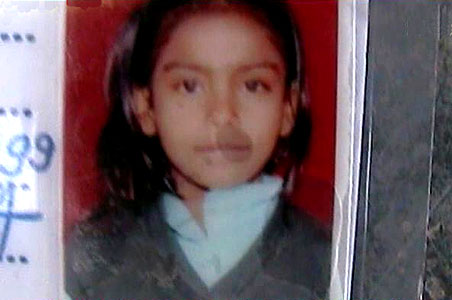
Tortured by teacher, 11-year-old girl succumbs to injuries

NDTV correspondent

The eleven-year-old girl, who was on life support in a city hospital in Delhi after being allegedly tortured by her school teacher, has succumbed to her injuries.

The teacher and the principal of the school have been suspended.
The girl was punished by a teacher at a government school in Bawana on Wednesday. The child’s parents allege she slipped into coma after her teacher banged her head and made her stand out in the sun for two hours.

The child was admitted with a severe seizure. Doctors had conveyed to the girl’s father that chances of survival are remote.
The class-two student was apparently brutally punished for not doing her homework.

The family has lodged a complaint but there has been no progress in the case. Police say they are waiting for full medical reports of the child before filing an FIR.

Read More
(Submitted by Aslam Merchant)