The AIPAC Spy Case

Where’s the Justice at the Justice Department?

By JAMES G. ABOUREZK

The big news last week was the defection of Republican Senator Arlen Specter to the Democrats; the bankruptcy filing of the Chrysler Corporation, and finally, the retirement of Justice David Souter from the U.S. Supreme Court.

A much smaller news item competing with these sensational stories was that the U.S. Justice Department announced that it is dropping the espionage charges against two former AIPAC agents. The story was so small that it barely was a blip on the media’s radar, bringing absolutely no comment on the network news and talk shows.
That’s known as clever public relations. Announce the bad news on a day when it won’t be noticed.

Steven Rosen and Keith Weissman had been charged in 2005 with the crime of espionage; specifically, handing over to Israel secret information they had retrieved from Larry Franklin, who was then a policy analyst in the U.S. Defense Department, working for Douglas Feith and for Paul Wolfowitz.

Franklin pleaded guilty to relaying top secret information on Iran to Rosen and Weissman, and was sentenced to 12 years and 7 months in prison, a term he is currently serving.

In the New York Times story detailing the Justice Department’s decision to drop the charges against Rosen and Weissman, the prosecutors claimed that the presiding federal judge, T.S. Ellis III, had raised the bar for the prosecution to prove its case against the two to a level they did not believe they could meet. The Judge said that the prosecutors could only prevail if they could prove that Rosen and Weissman “knew that their distribution of the information would harm U.S. National Security.” That was enough to make them dismiss the charges.

No one in the headquarters of the Justice Department took part in the announcement, but it was made by the prosecutors themselves, presumably the U.S. Attorney in charge of prosecution.
I’ve had some experience in court with U.S. Attorneys. What I know about how they operate is that if they don’t have a case, they will bring so many charges that forces the unlucky Defendant to plead guilty to at least one or two of them.

I would like to turn now the case of Sami Al-Arian, who was a college professor in Florida. Sami is a Palestinian, born in Kuwait. And why wasn’t he born in Palestine like a good Palestinian should be? Because, most likely, his parents were chased out of Palestine when Israel undertook its ethnic cleansing of that land in order to create an exclusive Jewish state.

Al Arian was charged in 2003 in a 50 count indictment, essentially with a plethora of terrorism charges. He waited 28 months in solitary in harsh conditions, before being tried in 2005. The trial lasted six months, with some 80 witnesses and 400 transcripts of intercepted phone conversations and faxes.

At the end of the prosecution’s case, Al Arian’s lawyers rested without offering any evidence or witnesses in his defense. After 13 days of deliberation, the jury acquitted Al Arian on 8 of 17 counts, and deadlocked on the other with 10 to 2 favoring acquittal. Two of the co-defendants charged along with Al Arian were totally acquitted.
Undaunted, the Justice Department prosecutors said they were considering re-trying Al Arian on the deadlocked jury charges, one of which carried a life sentence.

Read more

A Statement by the Asian Human Rights Commission

PAKISTAN: The dubious role of Pakistan army in dealing with Taliban thereby legitimizing the massacre

After the failure of the peace initiatives with the Taliban and Tehreek-e- Nifaz-e-Shariah Mohammadi (TNSM), the government of Pakistan has started an operation with the help of the Pakistan army in the northern parts of country, bordering Afghanistan, on the request of provincial government of North West Frontier Province (NWFP), resulting in the killings of innocent persons and the migration of several hundred thousand people from homes. According to information received from the affected areas, people find themselves trapped between the deep sea and the devil.

Caught in the cross-firing from the Taliban on one side and the Pakistan Army on the other, people have not been able to even collect the dead bodies of their loved ones. The military operation against the militants is carried out by gunship helicopters, mortar and jets but the entire land mass and vast mountainous areas are covered by militants armed with rockets, rocket launchers and other sophisticated arms which they captured from the NATO and allied forces as well as from the Pakistan army during the siege of almost three districts since six years. Media reports claim that the arms were allegedly supplied by the ISI – the intelligence agency of Pakistan.
The army is reluctant to either directly target the militants or disarm them, but instead is just retaliating to the gun fires from the Taliban militants in the mountains and blindly firing on the civilian population. The Inter Service Public Relation (ISPR) of the armed forces claim that more than 90 Taliban are killed in the military operation but local media sources claim that ISPR are providing wrong information as the most killings are from civilian population. More than two hundred security personnel including, army persons, are captured by the militants and about half a dozen army men were slaughtered by the militants since the last week of April. Civilians have to walk several miles to take refuge while both the governments – the NWFP and federal, have become mere spectators. The inland migrants have dispersed in different directions and are settling under the open skies.
The NWFP government has acted very arrogantly by pressurizing the federal government to implement the NAR and have an agreement with TNSM so that peace can be established in the northern parts. But when militants, particularly Taliban refused to abide by the agreement, the NWFP government has left people of the area at the mercy of the militants. More than half of the cabinet of the provincial government of NWFP is out of the province and are running their government from Dubai and Islamabad, the capital of Pakistan. Media access to the areas is not allowed and local journalists are under surveillance of state intelligence agencies. The notorious intelligence agency – the Inter Services Intelligence (ISI) are consistently asking local journalists to give them their stories before they are published or aired. The ISI has made it mandatory for local journalists to disclose the source of their news reports.

Read more
(Submitted by Abdul Hamid Bashani Khan)

Chimpanzees exchange meat for sex

By Victoria Gill


Share and share alike: a male chimp will give up his hard-earned catch for sex

Chimpanzees enter into “deals” whereby they exchange meat for sex, according to researchers.
Male chimps that are willing to share the proceeds of their hunting expeditions mate twice as often as their more selfish counterparts.
This is a long-term exchange, so males continue to share their catch with females when they are not fertile, copulating with them when they are.

The team describe their findings in the journal PLoS One.
Cristina Gomes and her colleagues, from the Max Planck Institute for Evolutionary Anthropology in Germany, studied chimps in the Tai Forest reserve in Ivory Coast.

She and her team observed the animals as they hunted, and monitored the number of times they copulated.

“By sharing, the males increase the number of times they mate, and the females increase their intake of calories,” said Dr Gomes.
“What’s amazing is that if a male shares with a particular female, he doubles the number of times he copulates with her, which is likely to increase the probability of fertilising that female.”

High value

Meat is important for the animals’ diet because it is so high in protein. Since female chimps do not usually hunt, “they have a hard time getting it on their own,” explained Dr Gomes.
The “meat for sex hypothesis” had already been proposed to explain why male chimps might share with females.

But previous attempts to record the phenomenon failed, because researchers looked for direct exchanges, where a male shared meat with a fertile female and copulated with her right away.
Dr Gomes’ team took a new approach. In a previous study, she had found that grooming exchange – where the animals take it in turns to groom each other – happens over long periods, she related. “So we thought, why not meat and sex?

“We looked at chimps when they were not in oestrus, this means they don’t have sexual swellings and aren’t copulating.”
“The males still share with them – they might share meat with a female one day, and only copulate with her a day or two later.”
She suggests this study could lay the foundations for human studies exploring the link between “good hunting skills and reproductive success”.

Read More

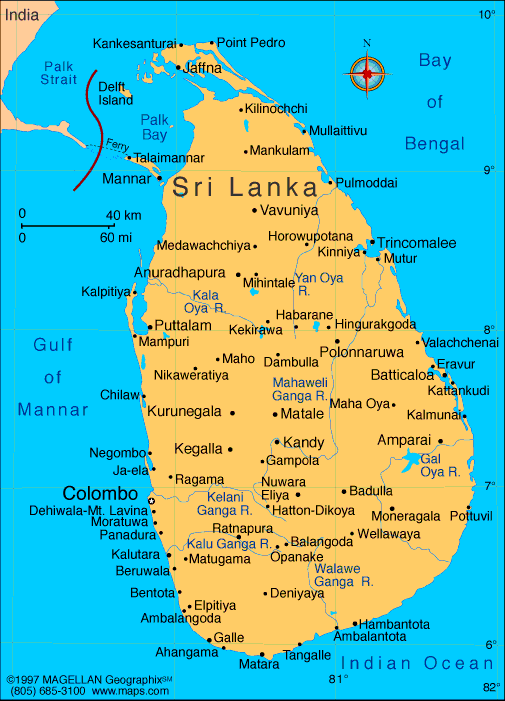
Teardrop: Now an Ocean of Tears

http://www.infoplease.com/atlas/country/srilanka.html

See enlargeable map

By B. R. Gowani

Sri Lanka’s geographic shape
Resembles a teardrop

A teardrop on a beloved’s cheek
Is frequently compared to a pearl
Poets and lovers see beauty in it
And advise not to let it drop

Alas! Sri Lanka is no more a pearl
Now that teardrop has in its lap
State and LTTE terror
Rapes and assaults
Refugees and ration-queues
Blood and corpses
Grief and lament
Orphans and widows

Once, long ago
Sri Lanka gave the World’s first hospital
Today, the state wounds and kills

Buddha’s enlightenment: not to desire anything
The State’s greed: not to grant a bit-autonomy

This pearl, Nature-created
But now, human-crushed
Is on a path to peace?
That’s what the rulers think
Naïve? they are not
Narcissist, they sure are
Afghans, Kashmiris, Palestinians, …
They did not disappear
And so some LTTE version will reappear

Meanwhile, the state will proclaim VICTORY
Whereas in fact
The teardrop has turned into
An ocean of tears

B. R. Gowani can be reached at brgowani@hotmail.com

Tamil People’s Rights

by A Sivanandan

There will be neither victory nor peace in Sri Lanka till the rights of the Tamil people are enshrined in a federal constitution that devolves power to the Tamil areas in the north and east – as was envisaged by the Norwegian peace process of 2002-05.
First, because the cause for which the LTTE has fought, if not its methods, is the cause of Tamil peoples everywhere, and cannot be suppressed. Second, because the present government, even more than all the governments before it, has, through the Aryanisation of race, the perversion of Buddhism into a violent, communal creed, and the exaltation of the Sinhala language as the language of office, achieved the successful symbiosis of the fascist elements that keeps it in power. In the process, it has killed off civil society with its blanket censorship, judicious murders and the suppression of the intelligentsia till there is no one left to oppose it. Instead, it has bred a culture of hate among the Sinhala masses that sees babies kitted out in army fatigues, accepts torture as a fact of war, and calls for the complete subjugation, if not the ethnic cleansing, of the Tamil people – which, in turn, ensures the perpetuation of an authoritarian government. Alas, my country.
A. Sivanandan is the Director of London-based Institute of Race Relations. The above letter appeared in London’s Guardian newspaper of February 5, 2009.
Guardian

Timeline: Sri Lanka

A chronology of key events:
Fifth century BC – Indo-Aryan migrants from northern India settle on the island; the Sinhalese emerge as the most powerful of the various clans.
Third century BC – Beginning of Tamil migration from India.
1505 – Portuguese arrive in Colombo, marking beginning of European interest.
1658 – Dutch force out Portuguese and establish control over whole island except central kingdom of Kandy.
1796 – Britain begins to take over island.
1815 – Kingdom of Kandy conquered. Britain starts bringing in Tamil labourers from southern India to work in tea, coffee and coconut plantations.
1833 – Whole island united under one British administration.
1931 – British grant the right to vote and introduce power sharing with Sinhalese-run cabinet.
1948 – Ceylon gains full independence.
Sinhala nationalism
1949 – Indian Tamil plantation workers disenfranchised and many deprived of citizenship.
1956 – Solomon Bandaranaike elected on wave of Sinhalese nationalism. Sinhala made sole official language and other measures introduced to bolster Sinhalese and Buddhist feeling. More than 100 Tamils killed in widespread violence after Tamil parliamentarians protest at new laws.
1958 – Anti-Tamil riots leave more than 200 people dead. Thousands of Tamils displaced.
1959 – Bandaranaike assassinated by a Buddhist monk. Succeeded by widow, Srimavo, who continues nationalisation programme.
1965 – Opposition United National Party wins elections and attempts to reverse nationalisation measures.
1970 – Srimavo Bandaranaike returns to power and extends nationalisation programme.
Ethnic tensions
1971 – Sinhalese Marxist uprising led by students and activists.
1972 – Ceylon changes its name to Sri Lanka and Buddhism given primary place as country’s religion, further antagonising Tamil minority.
1976 – Liberation Tigers of Tamil Eelam (LTTE) formed as tensions increase in Tamil-dominated areas of north and east.
1977 – Separatist Tamil United Liberation Front (TULF) party wins all seats in Tamil areas. Anti-Tamil riots leave more than 100 Tamils dead.
1981 Sinhala policemen accused of burning the Jaffna Public Library, causing further resentment in Tamil community.
Full Timeline

On The Last Spoor Of The Tiger

Betrayed by defectors from within and cornered by mortal foes from without, PC VINOJ KUMAR examines how Sri Lanka won the war. And why the LTTE lost it

SRI LANKAN President Mahinda Rajapaksa should consider writing a book on how to win wars. The Rajapaksa Doctrine is quite simple. There are three main rules. The First (and most important) Rule: Conduct the War Without Witnesses. Ensure that the theatre of war is out of bounds for the media, international monitors and aid agencies. The Second Rule: Give the Army a Free Hand. Do not constrain them with rules and international conventions. The Third Rule: (In the absence of witnesses), Don’t Worry About Human Rights Violations.

This strategy has paid rich dividends in Sri Lanka’s war against the LTTE, the rebel group fighting for Eelam, a separate nation for the Tamils of Sri Lanka. When Rajapaksa became President in November 2005, the LTTE controlled large swathes of territory in the northern districts of Mullaithivu, Killinochchi, and parts of Mannar. The LTTE held an area of about 15,000 sq km and ran a parallel government, complete with military, a judiciary, police and civil administration.
However, the LTTE’S statelet began to shatter as Rajapaksa started his military campaign around August 2006. He first evicted the LTTE from the small pockets it controlled in the Eastern Province. In January 2008, he called off the six-year-old ceasefire and initiated open war against the LTTE. Relentless attacks devastated the rebels, who began to retreat from town after town. The LTTE is now surrounded in an 8 sq km strip of coastal land in Mullaithivu and government troops are pushing forward to conquer the last patch of land from the rebels. Despite appeals from the international community, which has expressed concerns about the safety of the thousands of civilians trapped in the conflict zone, Sri Lanka has refused to halt operations. The army says that top rebel leaders, including LTTE supremo Velupillai Prabakaran, are holed up in this area.

In January, the LTTE lost its administrative capital, Kilinochchi. It then lost the strategic Elephant Pass and Mullaithivu. As the LTTE fell back, it took the people with them. “This was a poor strategy. The people became a burden for the LTTE, since it had to look after their needs,” says Col R Hariharan, a former Indian Military Intelligence official who has served in Sri Lanka. Col Hariharan feels that the LTTE should have adopted guerrilla tactics to counter the army, instead of fighting a conventional war. Several experts agree. Lieut Gen (retd) AS Kalkat, a former Indian Army commander who led IPKF operations in the 1980s, wrote in The Hindu, “Prabakaran thought that he had achieved Eelam in the North Eastern Province and the LTTE usurped the trappings of a sovereign state. He established the state ‘capital’ at Killinochchi, created ‘government departments’ and pretended that his armed cadres were a regular army, navy and air force. Then, either due to arrogance or overconfidence, Prabakaran made the blunder of taking on a regular army and tried to fight like one, with disastrous consequences. The LTTE was fighting outside its core competence.”

FOR THE LTTE, the post-9/11 scenario was detrimental,” says Hariharan. “Rajapaksa exploited the situation. He enlisted the support of the major world powers and presented his fight against the LTTE as part of the ‘Global War on Terror’. That the LTTE had been designated a terrorist outfit in nearly forty countries helped his cause.”

Tamil journalist Vithyatharan, who has a reputation for exposing army excesses, was detained for nearly two months on charges of having links with the LTTE. In January, senior journalist and vocal critic of the government Lasantha Wickramatunga wrote an editorial titled ‘And Then, They Came for Me’ in which he said, “When finally I am killed, it will be the government that kills me.” In February, unknown assailants assassinated him.

Says Tamil MP MK Sivajilingam, “If the government has nothing to hide, why did it prevent international monitors or aid agencies from entering the war zone? The LTTE was willing to let independent observers into its area, but the government refused.” Though the Tamil diaspora has organised protests against the ‘genocidal war,’ their cries for global intervention have been fruitless.
Sri Lanka has received military support from China, Pakistan, and India. India, which had a score to settle with the LTTE for its involvement in the assassination of former Prime Minister Rajiv Gandhi, provided crucial intelligence inputs, radars and weapons. It is also believed that the Sri Lankan Navy was able to destroy seven LTTE ships due to Indian intelligence inputs. The Indian Navy and the Coast Guard have also sealed the entire Indian coast to block LTTE supply routes from Tamil Nadu.

If external actors were arrayed against the LTTE, the revolt of Vinayagamoorthy Muralitharan, alias Karuna, the LTTE’S former Eastern commander, was an internal catastrophe. Karuna, who has defected to the Lankans and has been made a Minister, provided vital intelligence about LTTE battle tactics during army operations in the Wanni, the Sri Lankan heartland. Colombo journalist Kusal Perara says that with the loss of Karuna, the LTTE lost its major recruitment base. “Most of the fighting LTTE cadres came from the East and not from the North,” he says.

Meanwhile, Rajapaksa is already talking about how he has set an example for all nations in handling the war on terror….
But many Sri Lankans do not think the Tamil question has been resolved or will be resolved even if Prabakaran is eliminated. Rohana Gamage, a former navy officer turned politician, insists that the LTTE will re-emerge in another form. “There can be no military solution to the Tamil conflict,” he says. Rohana belongs to the opposition United National Party and is a member of the North Central Provincial Council. Adds Tasha Manoranjan, a US-based Tamil, “Rajapaksa’s inhumane military offensive will only breed further enmity between the Tamils and Sinhalas.” The unity and integrity of Sri Lanka continues to hang in the balance.

vinoj@tehelka.com

Tehelka

Viva Siva

Now in his eighties, A Sivanandan remains an important figure in the politics of race and class, maintaining his long-held insistence that only in the symbiosis of the two struggles can a genuinely radical politics be found. By Arun Kundnani
‘In a sense, before I became black, I became white.’ It is a surprising comment from someone who has been widely regarded as among the fiercest of black radical thinkers in Britain. A Sivanandan (he has long used only the initial of his forename), director of the Institute of Race Relations and founding editor of the journal Race and Class, is sitting at his desk at home surrounded by handwritten drafts of his second novel. Now in his eighties, for much of the past 40 years Sivanandan (‘Siva’ to his friends) has been one of the major influences on black political thinking in Britain.
A pamphleteer and an organiser, rather than a writer of books of theory, he is best known for a series of trenchant essays published from the early 1970s onwards, each focused on the immediate political priorities of the day. But implicit in all of his work has been a set of coherent and powerful ideas on culture, imperialism and political change.
Sivanandan has been receiving renewed attention since the recent publication of a collection of his non-fiction writing, Catching History on the Wing: Race, Culture and Globalisation (Pluto). At the heart of it is a visceral sense of the painful experience of racism and imperialism.
‘There is all sorts of personal pain in a colonial society,’ he says. ‘Especially when you have an English education and you come from a poor village where hardly anybody speaks English.’ Yet the absorption into European culture that at first alienated him from his people also provided the basis for his political activism. ‘I was able to articulate the pain of imperialism with the language that the Englishman gave me. I have taken the tool from the system to fight the system with.’
Sivanandan was born to a Tamil family in a small village in the north of Sri Lanka, then a British colony and known as Ceylon. His father had risen from a poor, tenant farmer background to become first a postal clerk and then a postmaster. But his Gandhian politics got him into trouble with his British bosses, who punished him by assigning him to one malaria-infested country post office after another.
To avoid this disruption, Sivanandan, the eldest of five children, was sent off to stay with his uncle in the capital Colombo, where he was able to enrol at a top Catholic school on discounted fees. ‘My uncle lived very close to the school but in a more or less slum area. So I played around with the slum boys and went to school with the petty bourgeoisie.’
Encountering Marxism as a student in 1940s Colombo, Sivanandan felt a resonance with some of the things that his father used to say. ‘Anything that is bad has a good side. Anything that is good has a bad side. In other words, there are contradictions. Nonetheless, life moves in terms of those contradictions. Life examines you and that is how knowledge grows.’
Still, activism with any of the Marxist sects did not appeal and Sivanandan was soon working as the manager of a large bank, firmly ensconced in the elite society of newly independent Ceylon and somewhat notorious for marrying across ethnic and religious lines – he was a Hindu from the minority Tamil community, his wife a Catholic from the majority Sinhalese. Then, in 1958, state communalism led to an eruption of anti-Tamil pogroms – the first salvo in the civil war that has continued on and off to the present day (see pages 43-47).
Disillusioned, he came to London. Soon afterwards, his marriage fell apart. And racial discrimination relegated the former bank manager to the lowly status of a tea-boy at a north-west London public library. Double baptism of fire
These two experiences – of ethnic conflict in Sri Lanka and racism in Britain – became the twin poles of his politics, his ‘double baptism of fire’. One inscribed in his soul the dangers of ethnic separatism, the other brought home the need for a black politics autonomous from the established left.
It was these, potentially conflicting, demands that drove his political creativity in the following decades. A perennial question would be how to steer a course between an inward-looking separatism on the one hand and oppressive absorption into another political culture on the other. Because that same question lies behind current debates on multiculturalism and globalisation, even his early work still has continued relevance.
For Sivanandan, culture is a vehicle for political and personal growth and ‘no culture grows except through bastardisation – a pure culture is a dead culture’. As he says of himself, ‘I am a bastard – culturally!’ Through colonialism, ‘the Portuguese have messed me up, the Sinhalese have messed me up, and so have the Dutch and the British. And I find myself a rich man because all these cultures are sitting inside of me.’
Coming from the north of Sri Lanka, where, as he puts it, ‘nothing grew, except children’, he has made ‘organic’ growth the touchstone of his thinking. He introduced the idea of ‘disorganic development’ to refer to the imposition of a capitalist economy on a feudal society, which is thus unable to produce the kinds of ameliorating social democratic tendencies that emerged with European capitalism. Breaking with the left dogma that took the western class struggle as the sole, legitimate progressive politics, he argued that, in conditions of disorganic development, political struggles emerge that take the form of mass resistance to the state and to imperialism with culture and religion rather than class as the rallying cries. Moreover, new technology had dispersed the hard edge of capitalist contradiction from the European factory floor to the imperial periphery.
Read More

Island of Blood

By Meenakshi Ganguli

If there were a chessboard to demonstrate the war between Sri Lankan forces and the LTTE, the pawns would be wearing sarongs and saris. These individuals — civilians, not soldiers — are the war’s ‘collateral damage’. Human rights groups are despised by both for they don’t understand this mathematics and mourn over the increasing number of corpses.
The LTTE is responsible for human rights abuses — forcibly recruiting people, turning schoolchildren into combatants, indiscriminate killings, using landmines and human bombs. Successive Sri Lankan governments, in order to appease the Sinhalese population, have failed to address the grievances of the Tamils, thus, building support for the Tigers.
To ensure its success, the government has chosen to silence the dissidents. Those who criticise its actions or policies are accused of being closet LTTE supporters; they are either shot down by unknown gunmen or men in vans prowling the streets of Colombo makes them ‘disappear’. Journalists and human rights defenders live in constant fear.
The military has made gains in reclaiming virtually all of northern Sri Lanka previously under the LTTE. The withdrawing Tigers have taken with them civilians to be used as combatants, provide labour to build trenches or serve as human shields. These are the people that the LTTE claims to represent and protect, and yet, it is deliberately putting them in danger.
For over two years, the Sri Lankan government knew that civilians were being forced to accompany the retreating Tigers, yet it did nothing about their safety. Instead, the detention camps house around 60,000 of those who managed to escape the
LTTE’s writ. They now feel that they will be persecuted when the war is over.
Even with reports of civilian casualties pouring in, the government has denied that it is targeting civilians. Credible reports, however, prove it’s a lie. The military says that those killed are not necessarily civilians. A senior Sri Lankan diplomat has reportedly said, “A fighter doesn’t become a civilian when he dons a sarong.” Health Secretary Athula Kahandaliyanage had stated, “It’s been found that terrorists fight in civil clothes and when they get wounded they can be mistakenly considered as civilians”. He added that there could be accidental injuries to non-combatants if they were in the line of fire.
Read More