
by NIKOLA MIKOVIC
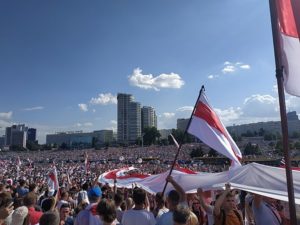
The Western-backed Belarusian opposition has failed to topple President Alexander Lukashenko, who is still firmly supported by Russia. Three months after the Eastern European country held controversial presidential elections, anti-Lukashenko opposition groups still hold protests all over the country, although once massive demonstrations, involving some 100,000 protesters taking to the streets, are now dying down to several thousand. Belarus, located in the heartland of Eastern Europe, lies north of the embattled Ukraine, east of Poland and Lithuania, and west of Russia, and has been the scene of yet another East-West confrontation over energy routes to Europe, with Russian Foreign Minister Sergey Lavrov accusing Belarusian opposition figures based in neighboring Poland and Lithuania of trying to destabilize the country.
Russia’s efforts to keep Belarus (which, translated, means white Russia) in its orbit goes back decades. After the dissolution of the Soviet Union, Belarus declared its independence in 1991. The country started its transition from communism to a market-oriented economy and changed its Soviet flag and symbols to those that were used during the short-lived Belarusian People’s Republic that existed from 1918 – 1919. Also, Belarus gradually started turning to the West. However, the situation changed in 1994 when Lukashenko won the first national elections held in Belarus since the nation seceded from the Soviet Union. He has been in power ever since and has been relatively successfully balancing between Russia and the West.
On August 9, according to Belarus’s Central Election Commission, Lukashenko won his fifth term with 80 percent of the vote. His major rival, Svetlana Tikhanovskaya, received about 10 percent of the vote, which triggered large-scale protests in Belarus. Tikhanovskaya, as well as other opposition figures, accused Lukashenko of rigging the election. Most European Union member-states did not recognize Lukashenko’s victory and have recently imposed sanctions on the Belarusian leader and his allies. Neighboring Lithuania went so far as to recognize Tikhanovskaya as the Belarusian President. However, all these actions did not result in the overthrow of Alexander Lukashenko.
Tikhanovskaya fled Belarus after reportedly receiving threats in the aftermath of the election. Previously, Belarusian authorities arrested another prominent opposition figure – Viktor Babariko, a former banker, who spent 20 years working for the local unit of Russia’s Gazprombank. He was accused of siphoning $430 million out of Belarus in money-laundering schemes. In early September Maria Kolesnikova, who became one of the faces of the mass protests, was also arrested. At this point, the entire Belarusian opposition is either exiled, or behind bars. At the same time, Lukashenko is playing a divide and rule card. He is trying to form a “systemic opposition” in Belarus based on a Russian model where three out of four parties in the Russian Parliament are nominally opposition, even though they almost never criticize President Vladimir Putin. That is why Lukashenko recently paid a visit to the banker, Viktor Babariko, and other political prisoners still kept in jail. It is believed that he needs support from Babariko ahead of the coming constitutional changes, which is something that the Kremlin firmly insists on.
The Energy Factor
Over the years, Belarus and Russia have had numerous oil and gas disputes. The Kremlin has been providing cheap energy to its ally, subsidizing the Belarusian Soviet style-economy for two decades.
Toward Freedom for more