
by SYED NOMANUL HAQ
 Progressive writers (left to right) Sibte Hasan, Faiz Ahmed Faiz, Hameed Akhtar and Ahmed Nadeem Qasmi
In one of his ghazals, Mirza Ghalib provokes us in the dancing sparks of his poetic craft:
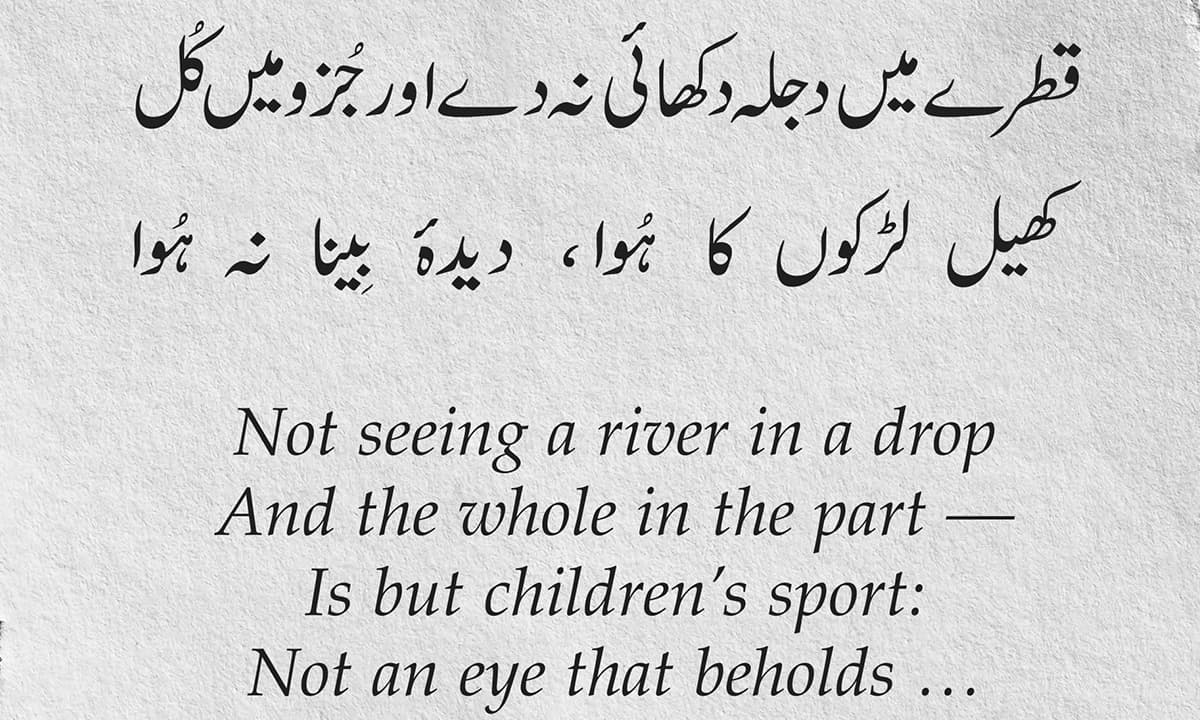
This provocation, rich in its cosmic thrust and embodied as it is in a telltale wit and a commanding grip on the Urdu idiom, served as a philosophical inspiration for Faiz Ahmed Faiz — a young incarcerated Faiz.
Writing the preface to his poetry collection Dast-e Saba (Hand of the Breeze) from Hyderabad’s Central Jail in 1952, Faiz pondered on this verse, and in the course of his explication articulated the core literary doctrine of those we call progressive writers —
“Had Ghalib been living in our own times, in all likelihood some critic would have shouted out saying that he has insulted children’s games; or that he seems to be a supporter of propaganda in literature — since issuing an instruction for the poet’s eye to see a river in the drop is explicit propaganda.
“A poet’s eye is concerned, so would the censure go, with beauty and beauty alone … and this business of seeing or showing rivers in drops may well be the trade of a philosopher or a sage or a politician; it is not the calling of a poet …
“But fortunately or unfortunately, the art of poetry (or any art for that matter) is not children’s sport … A poet or a writer must not only see the river in the drop, he is equally required to make others see it. And more, if Ghalib’s ‘river’ is taken to mean the totality of life and the cosmic system of all that exists, then the writer too is himself a drop of that river.
This means that in partnership with innumerable other drops, on his shoulders falls also the responsibility to set and determine the direction of this river, its flow and figure, and its destination.”
Faiz was a ranking member of the All Pakistan Progressive Writers’ Association that held its first meeting in 1947 at the YMCA Hall in Lahore, with Ahmed Nadeem Qasmi serving as its secretary.
But before steering into factual history, let us attend to the pithy and eloquent pronouncement of Faiz — a pronouncement that constructs for us the very philosophical backdrop against which the checkered story of progressive writers is played out.
Herald for more