
by ALI CROSBY
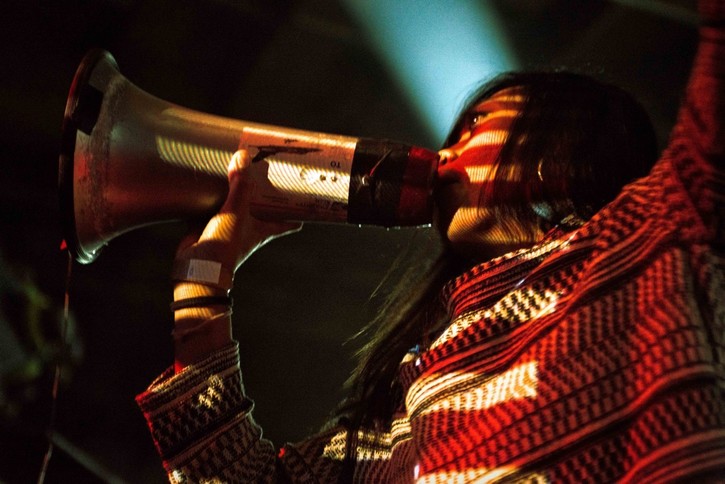 Hip hop artist Nova on the bullhorn PHOTO/Miguel-Edwards/Nova Ruth
An interview by Ali Crosby
As a young woman living in Malang, East Java, Nova decided to become a hip hop artist and use music to fight for social and environmental justice. Looking around her, there weren’t a whole lot of mentors, as this was a pretty unique path. Nova’s roots are musical, and singing has always been part of her life. But her combination of local culture and language with global genres is unprecedented.
Nova’s father is Totok Tewel, a Javanese rock music legend. While she spent periods of her life resisting his influence, choosing very different musical genres with which to experiment, his music has always been part of her life.
In 2000, she began rapping as one half of the band Twin Sista, who were represented in Perang Rap Compilation (2002), Poetry Battle #1 as part of Les Printemps Des Poètes (2007), Gang Festival (2008) and Ilmu Festival (2010).
Nova now collaborates in the global electronic group Filastine, with Spanish American artist Grey, whom she met in 2008 on a stop in Indonesia on the way to an Australian tour. They are sought-after performers, travelling between Europe, Java, America, and sometimes Australia.
Despite her jet-setting, Nova has never left her local roots. As a solo act, as well as with Filastine, she regularly performs at activist events and festivals, such as the Festival Mata Air (2009, 2011, 2014, 2016). At such events, she appeals to large and diverse audiences by remixing the romance of Javanese folk music with the audio-visual poetry of contemporary electronic music.
In 2012, Nova and Filastine released a video clip of the song ‘Genjer-Genjer,’ banned after 1965 for its associations with the Indonesian Communist Party (https://www.youtube.com/watch?v=Y_XS_2Hni8w). The translation of this video from Javanese to Indonesian to English demonstrates the importance to young people in Indonesia today of reconsidering the way history has been written in their country.
I first met Nova when she came to Sydney for the Gang Festival, an artist exchange that began in 2005. We then worked together at EngageMedia and remained friends. We made this interview in a mix of Indonesian and English emails over June and July.
Are you a feminist? Can you talk about what being a Javanese feminist means?
Yes. Because I want gender equality, but I prefer not to label myself. It’s not easy, for example, when I was 19, I went out a lot to make music and came back home really late. The neighbourhood talked about me and judged my family because a young woman is not supposed to get home too late. Also the guys who were still up and on the street would whistle when I passed them. Not feeling secure is part of gender inequality. But, I also like to cook and I cook more than my partner and never consider that as un-feminist, while it is clearly a form of gender inequality too. The typical Javanese role of women is ‘dapur, sumur, kasur’, which means that a woman looks after the kitchen, the well, and the bed. Although there are a lot of myths about women’s strength and intelligence, like the story of Rara Jonggrang (the princess who overcomes heartbreak) or Ken Dedes (the first queen of Singhasari), I think every Javanese woman should realise the strength given by their ancestors.
Can you describe the way your music circulates?
It always circulates in an underground way. But the underground music scene isn’t as small as you might think. The songs I wrote from Twin Sista to Filastine all have a certain activism, which is environmental and social justice activism, which means my listeners mostly are artists or activists or both. My music is not really easy to digest musically, especially the music I make with Filastine. Before I joined Grey, I thought his music was from the future and I still think this sometimes. As part of Twin Sista, I took part in big public festivals, sometimes on the main stage, but most of the time we are at the ‘other’ music stage because Filastine’s music is not so easy to describe in a program. We also play in warehouses and squats.
Inside Indonesia for more