
by BENEDICT ANDERSON
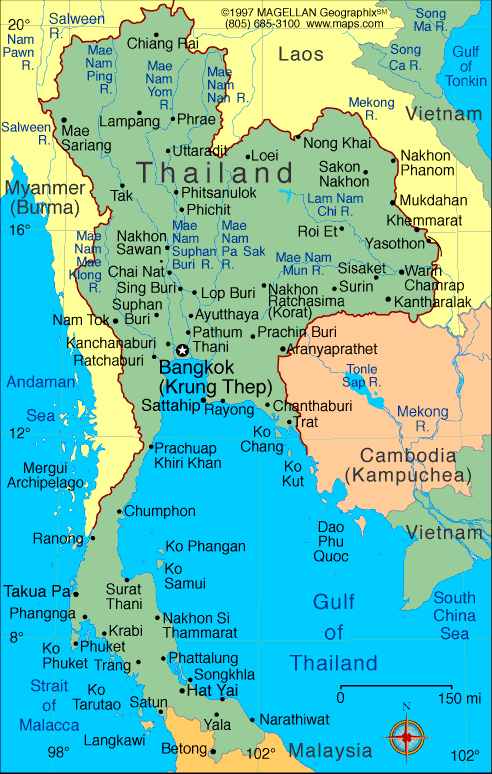 Map of Thailand MAP/Info Please
As a boy, I was fascinated by Sherlock Holmes. [1] He took drugs, of course—very shocking—but he was extremely clever. I was struck by what he said to Watson, who was rather dim: ‘When you’re searching for the solution to a problem, don’t look at what you can see. Look at what you can’t see.’ When I became a scholar and a teacher, the first thing I would tell my students was: ‘Look at what’s in front of you, but think about what is missing.’ And then some very interesting things start to happen. In the struggle for political power in Thailand between the Reds and the Yellows—which has been going on for fifteen years, getting hotter and hotter, more and more violent, with huge mobilizations and heated oratory—I noticed something that was missing.
The language used by both sides is very ugly. For example, Yingluck Shinawatra, Thailand’s first female prime minister, was always called a prostitute by the Yellow Shirts, who said she was very stupid and just a puppet for her brother, Thaksin. [2] The labels applied to men are equally harsh: reptile, idiot, gangster, homosexual, traitor, coward, dirty dog, corrupt, uneducated—all kinds of things. But there is one word that doesn’t appear, even though it’s rather mild: jek. This is the old expression for an overseas Chinese. If you are in the Thai countryside, you will see signs that say ‘nice jek restaurant’, and nobody is upset about it, although the rich, bourgeois Sino-Thais don’t like to use the term. So why is it not part of the political discourse? Strikingly, another term has become very popular in the last thirty years or so: lukchin, which means son or child of a Chinese. Students and intellectuals who belong to the Chinese diaspora have begun asking to be referred to in this way. Thailand is full of minorities, fifty or sixty at least, but they never call themselves child of this or child of that.
Journalists and scholars, both foreign and local, have put forward a number of explanations for the hatred and the violence of Thai politics: it is a struggle between dictatorship and democracy, conservatives and populists, monarchists and republicans, honesty and corruption—or between one class and another. These explanations are partial at best, and none of them captures the whole truth. Another theory speaks of Bangkok arrogance pitted against the rest of the country, which certainly has something to do with it. But in itself this cannot explain the most striking aspect of the whole political struggle, which is the regional distribution of support for the Reds and Yellows. The south is completely in the hands of the latter; Bangkok is also solidly Yellow; but the north and north-east of Thailand are Red strongholds. There is no explanation in terms of class conflict that can truly account for this polarization, and it has nothing to do with democracy either. Commentators do not talk about this regional dimension, even though it has been evident for a long time.
An encounter during a visit to Thailand encouraged me to think about this question. I was travelling to the airport in Bangkok; the taxi driver was an elderly Chinese man from the local Chinatown. We began talking about the political situation, and I asked him who he supported. He said, ‘Of course, I support Thaksin’, the leader of the Reds. Was it because he liked his policies, his attempts to provide greater social support, health care for the poor and so on? ‘No, the reason I support him is because he is a Hakka like me. We Hakkas are the only honest people in Thailand today. We work very hard, we had the courage to fight against the Manchu, we didn’t torture the feet of our women, we’re not pretentious.’ [3] I then asked his opinion of Abhisit Vejjajiva, the leader of the Yellow camp, whom he dismissed as a ‘goddamn Hokkien’; members of this group were lazy and not to be trusted in their dealings with others. My driver was equally hostile to Sondhi Limthongkul, another very important political figure. [4] ‘He is Hailamese. Those people are so dirty, they never even wash; they’re ignorant, stupid and cruel.’ At this point I plucked up the courage to ask him about the King: ‘He is a Teochew, and they are opportunists who always suck up to people more important than them. They are cowards, who only came here because they could not land in Vietnam or Indonesia or the Philippines.’ Finally I asked him what he thought about the rural Thai. ‘They are nice people, but they are quite different from the Chinese; they are happy as long as they have good food to eat, plenty of alcohol, and plenty of sex. They have no politics.’ ‘Doesn’t this mean’, I said, ‘that your view of Thai politics is like the Romance of the Three Kingdoms—the classic Chinese novel of feuding warlords.’ [5] He agreed that it was. So the four main players in Thai politics all came from one or another of the Chinese diaspora groups, and my taxi driver hated three of them, but not his fellow Hakka, Thaksin. [6] This led me to wonder about the identity of the overseas Chinese in Thailand, and where exactly they fit into Thai society.
New Left Review for more