
by AKIO TANAKA
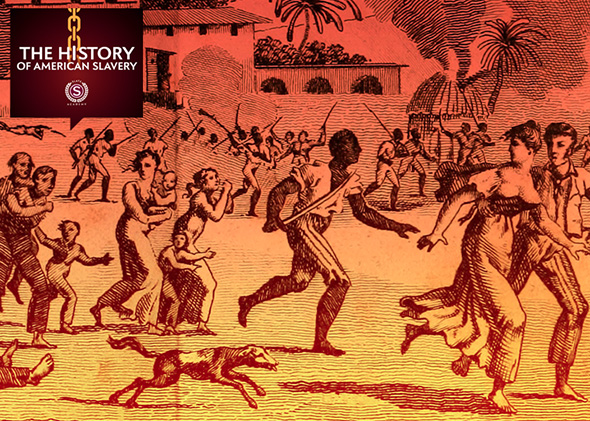 Burning of Cape Francais during the Haitian Revolution ILLUSTRATION/Lisa Larson-Walker/Wikimedia Common/Slate
A narrative for the ‘Global Warming Timeline’ chart
Prologue
The Age of Enlightenment ushered in revolutions in France and the US, but the revolution that really threatened the dominant global order was the revolution mounted by the slaves of French Haiti in 1804. In response to the revolt France and the US, a nation founded on slave labor and appropriated Indian land, joined forces to suppress the Haitian revolution. The US has intervened militarily in Haiti repeatedly since 1804, most recently in 2010 to maintain the lowest sweat-shop wages in the hemisphere.
The Age of Industrialization began with the inventions of the steam engine at the end of the eighteenth century and the internal combustion engine at the end of the nineteenth century. However, both coal and oil produce carbon dioxide which contributes to global warming. With the exponential growth in the world population over the past hundred years there has been corresponding exponential increase in the global temperature which is threatening the ecological survival of the planet.
During the last century the industrialized world was divided between two competing economic systems: Communism led by the Soviet Union and Capitalism led by the United States.
In 1989 the Soviet Union collapsed, and the United States saw it as a victory of Capitalism over Communism. The Democratic Party joined the Republican Party’s full embrace of the corporate agenda, and the corporations felt empowered to seek profits with absolutely no regard for the consequences to Earth and all its life forms. The US became a corporate-military empire using its military to secure oil for its oil based economy.
The world urgently needs an alternative to the radical ecological destructiveness of capitalism and the global warming of oil based economy.
Although Haiti has been under the US boot for two hundred years, another narrative was taking place next door just 100 miles south of the US.
Cuba had also been under the US boot since the Spanish American War in 1898, but in 1959 Cuba staged a socialist revolution, removed the US backed dictator Battista, and aligned with the Soviet Union. The Cuban government went on to provide resources of education and health care for its people that are unsurpassed in the hemisphere, but their economy was based on oil like the rest of the industrialized world.
Cuba was getting its oil from the Soviet Union, so when the Soviet Union collapsed Cuba lost its source of oil. It was a time of extreme hardship, but instead of cutting back on social programs, Cuba developed an economy based on sustainable organic agriculture and in the process managed to create a post peak oil economy and thus help stem global warming. They are creating a society based on environmental socialism.
Capitalism and Globalization
During the Gilded Age, 1865-1901, the corporation became the dominant form of business organization in the US, and the financial elements in the large centers owned the government. The US also became an Imperial Power in 1898 after the Spanish-American War during which they acquired the Philippines, Puerto Rico, Guam and Cuba.
Theodore Roosevelt tried to steer the Republican Party in the direction of Progressivism, including trust busting and increased regulation of businesses, but the country reverted back to free market ways after his administration. The 1920’s was a decade of increased consumer spending and economic growth fed by laissez faire economic policy. The resulting overproduction of goods and the speculation on the Stock Market led to the Crash of 1929.
The Depression which followed the Crash of 1929 was severe and prolonged, and to counter the threat being mounted by Bolshevik forces, the business community allowed FDR to propose legislations to put limits on business and measures to help the public. These were the measures that had been championed by progressives since the 1890’s: the Glass-Steagall Banking Act ’33 separated commercial banking from investment banking, the Security and Exchange Commission ’34 regulated the stock market, the Telecom Act ’34 created the FCC to regulate the airwaves, the Social Security Act ’35 and the Farm Security Act ’37 assured some measure of economic security for the workers and the farmers, and the Wagner Act ’35 legalized the Unions that were being organized by the workers. President Roosevelt’s also introduced public works programs, WPA and CCC, to put unemployed workers to build the physical infrastructure of the country.
[Atom Bomb – The imperialistic ambitions of several nations led to World War I (1914-18) and World War II (1939-45) which saw the development of the atomic bomb. Subsequently other nations developed the atomic bomb as an insurance against being blackmailed. 65 years later mankind is minutes away from total annihilation by the 20,000 nuclear warheads on operational alert.
University of Massachusetts-Boston for more