
by DAVID HOELSCHER
 IMAGE/Amazon
In the years since the so-called “New Atheism” burst onto the scene in the mid 2000s, the movement has not lacked for critics among nonbelievers and agnostics. Until recently, however, few of them wrote books on the subject. Of those who did, apparently the only ones who focused on the cultural and sociopolitical aspects of the movement were Chris Hedges (When Atheism Becomes Religion: America’s New Fundamentalists, Free Press, 2009—first published as I Don’t Believe in Atheists: The Dangerous Rise of the Secular Fundamentalist, Free Press, 2008) and Terry Eagleton (Reason, Faith, and Revolution: Reflections on the God Debate, Yale University Press, 2009). As those dates suggest, it’s been a good while since we’ve seen anything new in this vein.
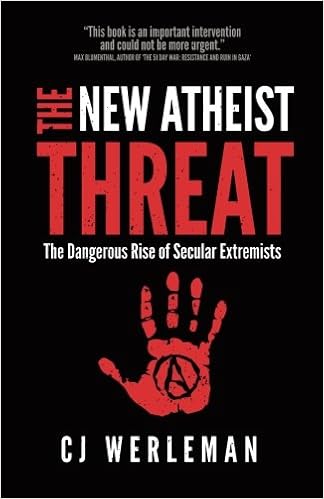
All of a sudden, though, two new titles have recently hit the market. In September, Dangerous Little Books released CJ Werleman’s The New Atheist Threat: The Dangerous Rise of Secular Extremists (280 pages). In October, Oxford University Press published Stephen LeDrew’s The Evolution of Atheism: The Politics of a Modern Movement (262 pages). Although differing dramatically in style and tone, these studies have much in common both thematically and in terms of sharing one hugely important flaw (discussed below) likely to go unnoticed by most readers. Both books are essential reading for anyone seeking to better understand the waywardness of a large chunk of the atheist movement.
CJ Werleman
CJ Werleman is an Australian journalist, polemicist, and political columnist currently living in the United States. Author of several anti-religion books, formerly a speaker in demand on the atheist conference circuit, Werleman was for a time a popular figure within the atheist movement. Recently though, after realizing that New Atheism is itself a dangerous species of fundamentalism, he became a staunch and vocal critic.
Werleman defines New Atheism as “evangelical atheism,” or, as he emphasizes elsewhere “evangelical anti-theism.” It is the conviction that religion is the leading source of problems around the world, and thus “is an obstacle to creating human perfection and a Western civilization utopia.” Werleman insists, as Hedges did before him, that the New Atheists are “secular fundamentalists.” They display a cultish commitment to science, a childishly simplistic view of religion, a severely bigoted stance toward Islam, and a slavish faith in what they take to be “the beneficent U.S. secular state.”
The book contains 11 chapters. In the first five, Werleman tells the story, in sometimes impressively self-deprecating manner, of his journey from religious indifference to New Atheism to pluralistic accommodationist. He provides much useful information about the insularity, anti-intellectualism, tendency toward groupthink, and anti-religious bigotry that characterize large swaths of the New Atheist firmament. In the remaining chapters, Werleman focuses on the New Atheists’ obsession with Islam, the motivations of violent Muslim extremists, and how New Atheist writings and speeches serve as useful propaganda instruments for everyone from Islamic terrorists to the Israeli government to the managers of the U.S. empire and its burgeoning homeland security complex.
Werleman convincingly demonstrates that the Islam that so troubles the New Atheists, particularly its most popular luminaries, Richard Dawkins, Sam Harris, and the late Christopher Hitchens, is a cartoonish caricature of the real thing as conceived and practiced by most Muslims; that the motivations of Islamic terrorists are mostly sociopolitical and economic rather than religious; that in its lack of concern for the welfare of Palestinians, in its inability “to see Palestinians beyond their Muslimness,” New Atheism “is a completely illiberal secular ideology”; and that New Atheist discourse provides public relations support for American imperialism and contributes to a climate of fear and resentment leading to increased harassment of and violence against Muslim Americans.
There are missteps. A minor but notable one is Werleman’s reference to the Tamil Tigers, the former revolutionary terrorist group in Sri Lanka, as “Marxist.” They were not Marxist and never claimed to be. A more serious problem is Werleman’s habit of letting long quotations—many are a third of a page or more—do too much of his work for him. Another is his claim that New Atheism has “become a pro-white supremacy movement.” Werleman discusses the work of several scholars and journalists who make an intriguing case that, in the manner in which it “others” Muslims, New Atheist rhetoric on Islam amounts to racism. But this racialization of a selected group would seem to lack White Supremacy’s universal application and rabid focus on skin color. If New Atheism promotes or supports the structural aspects of white privilege in the U.S.—and I believe that it does—then the term (i.e. White Supremacy), as defined in critical race theory, would seem to apply. But Werleman does not discuss structural racism in the U.S., or the socioeconomic aspects of religiosity and secularism among people of color, or atheism as it relates to those subjects.
Counterpunch for more