
by KANYA D’ALMEIDA
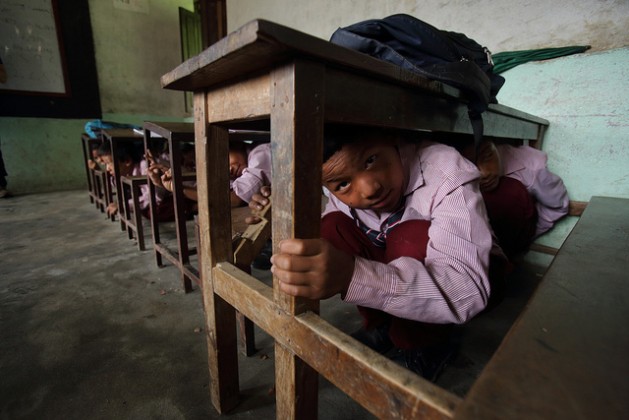 School children in Nepal’s Matatirtha village practice an earthquake drill in the event of a natural disaster. A 7.8-magnitude earthquake in Nepal on Apr. 25, 2015, has endangered the lives of close to a million children. PHOTO/Department of Foreign Affairs and Trade/CC-BY-2.0
“Nepal owes 3.8 billion dollars in debt to foreign lenders and spent 217 million dollars repaying debt in 2013.”
— Jubilee USA Network
The death toll has now passed 3,300, and there is no telling how much farther it will climb. Search and rescue operations in Nepal entered their third day Monday, as the government and international aid agencies scramble to cope with the aftermath of a 7.8-magnitude earthquake that struck this South Asian nation on Apr. 25.
Severe aftershocks have this land-locked country of 27.8 million people on edge, with scores missing and countless others feared dead, buried under the rubble.
With its epicenter in Lamjung District, located northwest of the capital, Kathmandu, and south of the China border, the massive quake rippled out over the entire country, causing several avalanches in the Himalayas including one that killed over 15 people and injured dozens more at the base camp of Mt. Everest, 200 km away.
The United Nations says Dhading, Gorkha, Rasuwa, Sindhupalchowk, Kavre, Nuwakot, Dolakha, Kathmandu, Lalitpur, Bhaktapur and Ramechhap are the worst affected areas. In total, 35 out of 75 districts in the Western and Central regions of the country are suffering the impacts of the quake and its severe aftershocks.
Questions abound as to how this impoverished nation, ranked 145 out of 187 on the United Nations Human Development Index (HDI) – making it one of the world’s Least Developed Countries (LDCs) – will recover from the disaster, considered the worst in Nepal in over 80 years.
One possible solution has come from the Jubilee USA Network, an alliance of over 75 U.S.-based organisations and 400 faith communities worldwide, which said in a press release Monday that Nepal could qualify for debt relief under the International Monetary Fund’s (IMF) new Catastrophe Containment and Relief Trust (CCR).
Inter Press Service for more