
by PRIYAMVADA NATARAJAN
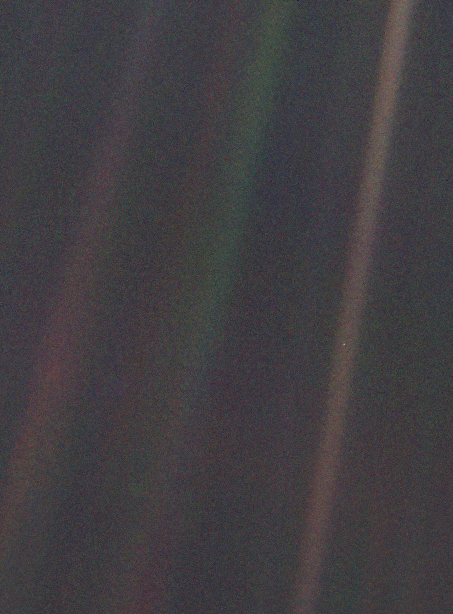 Seen from about 6 billion kilometers, Earth appears as a tiny dot (the blueish-white speck approximately halfway down the brown band to the right) within the darkness of deep space IMAGE/Wikipedia
Cosmigraphics: Picturing Space Through Time

You Are Here: Around the World in 92 Minutes—Photographs from the International Space Station
Interstellar
The Science of Interstellar
It was Carl Sagan who suggested that Voyager 1 take a look back and photograph the earth as the probe hurtled on its quest into deep space, beyond our solar system, where it remains today. Inspired by this image, Sagan mused in his book Pale Blue Dot: A Vision of the Human Future in Space (1994): “Look again at that dot. That’s here. That’s home. That’s us.” He ended by saying, “Every saint and sinner in the history of our species lived there—on a mote of dust suspended in a sunbeam.”
Sagan’s lyricism was intended to foster a timeless connection between all past and present inhabitants on earth. Masterful in his use of astronomical imagery to engage the public with science, he is best known for his thirteen-part television series Cosmos, which was first broadcast on PBS in 1980. It has since been viewed by over 500 million people in sixty countries. Many generations of scientists since then were brought to science by Cosmos.
The widely publicized image of the earth as a pale blue dot floating in space began a revolution in the perception of our planet. Photographic images of the night sky taken from the earth and satellite images taken from space, looking back at earth as well as looking outward into the solar system and beyond, continue to be an important source of the public’s knowledge about the cosmos. Consider, for example, the first photographic images of the full earth taken by the lunar orbiter in 1966, the famous image of the Horsehead Nebula taken from the Anglo-Australian Observatory by the astrophotographer David Malin, and Michael Benson’s images—some manipulated by computers—made from photographs taken from space probes in his book Beyond, which have provided stunning visual evidence of our place in the solar system and shaped our notions of space.
The New York Review of Books for more