
by DHIRU SONI, AHMED SHAIKH, ANIS KARODIA, and JOSEPH DAVID
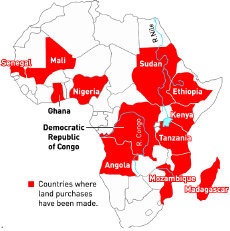 MAP/Farm land Grab
The new wave of ‘looting’ of land and other natural resources will likely continue on a scale hitherto unknown. Whatever the supposed benefits of this trend, urgent attention ought to be turned to the thousands of people in Africa and other emerging nations who will become landless in the countries of their birth.
Recently, at a Journal Club meeting, we had occasion to read and critically analyse an excerpt from William Dalrymple’s new book, ‘The Anarchy: How a Corporation Replaced the Mughal Empire, 1756-1803’. The book apparently is expected to be published next year. While the article provided a critical overview of the brutal British exploitative history in India, it alerted the reader to the fact that it was not the British Government per se that was responsible for ‘looting’ the riches of India, but a corporate named the ‘East India Company’. This does not in any way suggest that Britain can deny its complicity in the ‘raiding’ of India. Dalrymple, poignantly and eloquently reminds the reader of the ‘hurt’ that is still felt in India when the ‘loot’ is displayed in the form of art works or artifacts in a foreign land that was for all intentions and purposes a ‘right royal marauder’.
…
It is, therefore, against the broad canvas of Dalrymple’s provocative expose that the land question in Africa is contextualised. The African land question is replete with issues of increasing landlessness, insecure tenancy, eviction and conflict. Portrayed against the backdrop of African Land Tenure and Foreign Land Ownership, commonly referred to as Land Grabs, this article raises questions as to whether such a phenomenon poses a threat or provides opportunity for sustainable development in Africa. More specifically, our thesis contends that the current land acquisitions by foreign investors have put the land question in Africa back on the global development agenda and also argues that land ownership and land use in Africa is a highly contentious, yet emotive, and worthy of critical analysis.
The concept of land is complex and incorporates many different aspects. Even when land is narrowly defined as a question of control over agricultural and pastoral land (rather than rights to natural resources such as water, minerals or forests, which are linked to, and to a large degree, embedded within the question of land rights), the land question is multi-dimensional, with economic, political, social and spiritual dynamics – it is as one civil society activist put it, “When someone loses their land not only do they lose their livelihood, but they also lose their identity”.
During the period 2007 to 2008, when the food insecurity crises pervaded the globe, the land question took on a new meaning and direction. Africa became the new frontier for global food and agro-fuel production. Currently, billions of dollars are being mobilised to create the infrastructure that will connect more of Africa’s farmland to global markets, and billions more are being mobilised by investors to take over those farmlands to produce for foreign markets.
Pambazuka News for more