
by BINOY KAMPMARK
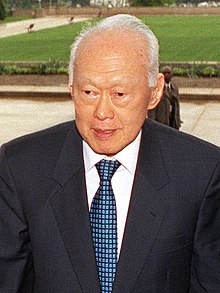 Singapore’s first Prime Minister Lee Kuan Yew (1923-2015)(1959-1990) PHOTO/Wikipedia
“If you can’t think because you can’t chew, try a banana.”
– Singapore statesman Lee Kuan Yew, BBC, Jul 5, 2000
You never hear the end of it. The “Singapore miracle”, the fabulous Asian city state, a model of development and wealth creation encrusted with “Asian values”, corporate innovation and transparent governance. “Prosperous, orderly, clean, efficient, and honestly governed,” noted The Economist, though it had to concede that it was not only the work of the late Lee Kuan Yew.
The 91-year-old Lee, statesman spectacular, was the “geostrategist”, the “wise man of the East”.[1] For many citizens, he was the “father”, a “king”.[2] Margaret Thatcher expressed her admiration for his clarity of vision. He led Singapore at a time of crisis, having seen its eviction from the Malaysian Federation in 1965. Vulnerable to being swallowed up, devoid of natural resources, he imposed on Singapore a model of development that would make its way into manuals on economic management.
Such commemorative tributes do little to find in Lee the idiosyncratic racist, the cultural theorist, the humourless strong man of all views Singaporean – because any of his views were obviously deemed good views. (Forced laughter was always a feature of audiences listening to Lee’s at times eccentric articulations.)
…
As Barr points out, Lee believed in three additional factors in his Weltanschauung: “medieval scientism” with its emphasis on “ductless glands in determining a person’s and a people’s drive to achieve”; Lamarck’s view of evolution; and “a belief in culturally-based eugenics and dysgenics”.[4]
While meritocracy may well have been the most stressed feature of his policy drive, Lee did not shy away from believing in superior races and values, funneled through his view of a racial hierarchy. “The Israelis,” for instance, “are very smart… the rabbi in any Jewish society was often the most intelligent and well-read, most learned of all.” Good genes always count. “That’s how they multiply, the bright ones multiply. That sums it up.”
…
In contrast, the Malays were somewhat lower in the pegging order, suffering a range of cultural “deficits”. They did not have, for instance, the “X-factor” in terms of development, though Lee, in the usual muddle over race and culture, decided to emphasise one over the other depending on his audience. When it came to the “Bell curve” on intelligence, he was convinced in claiming that “blacks on average score 85 percent on IQ and it is accurate, nothing to do with culture. The whites score an average 100. Asians score more.”[6]
The paradox of Singaporean governance does not lie in its endorsement of freedom – repressive measures cake the model and ice its functions, allowing the economic arm of existence to work the magic of numbers and gross domestic product. It rather endorses freedom in various measures, fed by way of drip and concessions, and encouragements, to the money making and investing fraternity.
Counterpunch for more