
by DAVID GRAEBER
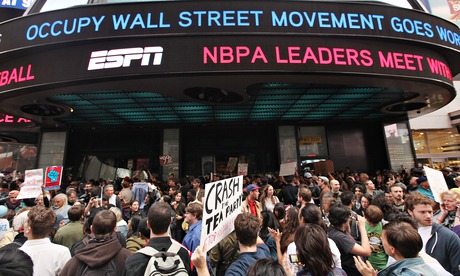 Occupy Wall Street protesters in New York’s Times Square. ‘A miserly 1% are presiding over a social order marked by increasing social, economic and even technological stagnation.’ PHOTO/Mario Tama/Getty Images
The real importance of Thomas Piketty’s blockbuster, Capital in the 21st Century, is that it demonstrates, in excruciating detail (and this remains true despite some predictable petty squabbling) that, in the case of at least one core equation, the numbers simply don’t add up. Capitalism does not contain an inherent tendency to civilise itself. Left to its own devices, it can be expected to create rates of return on investment so much higher than overall rates of economic growth that the only possible result will be to transfer more and more wealth into the hands of a hereditary elite of investors, to the comparative impoverishment of everybody else.
In other words, what happened in western Europe and North America between roughly 1917 and 1975 – when capitalism did indeed create high growth and lower inequality – was something of a historical anomaly. There is a growing realisation among economic historians that this was indeed the case. There are many theories as to why. Adair Turner, former chairman of the Financial Services Authority, suggests it was the particular nature of mid-century industrial technology that allowed both high growth rates and a mass trade union movement. Piketty himself points to the destruction of capital during the world wars, and the high rates of taxation and regulation that war mobilisation allowed. Others have different explanations.
The Guardian for more