
by NIRANJAN RAMAKRISHNAN
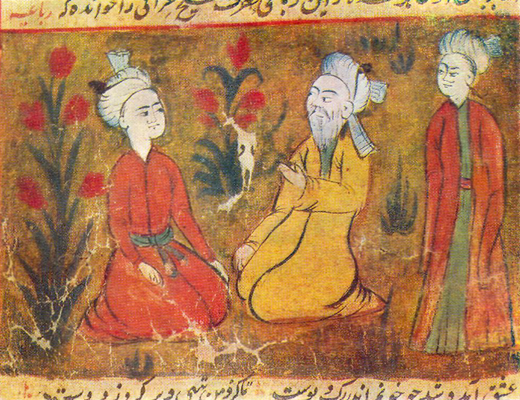 Amir Khusrow (1253-1325 CE) teaching his disciples; miniature from a manuscript of Majlis Al-Usshak by Husayn Bayqarah. SOURCE/Wikipedia
“From Ilyich to Ilyich, no stroke, no heart attack”, the Ukrainian gentleman muttered. We were chatting at a wedding reception a few decades ago. He had emigrated from the Soviet Union, and somewhere along our conversation I had happened to mention Anastas Mikoyan. He was agreeably surprised. Everyone knew of Gromyko, the poker face of Soviet diplomacy from late Stalin to early Gorbachev; few outside the USSR had heard of the old-time communist from Armenia. But Mikoyan’s was the more eye-popping high wire act. The October Revolution, Stalin’s purges, Khrushchev’s housecleaning, and Brezhnev’s putsch – he had survived and flourished through them all. Whatever else changed in the Kremlin, whether it was VI Lenin or LI Brezhnev in the corner office, the two ‘Ilyich’s my Ukrainian acquaintance was alluding to, Old Anastas had remained a Soviet fixture.
Mikoyan, who somewhat resembled Walt Disney owing perhaps to the mustache, is long gone and little noted. I remembered him suddenly last week when reading about Amir Khusrau, a multifaceted genius from 13th century India.
Khusrau (1253-1325) was a Renaissance Man long in advance of the Renaissance. Credited by some historians with inventing the sitar and the tabla, he was also a fine poet, with compositions both in the high Persian of the court and in the rough Hindi of the North Indian countryside. Khusrau is also said to have invented qawwali, a unique style of singing popularized in the West by Nusrat Fateh Ali Khan. And he introduced the ghazal poetry form to India. Khusrau was probably a pioneer too in the art of the poem-riddle, called paheli. Some say he invented the khayal and tarana styles of singing. If true he laid the foundations of Hindustani music.
Nearly 700 years after he died, his name is recognized by millions and his songs endure.
A shade less known than the literary Khusrau is Khusrau the spiritual seeker. There lived in Delhi in Khusrau’s time a famous Sufi saint and mystic, the Hazrat Nizamuddin Aulia, known far and wide for his benignity and simplicity. Khusrau was his favorite acolyte, no doubt as much on account of his poetic and musical talent as his penetrating intellect.
…
His genius can be gauged by his distillation of the Bhakti Yoga into one solitary Hindi couplet, in language accessible to the most illiterate denizen of the Indo-Gangetic plain,
Khusrau Darya Prem ka, ulti vaa ki dhaar
Jo ubara so doob gaya, jo dooba so paar
The River of Love, Khusrau, upside down is its process
He that swims goes under, he sinks in it that crosses
[my translation]
Aside from this general embrace, Khusrau wrote too of his abiding love for his spiritual master, Nizamuddin. In this vein Khusrau is portrayed as a bride whose heart, personality, and identity have all been surrendered upon a single glance by the groom, ‘Nijaam’. Somehow both the nature of the poetry, and the lack of mawkishness in the allusions, all suggest that this was nothing along the lines of the Catholic church’s travails in our time.
Besides, the mischief in Khusrau’s other poetry would indicate that he had plenty of to do without mixing spirituality and corporeal pursuits. Consider this:
Zabaan e yaar e man Turki, wa man Turki na mi daanam
Che khush boodi, gar boodi zabaanash dar dahan e man
My lover’s tongue is Turkish, and Turkish I do not know.
What a happy resolution, if her tongue were in my mouth!
Or,
Peeri o shaahid-parasti na khush ast
Khusrova taa ki pareeshaani hanooz
Old age and amorous worship go ill-together
Hey Khusrau, you still disturb this notion
Khusrau, as Nizamuddin, was from all accounts free from religious bigotry. Nizamuddin belonged to a Sufi spiritual order, and ran akhanaqah, or monastery, in what is now the heart of today’s New Delhi (the entire neighborhood is still called Nizamuddin). People from every faith thronged the shrine, as they do even today. Evidently Khusrau’s freethinking went well beyond traditional Sufi liberality. Consider these opening lines of the first poem listed on the Khusrau page in Wikipedia,
Kafir e ishqam musalmani mara darkaar neest
Har rag e man taar gashta haajat e zunnaar neest;
Love-worshiping-infidel am I, for Muslimhood I have no need
Every vein of mine girdles me, for the sacred thread I have no need;
It was perilous enough for a non-Muslim to declare that he had no use for Muslimhood; for a Muslim it was almost guaranteed to prove lethal. If in 21st century Afghanistan a man could be condemned to death on the charge of attempting to leave Islam, one can only wonder at Khusrau’s chutzpah in the early 14th. But he didn’t stop there. The final lines of the same poem reveal that it was not the prospect of democratic adoration that attracted him either. A general go-to-the-blazes spirit seems to have informed his attitude.
Khalq migoyad, ki Khusrau butparasti mikunad
Aare-aare mikunam, ba khalq mara kaar neest.
People will say that Khusrau does idol worship
Yes Yes, I do, for people I have no use.
Though Khusrau is enormously popular among qawwali singers, and several of his songs are staple concert fare, the above song is one avoided entirely, for obvious reasons.
Counterpunch for more