
by NOAM CHOMSKY
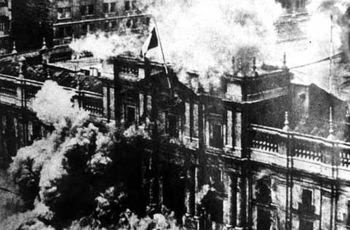 On September 11, 1973, the US supported coup led by General Augusto Pinochet resulted in a death of democratically elected Dr. Salvadore Allende. In the picture above, La Moneda Palace, the official residence of the President is under attack. Pinochet’s repressive rule lasted till March 1990. SOURCE/Liberty Moonbeam
A number of analysts have observed that although bin Laden was finally killed, he won some major successes in his war against the U.S. “He repeatedly asserted that the only way to drive the U.S. from the Muslim world and defeat its satraps was by drawing Americans into a series of small but expensive wars that would ultimately bankrupt them,” Eric Margolis writes. “‘Bleeding the U.S.,’ in his words.” The United States, first under George W. Bush and then Barack Obama, rushed right into bin Laden’s trap… Grotesquely overblown military outlays and debt addiction… may be the most pernicious legacy of the man who thought he could defeat the United States” — particularly when the debt is being cynically exploited by the far right, with the collusion of the Democrat establishment, to undermine what remains of social programs, public education, unions, and, in general, remaining barriers to corporate tyranny.
…
The First 9/11
Was there an alternative? There is every likelihood that the Jihadi movement, much of it highly critical of bin Laden, could have been split and undermined after 9/11. The “crime against humanity,” as it was rightly called, could have been approached as a crime, with an international operation to apprehend the likely suspects. That was recognized at the time, but no such idea was even considered.
In 9-11, I quoted Robert Fisk’s conclusion that the “horrendous crime” of 9/11 was committed with “wickedness and awesome cruelty,” an accurate judgment. It is useful to bear in mind that the crimes could have been even worse. Suppose, for example, that the attack had gone as far as bombing the White House, killing the president, imposing a brutal military dictatorship that killed thousands and tortured tens of thousands while establishing an international terror center that helped impose similar torture-and-terror states elsewhere and carried out an international assassination campaign; and as an extra fillip, brought in a team of economists — call them “the Kandahar boys” — who quickly drove the economy into one of the worst depressions in its history. That, plainly, would have been a lot worse than 9/11.
Unfortunately, it is not a thought experiment. It happened. The only inaccuracy in this brief account is that the numbers should be multiplied by 25 to yield per capita equivalents, the appropriate measure. I am, of course, referring to what in Latin America is often called “the first 9/11”: September 11, 1973, when the U.S. succeeded in its intensive efforts to overthrow the democratic government of Salvador Allende in Chile with a military coup that placed General Pinochet’s brutal regime in office. The goal, in the words of the Nixon administration, was to kill the “virus” that might encourage all those “foreigners [who] are out to screw us” to take over their own resources and in other ways to pursue an intolerable policy of independent development. In the background was the conclusion of the National Security Council that, if the US could not control Latin America, it could not expect “to achieve a successful order elsewhere in the world.”
The first 9/11, unlike the second, did not change the world. It was “nothing of very great consequence,” as Henry Kissinger assured his boss a few days later.
TD for more