
OAKLAND INSTITUTE
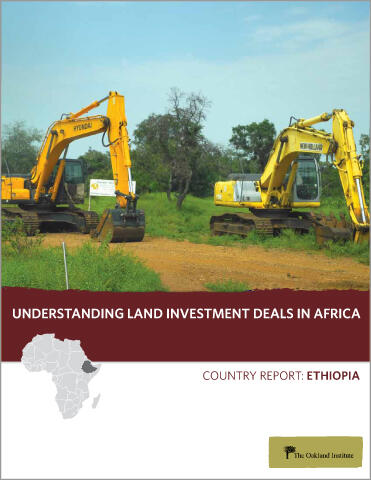
For decades, Ethiopia has been known to the outside world as a country of famine, food shortages, endemic hunger, and chronic dependency on foreign aid. Despite receiving billions of dollars in aid, Ethiopians remain among the poorest in the world. Our research shows that at least 3,619,509 ha of land have been transferred to investors, although the actual number may be higher.
About This Report
This report is part of the Oakland Institute’s (OI) seven-country case study project to document and examine land investment deals in Africa (Ethiopia, Mali, Mozambique, Sierra Leone, Sudan, Tanzania, and Zambia) in order to determine social, economic, and environmental implications of land acquisitions in the developing world.
This report is the product of a partnership between the OI and the Solidarity Movement for a New Ethiopia (SMNE). Research took place between October 2010 and January 2011 and involved field trips to the Benishangul, Gambella, and Oromia regions.
The research team conducted thorough examination of the actual agreements and the extent and distribution of specific land deals. Through field research, involving extensive documentation and interviews with local informants, multiple aspects of commercial land investments were examined including their social, political, economic, and legal impacts.
The team met with government officials, civil society, investors, and the local communities that have been impacted by land investments. People’s voices and stories appear throughout this report, but due to the sensitive nature of this issue and government’s increasing intolerance of dissent, their names and precise locations have been omitted.
OI for more