
by FAROOQ BABRAKZAI
In a mystery, the sleuth must be believably involved and emotionally invested in solving the crime. — Diane Mott Davidson
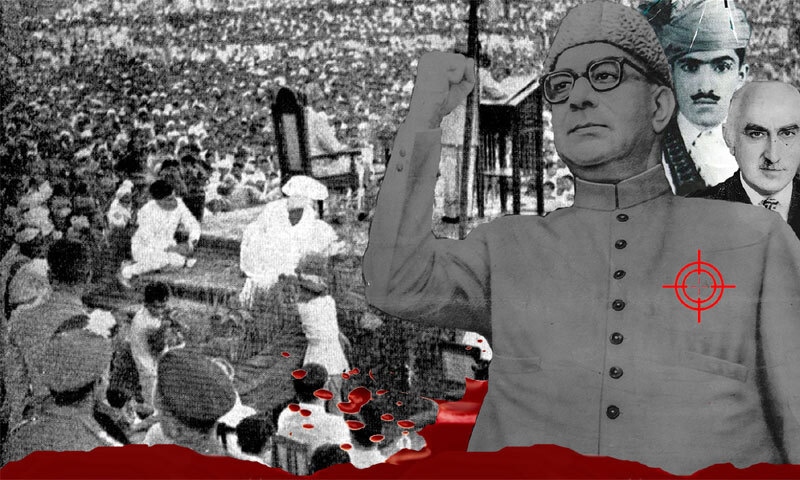
On Tuesday, 16 October, 1951, around 4 pm, the first prime minister of Pakistan, Liaquat Ali Khan, was going to address a public meeting in Company Garden in Rawalpindi. As he walked to the microphone and uttered the words“Baraadaraan-i-Millat” [Brothers of the Nation], a man named Said Akbar, sitting on the ground near the dais, fired two bullets at him in rapid succession with a 9mm semi-automatic pistol.
Chaos and mayhem suddenly erupted in the meeting. Khan Najaf Khan, the Deputy Superintendent of Police who had personally supervised the security arrangements, yelled in Pashto, “Who fired the shots? Shoot!”. Within seconds, a police inspector, Mohammad Shah, came running with his service revolver drawn and shot Said Akbar five times at close range, in such a haphazard manner that he missed one shot altogether.
As Said Akbar was lying on the ground dying, he was also stabbed more than 26 times with spears by Muslim League volunteers. The recording equipment of Radio Pakistan was on and captured the sounds of the firing and the chaos for one minute and 13 seconds, and then fell silent. The entire shooting episode ended within 48 seconds. The recording is available online. Liaquat Ali Khan was taken to the Combined Military Hospital, where he succumbed to his injuries.
The assassin, Said Akbar, was my father, who had come to Rawalpindi from Abbottabad on 14 October.
One of Pakistan’s founding fathers and the country’s first prime minister was assassinated at a public gathering 74 years ago. Despite the formation of an Inquiry Commission and two other police investigations — one by Scotland Yard — until today, there has been no satisfactory closure regarding those tragic events. Now, the son of the assassin has penned his own investigation into the events in the shape of a book, which provides, for the first time ever, his family’s perspective as well as delves into the weaknesses of the official accounts and spans Pakistan’s tumultuous history — from the first war over Kashmir, the Rawalpindi Conspiracy and internal friction within the new state’s functionaries. Eos presents, with permission, excerpts from The Assassination of Liaquat Ali Khan: 1947-1952 by Farooq Babrakzai, published by Vanguard Books…
Intelligence failures
Neither the CID (Criminal Investigation Department) nor the police personnel had any prior knowledge of Said Akbar’s presence in Rawalpindi, let alone at the public meeting. All police and CID claims about keeping Said Akbar under surveillance in Rawalpindi for three days prior to the murder, upon close examination, turned out to be false; stories that were fabricated after the tragedy. No CID or police official was able to establish Said Akbar’s identity in the public meeting
Dawn for more