
by SAMEER RAHIM
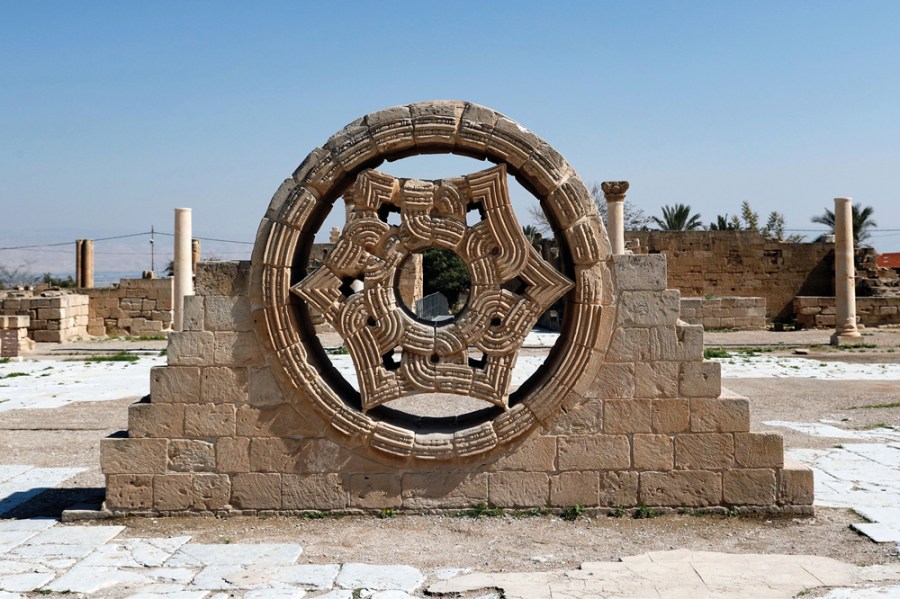
Just north of Jericho lie the impressive remains of an Umayyad-era palace. When I visited Khirbat al-Mafjar (also known as Hisham’s Palace) in 2018, its psychedelic mosaics were, sadly, covered up. Instead, my eye was caught by a stone-carved rose window with a six-pointed star and hollow circle in the middle. The window had been reconstructed from 106 fragments scattered during an earthquake, which probably took place shortly after the palace was built in the eighth century. Originally, the window would have been placed somewhere high up, allowing streams of light to illuminate the caliph and his courtiers. I was immediately reminded of the rose windows in gothic cathedrals and wondered whether there was any contact-point between this Muslim palace and the Christian architecture of the Middle Ages.
Diana Darke has been pondering this question for many years. As she writes in Stealing from the Saracens: How Islamic Architecture Shaped Europe, ‘my entire life could be viewed as an apprenticeship for writing this book.’ Her argument is simple: what we think of as quintessentially European sites – a French cathedral, for instance, or a Venetian palace – have been fundamentally shaped by the ‘Saracen’ or Islamic world. (Sometimes Darke says the Middle East, a significant slippage.) She was provoked into taking up her pen after the Notre-Dame fire in April 2019. As troublemakers spread rumours online that the conflagration had been started by a Muslim, or that this terrible accident symbolised the death of Christian civilisation, Darke published a blog titled ‘The heritage of Notre-Dame – less European than people think,’ in which she explicitly connected the famous rose windows of the cathedral with the one at Khirbat al-Mafjar. For good measure, she also suggested that gothic arches, ribbed vaulting and church spires were all ultimately derived from Muslim models. That blog has now been turned into the book under review.
Apollo for more