
by ANGUS MCNELLY
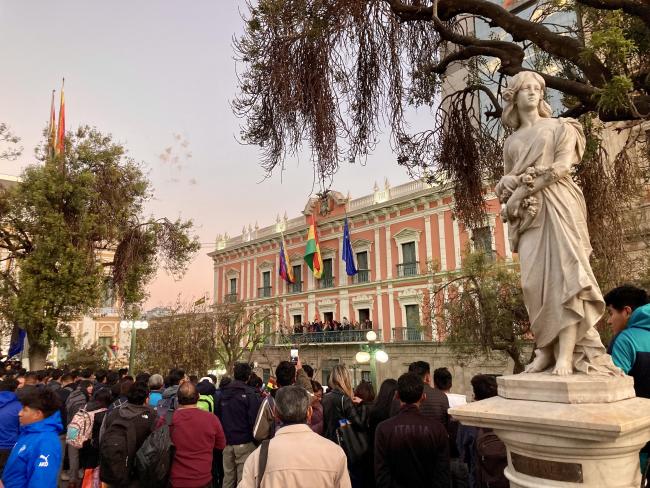
A general and his troops stormed the seat of government in an apparent coup attempt. Three theories have emerged in a context of economic turmoil and political infighting within the ruling party.
On Wednesday, June 26, at 2:30 pm local time, tanks stormed La Paz’s Plaza Murillo, the center of government in Bolivia. The President Luis Arce’s administration labeled the incursions, led by the commander of the Army, General Juan José Zúñiga, “irregular mobilizations.” The spark for the military’s actions was the removal of Zúñiga from his post the previous day, following his televised June 24 comments about former president Evo Morales. “[Morales] can no longer be president of this country,” Zúñiga stated, adding that he would not allow “the constitution to be trampled, to disobey the mandate of the people.”
As soldiers filled the plaza, Zúñiga told the press that the Armed Forces “wanted to establish democracy.” “There will be a new cabinet of ministers… our state cannot continue like this,” Zúñiga added. “We want to recover our homeland. [We have had] enough of the impoverishment of our homeland.”
Armored vehicles then rammed the doors of the historical presidential palace, known as the Palacio Quemado. In an extraordinary scene that would not have been out of place in a telenovela, President Arce faced down the leader of the so-called coup plot. An air of tension descended upon the sister cities of La Paz and El Alto. People left their jobs early, and long queues formed outside gas stations and cash machines. The Bolivian Workers’ Central (COB), the leading trade union in the country, and the peasants confederation, the CSUTCB, announced a national strike, and people took to the streets in the city center, marching towards Plaza Murillo.
At around 5:00 pm, Arce addressed the Bolivian people from the Casa Grande del Pueblo, the seat of the executive. “The country today is facing an attempted coup d’état… We need the Bolivian people to organize against the coup d’état, in favour of democracy,” he said. “We cannot allow coup attempts to take Bolivian lives. We want to urge everyone to defend democracy.” He appointed a new military high command, with José Sánchez as commander of the Army, Gerardo Zabala the commander of the Air Force, and Renán Guardia the commander of the Navy.