How to learn nothing from crisis

by DOUG HENWOOD

(This is the edited text of a talk given by LBO editor Doug Henwood at the Studies in Political Economy annual meeting in Ottawa, January 29, 2010.)

Greetings from the USA, where a populist rebellion is underway. Let’s take its measure.

First, for a moment it looked like Ben Bernanke faced rough sledding in his bid for a second term as chair of the Federal Reserve. In the run-up to the confirmation vote, a swelling roster of Senators of both parties said they wouldn’t vote for him. Of course, when it was over, he won, 70–30—a squeaker as these things go, but a landslide by any reasonable standard.

One reason for Bernanke’s unpopularity: he failed to acknowledge, much less deflate, the housing bubble back in 2005. Right, up to a point, but had he raised interest rates or cracked down on the availability of mortgage credit he would have faced…a populist outcry. American populists love nothing more than easy credit and rising house prices. But another reason for his unpopularity: pumping billions—trillions, if you’re an aggressive counter—into the financial system after the bubble burst. If he hadn’t done that, we’d all be wearing barrels. He could have done it more transparently and justly, but the principle of pumping aggressively to avert deflationary collapse has been pretty well established since the Fed didn’t do that in the early 1930s. Populists used to love the idea of an elastic currency to prevent depressions, but now that the leading avatars of populism wear teabags on their heads, austerity is their favorite strategy.

Another sign of the populist insurgency is the new tone struck by the Obama administration—hostile to the banks. It’s not for real, but let’s forget that for now. The reason for the populist turn is, of course, the victory by Scott Brown in the special election to fill the Senate seat vacated by Teddy Kennedy. That victory seemed to overturn the laws of nature—the seat had been held by a Kennedy, first John then Teddy, from 1953 through 2009. (There was a two-year interregnum, filled by a placeholder, until Teddy ripened to the Senatorial minimum age of 30.) Imagine the shock when the dull, complacent Martha Coakley, who deemed campaigning on the chilly streets of Boston beneath her, lost the seat that seemed the Democrats’ birthright.

Brown—a man who once posed nude for Cosmo, whose wife appeared in a music video suggestively squirting suntan oil, and whose daughter did a stint on American Idol—isn’t your standard issue Moral Majority-style candidate. But he does appeal to that other strain of populist rebellion, the Tea Baggers (or did—until he betrayed them by voting for a weak jobs bi

Upsurge! It’s amazing that amidst our worst economic crisis since the Great Depression, most of the dissent is coming from the right. Despite watching 8.5 million jobs disappear, much of the population has been passive while the bankers got billions and the jobless got an average of $305 a week in unemployment benefits—if they were lucky. Unlike the 1930s, there’s been no….

Left Business Observer for more

March in Review (Canada, Part I)

by DOMINION STAFF

Women and immigrant support groups criticized the Canadian Border Service Agency (CBSA) for raiding a Toronto women’s shelter to apprehend “Jane,” a single mother who says she left Ghana to escape violence. A representative of the Ontario Association for Interval and Transition Homes said that while CBSA agents had previously waited outside shelters to stop women, this was the first time they had been known to enter.

The Canadian government released its 2010-2011 “austerity” budget. Though the budget declares the government’s economic stimulus program a success, it was criticized for not including more stimulus funding, for opening up economic sectors to foreign ownership (seen as a path to de-regulation) and for ignoring the need for a more flexible employment insurance program.

In his response to the Speech from the Throne, Prime Minister Stephen Harper said the Canadian government “will take steps to endorse [the United Nations Declaration on the Rights of Indigenous Peoples] in a manner fully consistent with Canada’s Constitution and laws.” Canada was one of only three countries to vote “no” to the non-binding agreement when passed by the UN General Assembly in 2007.

Dominion for more

Games prey on your mind – Internet addiction in South Korea

by CHRISTOPHER CALDWELL

Kim Yoo-chul and Choi Mi-sun had been on the run for months – allegedly for doing something unspeakable – when they were arrested last week in Gyeonggi province in South Korea. Mr Kim, 41, and Ms Choi, 25, were ardent internet users. They met online. They had a baby. But becoming parents did not temper their computer habit. They grew fascinated with an online game called Prius, which allowed them to raise a virtual “child” called Anima. In the interests of their virtual child they neglected their real one. Last September they returned from a 12-hour session at an internet café to find their baby dead of starvation.

Financial Times for more

(Submitted by reader)

Four Friends – Save the First Nations University of Canada

Please help us save and support First Nations University of Canada. Send this video to FOUR Friends and also go to First Nations University to print the letter of support and send it to your MP, Indian Affairs or the Prime Minister.

WE NEED YOUR SUPPORT TO SAVE OUR SCHOOL

“Everything that I’ve ever achieved in my life was made possible because someone believed in me and my right to an education,” Ignatieff told a crowd of students that assembled to hear him speak.

“The least I can do is to repay that faith by standing with you to defend this extraordinary institution which is unique in Canada, unique in the world… its destruction is an act of folly which we must stand together and fight.”

Joanne Arnotte

Explanation of Urdu Poet Ghalib’s verses 56th installment, in three scripts: Urdu, Gujarati & English.

by ASGHAR VASANWALA

Madhubala

This is my 56th installment. I have received excellent response from lot of friends, both Urdu and non-Urdu speakers. Please know that this is my own, Asghar Vasanwala’s, work and not a forwarding of someone else’s work as some you thought. Please forward this to your friends. Also, please send me your comments/complements. I will appreciate if you forward me email addresses of your Urdu/non-Urdu friends.

Here are today’s verses (she’r) & its explanations in Urdu, Gujarati, and English.

For reading in Urdu Script Click

This is the 4th verse of Ghalib’s 18th ghazal.

Vaa-e divangi-e-shouq ke har-dam mujh ko
Fie, my love-obsession; under your pressure, every moment
Aap jana udhar, aur aap hi heraN hona
I hasten to her lane for her glimpse, but return bewildered.

Vaa-e = Fie, divangi-e-shouq=love obsession, love madness har-dam = every moment, in every breath, Udhar=that side, towards her HeraN= Perplexed, confused, bewildered
Continue reading “Explanation of Urdu Poet Ghalib’s verses 56th installment, in three scripts: Urdu, Gujarati & English.”

Remembering Hari Sharma (a letter)

Dear Friends: It is with heavy heart I read that Hari Sharma has passed away.

Personally, I had a great admiration for Hari as an author, professor, activist and a great human being. His book (co-edited with Kathleen Gough), Imperialism and Revolution in South Asia, opened many facets of political understanding for me as a young student from Pakistan in the USA around early 1970s. I remember having heated discussions with him and many other associates during the formation of IPANA. He was an avid supporter and contributor to Pakistan Progressive which was published for many years. When I lived in Vancouver BC, during the mid 1980s, I had a chance to see him occasionally and enjoyed his company and got exposed to his relentless activism. Until recently, he was active in many causes and kept up with his struggles for human rights and equality for all. It is through some of his ideas that personally I got inspired to work for the Los Angeles based South Asian Network (SAN) and with other communities.

He will certainly be missed by all, especially those who care about human struggle towards creating a decent society regardless of age, gender, religion, or caste and class. Hari Sharma’s loss for us is only highlighted when we get to know him what he was and when he is not amongst us.

I hope that some one from the new generation will pick up his books and his thoughts to carry on the much needed struggle.

In Solidarity,

Asad Zaidi

A Matter Of Timing

by URI AVNERY

The Government of Israel insulted the Vice President of the United States, Joe Biden, one of the greatest “friends” of Israel and spat in the face of President Barack Obama. So what?

Some weeks the news is dominated by a single word. Last week’s word was “timing”.

It’s all a matter of timing. The Government of Israel has insulted the Vice President of the United States, Joe Biden, one of the greatest “friends” of Israel (meaning: somebody totally subservient to AIPAC) and spat in the face of President Barack Obama. So what? It’s all a matter of timing.

If the government had announced the building of 1600 new housing units in East Jerusalem a day earlier, it would have been OK. If it had announced it three days later, it would have been wonderful. But doing it exactly when Joe Biden was about to have dinner with Bibi and Sarah’le – that was really bad timing.

The matter itself is not important. Another thousand housing units in East Jerusalem, or 10 thousand, or 100 thousand – what different does it make? The only thing that matters is the timing.

As the Frenchman said: It’s worse than criminal, it’s stupid.

THE WORD “stupid” also figured prominently last week, second only to “timing”.

Stupidity is an accepted phenomenon in politics. I would almost say: to succeed in politics, one needs a measure of stupidity. Voters don’t like politicians who are too intelligent. They make them feel inferior. A foolish politician, on the other hand, appears to be “one of the folks”.

Outlook for more

Student Protests in Dominican Republic Shut Down Universities

by DAVID HOLMES MORRIS

Eight injured, several jailed amid charges students were armed

Tear gas filled the air and classes were suspended at universities in San Francisco de Macorís and Santo Domingo, in the Dominican Republic, during student protests on Thursday and Friday, March 11 and 12, primarily over physical conditions at the medical and engineering schools in San Francisco de Macorís, in the northeast of the country.

The Frente Estudiantil de Liberación Amin Abel (FELABEL — Amin Abel Student Liberation Front) was expelled from the campus of the Universidad Autónoma de Santo Domingo (UASD — Autonomous University of Santo Domingo) on Friday after federal authorities and university administrators announced they had discovered a cache of arms, including machine guns, rifles and hand grenades, in a basement room on the UASD campus used by the student group. Members of FELABEL, denying any responsibility for the weapons, said they had been planted by authorities to discredit the group and to distract attention from the aims of their protests.

In connection with the weapons, agents of the National Police arrested three student activists and the head of the UASD employees’ association, Ángel Osiris Torres, in a hospital waiting room where they had gone to visit Engel Rodríguez, who had been shot, reportedly by the National Police, during a demonstration at UASD on Thursday. Rodríguez was not himself involved in the demonstrations.

Upside Down World for more

Respect difference, says Koehler, at Islamic art premiere in Berlin

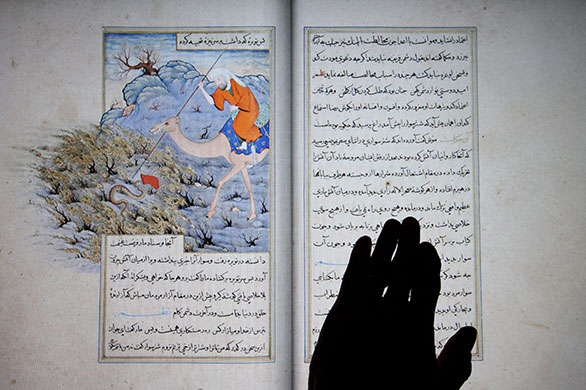
A touch-sensitive screen showing the Anvar-i-Suhayli (Lights of Canopus) collection of 15th century fables. PHOTO/Sean Gallup/Getty Images. Guardian for more photos

Berlin – German President Horst Koehler called Tuesday for people to respect one another’s differences, at the Berlin opening of the Aga Khan exhibition, which includes some of the world’s most important Islamic art.

‘To admire the art of another, it is first necessary to respect what the other person thinks and feels,’ Koehler said, expressing his hope that the exhibition would encourage a cultural dialogue, ‘which respects otherness.’

The exhibition comprises around 200 items from the Aga Khan’s world famous art collection, including paintings, drawings, manuscripts, ceramics and wood carvings, spanning more than 1,000 years of Islamic cultural history.

Monsters and Critics for more