
by ASGHAR VASANWALA
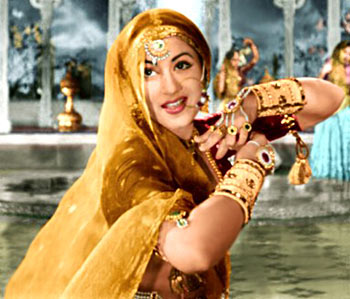 Madhubala
This is my 56th installment. I have received excellent response from lot of friends, both Urdu and non-Urdu speakers. Please know that this is my own, Asghar Vasanwala’s, work and not a forwarding of someone else’s work as some you thought. Please forward this to your friends. Also, please send me your comments/complements. I will appreciate if you forward me email addresses of your Urdu/non-Urdu friends.
Here are today’s verses (she’r) & its explanations in Urdu, Gujarati, and English.
For reading in Urdu Script Click
This is the 4th verse of Ghalib’s 18th ghazal.
Vaa-e divangi-e-shouq ke har-dam mujh ko
Fie, my love-obsession; under your pressure, every moment
Aap jana udhar, aur aap hi heraN hona
I hasten to her lane for her glimpse, but return bewildered.
Vaa-e = Fie, divangi-e-shouq=love obsession, love madness har-dam = every moment, in every breath, Udhar=that side, towards her HeraN= Perplexed, confused, bewildered
Meaning:
Ghalib says, “My love obsession has made me miserable. Under its pressure, I hasten to her lane for a glimpse and return perplexed and disappointed. I know her glimpse is impossible to have; so, why do I try again and again?” This is nothing but my obsession with her; under its insistence, I go to her lane repeatedly and return disappointed.
Finer aspects: In this verse, Ghalib has portrayed his love obsession; it is a beautiful portrayal. He describes how he is caught between his impulse to see her and the fact, it is unattainable. His disappointment touches our hearts. This verse also applies to those celebrity-fans who yearn meeting their diva or hero, but cannot.
In this verse, Ghalib has used word “Har-dam”. It means ‘every moment’ as well as ‘in every breath’. If we apply, the second meaning “In every Breadth”, the verse becomes a Sufi thought. See explanation below.
Ghalibologists’ opinions:
“Taba’ Tabaee’s opinion: “Har dam” means in every breath. So, Ghalib says, “In every breath I run towards my Lord, my creator, but in the next moment I return failed. I regret and lament my helplessness.”
Jalwa az bas ke taqaza-e-nigah karta hai
Her dazzling appearance demands attention of all
Johar-e-aaina bhi, chahe hai mizgaN hona
Even scratches in mirror want to become eyelashes, for witnessing her.
Jalwa = manifest, dazzling presence taqaza=insistence, demand taqaza-e-nigah = demanding attention, Johar-e-aaina=scratches in mirror.
In olden times, mirrors were hand polished or manually silvered; that left scratches in mirror. Ghalib could be talking about hand polished metal mirror.
Meaning:
In this verse, Ghalib says, “Dazzle of my sweetheart’s beauty is overwhelming. It commands all to watch. Obeying that command, mirror becomes eyes and its scratches become eyelashes.”
Finer aspects:
In this verse, Ghalib has presented a very delicate subject. It demands our “wow!” Here, Ghalib has given life and admiration to even scratches of mirror. Why not? Mirror has absorbed his beloved’s image; so, everything in mirror becomes beauty to him.
Ghalibologists’ opinions:
Saha’s and Saeed’s opinion: in quest of viewing your beauty, even scratches of mirror yearn becoming eyelashes.
Aasi’s opinion: Because her beauty commands everyone to watch her, so, when mirror absorbed her view, scratches in mirror transformed and started acting like eyelashes. Or, under effect of her dazzling beauty, scratches became eyelashes.
This is the 2nd verse of Ghalib’s 18th ghazal.
Ishrat-e-qatl-gahe ahl-e-tamanna mat puchh
How can I describe jubilation among lovers, in killing ground?
Eid-e-nazzara hai sham-sheer ka uryaN hona
Is it just a bare sword in her hand? No, it is an Eid crescent, a Cause célèbre for all joyous vistas of world
Ishrat = joy, jubilation Qatl-gah=killing arena, killing ground ahl-e-tamanna=craving lovers, Eid = celebration, joy nazzara=scene Sham-sheer=(curved) sword UryaN = bare, out from sheathe
Meaning:
In this verse, Ghalib presents a scenario when a crowd of craving lovers is out on a killing ground, eager to be beheaded by their sweetheart. They are eager because death at her hand is fulfilling; as they will be so close to her on their last breath. So, when she drew her sword from sheathe, lovers went jubilant as if her curved sword were an Eid crescent. Ghalib says, “Please do not ask me to narrate this jubilant scene; I have no words. However, I can say this much: the scene was an all time event; this Jubilation was like a crescent moon for the festivities of world, a cause de célèbre” Ghalib has likened sword with Eid crescent because her sword is thin and curved like a new moon.
Please note that Urdu poetry is about symbols. Beloved’s eyebrows are sword shaped; they pierce hearts of lovers. Even her eyes are called killing arrows/swords. If we interject eyes and eyebrows into this verse, meaning becomes a different realm.
Finer aspects:
In this verse, Ghalib calls lovers “hopeful group”; and, the scene of sighting her sword and ensuing jubilation as crescent moon for the festivities of world, a cause de célèbre.
Those ready to lay their lives for their religion, their country, or their cause enter battlefield with similar fervor. When swords brandish, they see them as Eid crescent and become jubilant because they believe within moments they will wear martyrdom crown.
In battlefield of Karbala, companions of Imam Hussein gave their heads fighting against falsehood, with similar fervor and jubilation.
If following in Gujarati script is not readable because it may not have Unicode fonts, please click this link and read. Link is virus free.
Asghar Vasanwala can be reached at asgharf@att.net