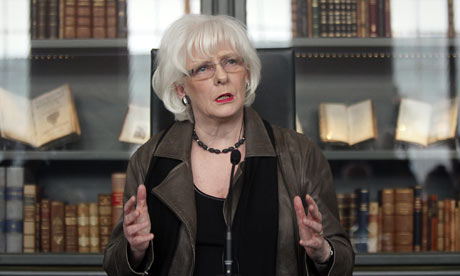
Iceland: the world’s most feminist country

Johanna Sigurdardottir, prime minister of Iceland. PHOTO/Bob Strong of Reuters

by JULIE BINDEL

Iceland has just banned all strip clubs. Perhaps it’s down to the lesbian prime minister, but this may just be the most female-friendly country on the planet

Iceland is fast becoming a world-leader in feminism. A country with a tiny population of 320,000, it is on the brink of achieving what many considered to be impossible: closing down its sex industry.

While activists in Britain battle on in an attempt to regulate lapdance clubs – the number of which has been growing at an alarming rate during the last decade – Iceland has passed a law that will result in every strip club in the country being shut down. And forget hiring a topless waitress in an attempt to get around the bar: the law, which was passed with no votes against and only two abstentions, will make it illegal for any business to profit from the nudity of its employees.

Even more impressive: the Nordic state is the first country in the world to ban stripping and lapdancing for feminist, rather than religious, reasons. Kolbrún Halldórsdóttir, the politician who first proposed the ban, firmly told the national press on Wednesday: “It is not acceptable that women or people in general are a product to be sold.” When I asked her if she thinks Iceland has become the greatest feminist country in the world, she replied: “It is certainly up there. Mainly as a result of the feminist groups putting pressure on parliamentarians. These women work 24 hours a day, seven days a week with their campaigns and it eventually filters down to all of society.”

Guardian for more

Joothan: A Dalit’s Life in India

by NAMIT ARORA

A review of a memoir by an ‘untouchable’ starting in the 1950s in rural Uttar Pradesh, India.

I grew up in the central Indian city of Gwalior until I left home for college. This was the 70s and 80s. My father worked as a textile engineer in a company town owned by the Birla Group, where we lived in a middle class residential quarter for the professional staff and their families. Our 3-BR house had a small front lawn and a vegetable patch behind. Domestic helpers, such as a washerwoman and a dishwashing woman, entered our house via the front door—all except one, who came in via the rear door. This was the latrine cleaning woman, or her husband at times. As in most traditional homes, our squat toilet was near the rear door, across an open courtyard. She also brought along a couple of scrawny kids, who waited by the vegetable patch while their mother worked.

3 Quarks Daily for more

Greek: Dynasty of Priestesses

by ETI BONN MULLER

Evidence of a powerful female bloodline emerges from the Iron Age necropolis of Orthi Petra at Eleutherna on Crete

For a quarter century, Greek excavation director Nicholas Stampolidis and his dedicated team have been unearthing the untold stories of the people buried some 2,800 years ago in the necropolis of Orthi Petra at Eleutherna on Crete. Until now, the site has perhaps been best known for the tomb its excavators dubbed “A1K1,” an assemblage of 141 cremated individuals, all but two of whom were aristocratic men who likely fell in battle in foreign lands. Excavated between 1992 and 1996, this elaborate rock-cut tomb was brimming with fantastic burial goods that date from the ninth to the seventh century B.C., including bronze vessels, gold and silver jewelry, and military regalia, as literally befits the burial of Homeric war heroes. Now, two unprecedented discoveries since 2007–three lavish jar burials that contained the remains of a dozen related female individuals and a monumental funerary building where a high priestess and her protégés, also all related, were laid to rest–are adding to our knowledge of Eleutherna’s women, and forcing the scholarly community to reevaluate their importance and role in the so-called “Dark Ages” of Greece (see “Top 10 Discoveries of 2009”).

Archaeology fore more

Turkish Premier: ‘There can be no talk of genocide’

THE SPIEGEL

In a Spiegel interview, Turkish Prime Minister Recep Tayyip Erdogan, 56, discusses Ankara’s relationship with the European Union, the debate over genocide against the Armenians and his role as a mediator in the dispute over Iran’s nuclear policy.

SPIEGEL: Mr. Prime Minister, your country is currently giving a confusing impression. It is more modern and open than it was before you came into office, and yet it is also more pious and Islamic. Where are you taking Turkey: toward the West, toward Europe or toward the East?

Erdogan: Turkey has changed considerably and has been modernized in the last seven-and-a-half years. Unlike previous governments, we take the founder of the republic, (Mustafa Kemal) Atatürk, at his word and are trying to bring the country to the level of contemporary civilization. In doing so, we look in all directions. We don’t turn our face from the East when we look to the West. We see this as a process of normalization.

Spiegel for more

The Diffusion of Activities

by PRABHAT PATNAIK

One of the striking features of the recent period has been the diffusion of manufacturing and service activities from the countries of the core to the periphery. The logic of competitive striving for the export market among the many “labour reserve” economies in the periphery leads to the accumulation of ever-growing reserves and a constraint on domestic absorption. To believe that the contradictions that emerge will disappear if only the economies with current surpluses appreciate their exchange rates is a fantasy. Such an appreciation, if it is not to reduce the level of activity in the appreciating economies, must be accompanied by an enlargement of the fiscal deficit in these economies, which means both an abandonment of the tenet of “sound finance” and increased domestic absorption entailing a retreat from the strategy of export-led growth.

MRZine for more

Vietnam: Law Leads Two Women Leaders to Different Worlds

by CHAN NGON

HO CHI MINH CITY, Vietnam, Mar 29, 2010 (IPS) – Both chose the legal profession for their career path, and both are bent on fighting for more rights for the people. But the fortunes of Vietnamese women lawyers Tran Thi Quoc Khan and Le Thi Cong Nhan cannot be more different: One enjoys prominence in the National Assembly, while the other was just recently released from jail.

Their divergent tales show two faces of courage in Vietnam, where battling for rights remains a task that has to be handled not only with passion, but also great skill.

At 51, Quoc Khanh has two decades of experience over Cong Nhan. Aside from a master’s degree in law, she holds two other diplomas, one in politics, the other in journalism. The mother of two children, Quoc Khanh began working at the Hanoi Department of Justice in 1995. By 2002, with the support of the Hanoi Bar Association and the Hanoi Fatherland Front, she had won a seat at Vietnam’s National Assembly.

Inter Press Service for more

Not much difference in Obama White House

by INGRID B. MORK

I like Al-Jazeera on the whole, as being pretty fair-minded and unbiased. Occasionally little things annoy me, such as the various presenters habit of interrupting people I find interesting, or scathing remarks by certain presenters regarding regime members in Iran. Al-Jazeera seems to have become more Americanised lately, which can be a positive thing as well as negative.

Regarding Iran. There is one person who speaks occasionally as an expert on the situation there. I just can`t remember his name offhand. He speaks calmly and knowledgeably without getting angry or flustered. He is a proffessor at Tehran University. (I think his name is Mirandi.)

What I wish to talk about now is Clinton.

I would have watched Inside Story yesterday were it not for being subjected to the sound of the Clinton woman, pontificating at the AIPAC (American Israeli Political Action Committee) conference on the rights of both Palestinian and Israeli children to live in peace and security. Noble sentiments indeed. I just wonder, where was her condemnation of the slaughter of hundreds of Palestinian children a year past January?

I’m afraid that I find the present trio in the White House, President Barack Obama, vice President Joseph Biden, and the Secretary of State Hillary Clinton, almost as obnoxious as the previous trio of George Bush, Dick Cheney and Condoleezza Rice.

Not only are these people directly responsible for the deaths and displacement of thousands, if not millions of innocent civilians in various parts of the world but they are indirectly responsible for the attrocities inflicted on the indigenous people of Palestine.

Combodian activist Somaly Mam talks to Roxana Olivera

PHOTO/Roxana Olivera
Her fight to end sexual slavery around the globe

Somaly Mam knows the harsh truth of the commercial sexual exploitation of children. For years she lived it from the inside. Mam was just 12 when her grandfather sold her into the sex trade in Cambodia. In the ensuing decade she was traded through brothels across Southeast Asia where she suffered unimaginable horrors. She counts herself fortunate to have escaped death at the hands of entrepreneurial pimps and brothel keepers. But, unable to forget the faces of the girls she left behind, Mam decided to rescue them. Today, she fights child sex trafficking, sexual slavery, illegal confinement and sexual violence at home and abroad.

‘I want you to know what is going on in Cambodia, in Asia and around the world,’ says Mam, speaking in New York City at an anti-trafficking rally organized by The Body Shop and ECPAT (End Child Prostitution, Child Pornography and the Trafficking of Children for Sexual Purposes). ‘Four-year-old girls are being raped. Five-year-olds are being tortured. They are being robbed of their innocence. These children are being sold, trafficked for sex… And the world somehow puts up with it.’

New Internationalist for more

Walking With The Comrades

by ARUNDHATI ROY


Gandhians with a Gun? Arundhati Roy plunges into the sea of Gondi people to find some answers…

The terse, typewritten note slipped under my door in a sealed envelope confirmed my appointment with India’s Gravest Internal Security Threat. I’d been waiting for months to hear from them. I had to be at the Ma Danteshwari mandir in Dantewada, Chhattisgarh, at any of four given times on two given days. That was to take care of bad weather, punctures, blockades, transport strikes and sheer bad luck. The note said: “Writer should have camera, tika and coconut. Meeter will have cap, Hindi Outlook magazine and bananas. Password: Namashkar Guruji.”

Namashkar Guruji. I wondered whether the Meeter and Greeter would be expecting a man. And whether I should get myself a moustache.

There are many ways to describe Dantewada. It’s an oxymoron. It’s a border town smack in the heart of India. It’s the epicentre of a war. It’s an upside down, inside out town.

In Dantewada, the police wear plain clothes and the rebels wear uniforms. The jail superintendent is in jail. The prisoners are free (three hundred of them escaped from the old town jail two years ago). Women who have been raped are in police custody. The rapists give speeches in the bazaar.

Outlook India for more

Two Responses to Arundhati Roy

by JAIRUS BANAJI

Arundhati Roy’s essay “Walking with the Comrades” is a powerful indictment of the Indian state and its brutality but its political drawbacks are screamingly obvious. Arundhati clearly believes that the Indian state is such a bastion of oppression and unrelieved brutality that there is no alternative to violent struggle or ‘protracted war’. In other words, democracy is a pure excrescence on a military apparatus that forms the true backbone of the Indian state. It is simply its ‘benign façade’. If all you had in India were forest communities and corporate predators, tribals and paramilitary forces, the government and the Maoists, her espousal of the Maoists might just cut ice. But where does the rest of India fit in? What categories do we have for them? Or are we seriously supposed to believe that the extraordinary tide of insurrection will wash over the messy landscapes of urban India and over the millions of disorganised workers in our countryside without the emergence of a powerful social agency, a broad alliance of salaried and wage-earning strata, that can contest the stranglehold of capitalism? Without mass organisations, battles for democracy, struggles for the radicalisation of culture, etc., etc.? Does any of this matter for her?

Kafila for more

by ANIRBAN GUPTA NIGAM

he last book François Furet wrote before his death in 1997 was called The Passing of an Illusion. At the very beginning of the first chapter of that book, Furet spelt out the central question driving his study:

What is surprising is not that certain intellectuals should share the spirit of the times, but that they should fall prey to it, without making any effort to mark it with their own stamp. […] twentieth century French writers aligned themselves with parties, especially radical ones hostile to democracy. They always played the same (provisional) role as supernumeraries, were manipulated as one man, and were sacrificed when necessary, to the will of the party. So we are bound to wonder what it was that made those ideologies so alluring, that gave them an attraction so general yet so mysterious.

Kafila for more

(Submitted by reader)