
Remembering Robert Fisk: Relentless truth seeker in the Middle East
by CHARLOTTE DENNETT
Robert Fisk’s death on October 30th came as a profound shock to journalists around the world, especially those who knew him. And, in a deeply personal way, it was devastating to me as well, though I never met him. I will try to explain what his truth-seeking meant to me, as a former reporter in Beirut and as someone who has shared his anguish over the horrific death and destruction that has engulfed the Middle East.
Regrettably, the first time I missed meeting him happened some four decades ago. He arrived in Beirut in 1976, a year after I l left as a refugee of the Lebanese civil war. He carried on, bravely covering that 15 year old war as well as the wars in Afghanistan, Iraq, Syria and Yemen. He seemed possessed to tell the world what the mainstream media was not reporting about the Middle East, which (I told my future husband after returning to the States), was the most censored part of the world. I would later explain why this was so while investigating the death of my father, America’s first master spy in the Middle East; in telling my own story, I would often seek out Fisk’s reportage in The Independent for insights and reliable information.
The second missed meeting happened after I watched, on October 28th, the 2019 documentary on his life by Yung Chang called This is Not a Movie: Robert Fisk and the Politics of Truth. It so moved me that I vowed to get ahold of him immediately. Alas, I missed him again. He died two days later. Sometimes, life is unfair. So, obviously, is unexpected death.
He apparently died of a severe stroke at age 74. His death comes at a time when journalism is under siege as “fake news” and in a world that needs the truth more than ever. But his loss is even greater for anyone who wants to understand what is really happening in the Middle East.
In the film, Fisk explains how as as boy he was greatly influenced by his father, who loved history and shared with his son his experiences in two world wars, with many trips to the battlesights. Fisk would go on to discover that the mysteries of the Middle East conflict could be unlocked by first studying the infamous Sykes-Picot agreement of 1916, which secretly carved up the former Ottoman Empire after World War I for French and British plunder?. Since then, the journalist/historian avers, no place on earth has suffered more than the Middle East. “The history of the Middle East,” he tells us, “is a history of war.”
Toward Freedom for more
Weeks after dying, Robert Fisk is savaged by liberal war propagandists. Why? Because he was a brave anti-imperialist
by GEORGE GALLOWAY
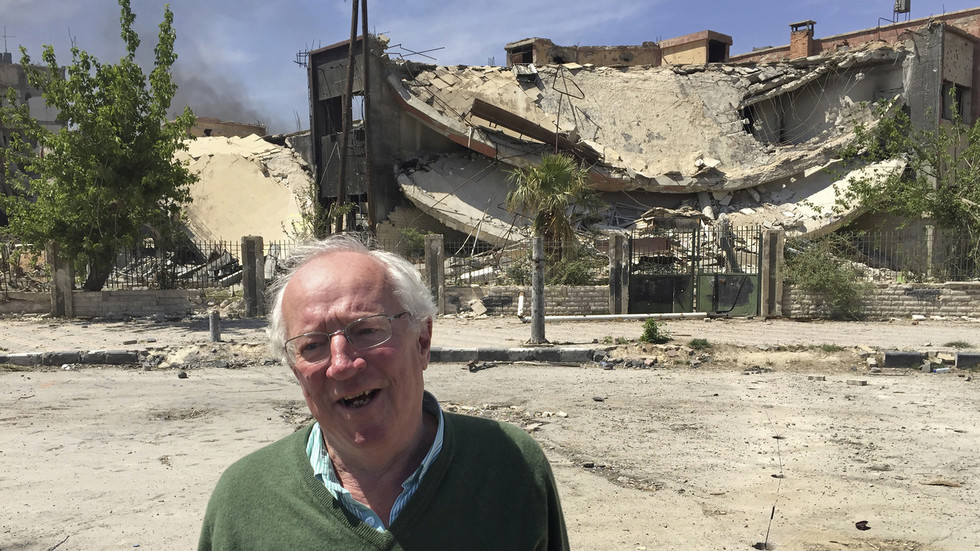
For almost 50 years, British journalist Robert Fisk single-handedly exposed the truth of the West’s wars. It’s only now he’s gone that shameful, kow-towing cowards have come out to try to smear a man who can no longer fight back.
I first fell in love with Robert Fisk’s journalism almost 40 years ago when he wore the unlikely guise of foreign correspondent for the London Times, nowadays – as it had been for centuries – the house journal of war and imperial adventure, but then playing host to that rarest of writers: unbribed, untwisted, and unguided by the missile projectors.
I had been in Beirut in 1982, with PLO Chairman Yasser Arafat, when the news came through from London that the Israeli Ambassador Shlomo Argov had been shot by the renegade terrorist Abu Nidal, who was based in Saddam Hussein’s Iraq. We both knew what would happen next. And while scarpering was the easy option for me, no such possibility existed for Arafat.
A massive Israeli invasion of Lebanon swiftly followed. It eventually, after stiff resistance (most memorably and ironically in the Crusader fortress of Beaufort Castle), smashed through the gates of the Arab capital city itself. The rest, the massacres at the Sabra and Chatilla refugee camps and all, is history.
During the siege of Beirut, Fisk introduced his readers, including me, to the use of white phosphorus by the Israeli forces. I remember almost verbatim decades later his description of how the phosphorus slowly cooked from the inside the child victims he was visiting in a Beirut hospital. Having inhaled it, it was a fire neither the victim nor the doctors could extinguish.
While the rest of the media prattled on about “terrorist targets” being attacked, Fisk, like me, knew what was actually being razed to the ground: the miserable refugee existence of generations of Palestinians marooned in camps many miles from their homes, in which foreigners now slept, waking to pick the oranges from their trees.
I had no voice then, but Fisk did, and he used it courageously, shaming most of his journalistic colleagues by so doing.
I followed Fisk to the Independent, then the great hope of those seeking, well, independent journalism. That hope didn’t last long. The Indy became just like all the rest, before being bought (then partially sold) by a former spy of the KGB in London and becoming a small, discredited website with few readers.
But we always had Fisk.
RT TV for more
Establishment Journalists are Piling on to Smear Robert Fisk Now He Cannot Answer Back
by JONATHAN COOK
Something remarkable even by the usually dismal standards of the stenographic media blue-tick brigade has been happening in the past few days. Leading journalists in the corporate media have suddenly felt the urgent need not only to criticise the late, much-respected foreign correspondent Robert Fisk, but to pile in against him, using the most outrageous smears imaginable. He is suddenly a fraud, a fabulist, a fantasist, a liar.
What is most ironic is that the journalists doing this are some of the biggest frauds themselves, journalists who have made a career out of deceiving their readers. In fact, many of the crowd attacking Fisk when he can no longer defend himself are precisely the journalists who have the worst record of journalistic malpractice and on some of the biggest issues of our times.
Set aside the fact these corporate blue ticks are citing Oz Katerji – a conman on Syria – for their assessment of Robert Fisk. These very journalists helped carry out the biggest fraud in recent journalistic history, selling you the Iraq WMD lies. They have zero credibility https://t.co/VZq8MgOQ22
— Jonathan Cook (@Jonathan_K_Cook) November 29, 2020
At least I have the courage to criticise them while they are alive. They know dead men can’t sue. It is complete and utter cowardice to attack Fisk when they could have made their comments earlier, to his face. In fact, if they truly believed any of the things they are so keen to tell us now, they had an absolute duty to say them when Fisk was alive rather than allowing the public to be deceived by someone they regarded as a liar and fantasist. They didn’t make public these serious allegations – they didn’t air their concerns about the supposedly fabricated facts in Fisk’s stories – when he was alive because they know he would have made mincemeat of them.
Most preposterous of all is the fact that the actual trigger for this sudden, very belated outpouring of concern about Fisk is a hit-piece written by Oz Katerji. I’m not sure whether I can find the generosity to call Katerji a journalist. Like Elliot Higgins of the US government-funded Bellingcat, he’s more like an attack dog beloved by establishment blue-ticks: he is there to enforce accepted western imperial narratives, disguising his lock-step support for the establishment line as edgy, power-to-the-people radicalism.
Anyone who challenges Katerji’s establishment-serving agenda gets called names – sometimes very rude ones. Fisk is just the latest target of a Katerji hatchet job against any journalist (myself, of course, included) who dares to step outside of the Overton Window. That these “serious” journalists think they can hang their defamation of Fisk on to anything said by Katerji, most especially the thin gruel he produces in his latest article, is truly shameful. If their concerns really relate to journalistic integrity and reliability, Katerji would be the very last person to cite.
Palestine Chronicle for more
Fisk had independence of mind – which is why he angered governments
by PATRICK COCKBURN
Robert Fisk and I often used to discuss the merits and demerits of responding in print to personal attacks on us filled with provable falsehoods. The temptation to refute such falsehood is hard to resist, but we recognised that therein lies a trap because even the most persuasive refutation of a gross lie necessitates repeating the untruth and giving it greater publicity.
It was also self-evident that partisan critics were not going to apologise and retire in embarrassment if their mendacity or misinformation was exposed, but would simply replace one set of lies with another. The effectiveness of this brazen disregard for truth is demonstrated daily by Donald Trump who almost won re-election despite repeated exposure.
Robert, who died on 30 October, spent almost half a century reporting war and civil wars in the Middle East and elsewhere. He understood that people who are trying to kill each other will not hesitate to lie about each other, and about anybody, notably about journalists, whose information – particularly if it is true – they deem not to be in their interests.
It was all too easy to be demonised as a pawn of Saddam Hussein in 2003 if one said, as Robert frequently did, that the Anglo-American invasion of Iraq would end badly. Similar denunciations of partiality were directed against anybody who wrote about the Syrian conflict post-2011 as a genuine civil war, described the armed Arab opposition as being mostly jihadis, and suggested that Bashar al-Assad was likely to stay as leader, given the balance of power between those fighting each other.
Governments and other proponents of such views do not like to be contradicted and will put great energy into seeking to discredit those who do so. Robert knew this very well, writing that “armies at war – like their governments – are best observed with a mighty degree of scepticism, even cynicism. So far as armies and militias go, there are no good guys.” As a reporter, he worked on this grim assumption. He did not mean that he believed that good people did not exist, but he knew that they are almost invariably to be found among the victims of violence rather than the perpetrators.
Robert was obsessively energetic in investigating the truth about what was really going on and stuck to it, even when what he was writing was contradicted or ignored by other journalists. Probably it was this independence of mind which annoyed so much of the media. Over the years, I became used to listening to reporters spluttering with indignation over another front-page exclusive by Robert. At first, I used to keep silent, reflecting that hell hath no fury like a reporter scooped, and recalling the words of a distinguished American journalist friend who dismissed such bad-mouthing of Robert as “80 per cent envy”.
UNZ for more
The Life of Robert Fisk
by RICHARD FALK & DANIEL FALCONE
In this interview, International Scholar Richard Falk provides his personal recollections of Robert Fisk. Falk explains how Fisk provided the world with well- informed perspectives that offered critical thinking and grim realities of the acute struggles stirring throughout the Middle East region. Falk comments on Fisk’s “unsparing exposure of Israeli abusive policies and practices toward the Palestinian people” indicating that his “departure from the region left a journalistic gap that has not been filled.”
Falk also discusses how the study, coverage and understanding of the Palestinian cause has shifted over the years from one of “exposing the hypocrisy and greed of the powerful” to more political and activist-centered solution based forms, within geo-political coverage. Despite this, Falk praises Fisk for “his commitments to peace, self-determination, and neutrality.”
Daniel Falcone: I can recall being amazed by Robert Fisk’s researching capabilities and stamina. In order to read both Pity the Nation and The Great War for Civilization it requires the reader to get through over 1,700 pages. Can you comment on Fisk’s reporting over the years in general as a Middle East correspondent?
Richard Falk: Fisk was a vivid writer with a startling ability to observe, comment, and interpret. In this sense, unlike the others I have mentioned with the partial exception of Gloria Emerson, Fisk could be read for literary satisfaction as well as for a kind of episodic journalistic autobiography that brought together his experience of contemporary wars and strife. What his published books establish is the extent of Fisk’s illuminating understanding of turmoil in the world, and the degree to which the blood being spilled can be traced back to European colonialism and forward to American imperial ambition in both Asia and the Middle East.
CounterPunch for more