
by KHALID ALBIAH & MARYAM AL-KHASAWNEH
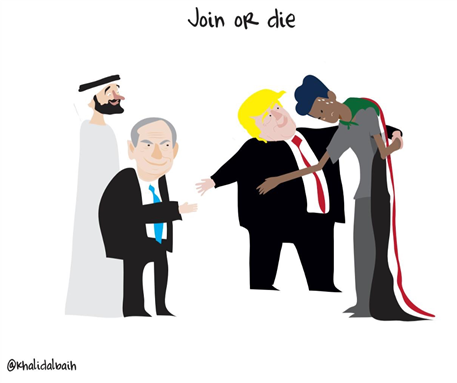
“If you can only be tall because someone else is on their knee, then you have a serious problem.”
—Toni Morrison
In the post-colonial Arab world, dictatorships have kept the people on their knees for decades, that is until the popular Arab uprisings of 2011. As a political cartoonist, the Arab uprisings changed my life. They put me and many of my fellow activists on a track toward socially-engaged work, which is, becoming more difficult to exercise with time. The recent formal UAE-Israel normalization agreement, and its repercussions for Sudan, is just another reminder that little has changed; omnipresent dictatorial systems of rule in the region never fail to remind us that the price for criticism is heavy-handed and that censorship is the most effective means by which to subdue critical, oppositional ideas. This is especially the case now when it comes to criticizing Israel and the geopolitics of its allies in the region.
In my home country Sudan, artists played a major role in the 2019 revolution that toppled the thirty-year-old authoritarian regime of General Omar al-Bashir and his allied National Islamic Front. For many observers, developments in Sudan helped kickstart the so-called “second wave” of the Arab uprisings which manifested in Algeria and Lebanon. Some anticipated that Sudan would be a new inspiration for hope and a model of inclusive governance in the region. However, the Sudanese people face many obstacles to consolidating their gains and realizing their aspirations. One is the stability and success of the transitional government, which is based on a fragile alliance between civilian groups and the armed forces. Another is the struggle to negotiate peace deals with different rebel groups around the country. Perhaps one of the most burdensome obstacles is the continuing downward spiral of the economy—itself a legacy of leftover US sanctions on Sudan which continue despite the fall of Bashir. The African Union and European Union have provided new forms of support to Sudan since the fall of Bashir. The EU aid is in large part because for it, a stable Sudan can supposedly help control the flow of Sub-Saharan refugees toward European shores. Yet despite such support, the country has been unable to recover.
As alluded to, one of the main hurdles blocking the revival of the Sudanese economy is the persistence of US sanctions resulting from the inclusion of Sudan on the US list of State-Sponsored Terrorism (STT) countries. Some claim its continued placement on the list is tied to the US request that Sudan pay 330 million US dollars in compensation to relatives of US victims of al-Qa‘ida because Bashir harbored Osama bin Laden in the 1990s. Such dynamics, are puzzling and makes one question whether Sudan is being pushed—perhaps deliberately—back toward instability.
Jadaliya for more