
The mass killings of 1965-66 in Indonesia were international, not just local, events – and the US played an important role
by BRAD SIMPSON
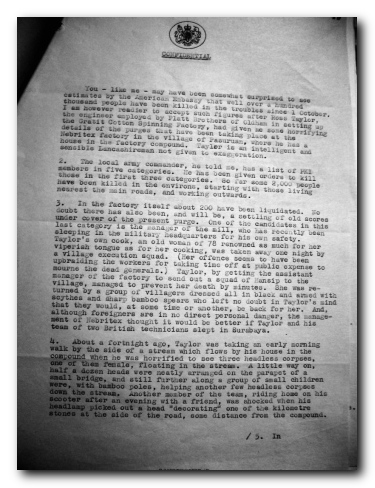 Confidential documents reveal the secrets of 1965. Brad Simpson
Recalling the mass killings in Indonesia following the 30 September 1965 movement, Howard Federspiel, the US State Department’s intelligence staffer for Indonesia, observed that ‘No one cared as long as they were Communists, that they were being butchered.’ Indeed, it is hard to find any western governments that expressed concern about what the Central Intelligence Agency (CIA) called one of the great mass murders of modern history. Far from it. Western governments, led by the United States, actively sought to create conditions that would lead to a violent clash between the army and the Indonesian Communist Party (PKI) and, once the mass killings began, offered quiet but enthusiastic support to the Indonesian army. The killings of 1965 and 1966 were, in other words, international events of global significance, as the governments that supported the army in carrying out the killings recognised.
Encouraging a violent clash
For nearly a decade preceding the events of 30 September 1965 the US feared the growing radicalism and anti-westernism of President Sukarno and the increasing political power of the PKI. These twin fears led the Eisenhower Administration into a massive and disastrous covert operation in support of the regional rebellions of 1957-1958, events that led directly to Sukarno’s abandonment of parliamentary democracy and the implementation of the authoritarian system known as Guided Democracy. Eisenhower’s successors, John F Kennedy and Lyndon B Johnson, each used programs of economic, technical and military assistance to encourage a greater role for the Indonesian armed forces in Indonesia’s economic and political life as a means of blunting or reversing the influence of the PKI.
In August 1964, as relations between the US and Indonesia deteriorated rapidly, in part due to Sukarno’s confrontation with Britain over the formation of Malaysia, the US went further, adopting a covert strategy aimed at sparking a violent conflict between the military and the PKI. In doing so the US joined Britain, which had adopted a covert warfare approach in 1963, attempting to frustrate Indonesia’s campaign to block the formation of Malaysia and, if possible, provoke ‘a prolonged struggle for power leading to civil war or anarchy’ in Indonesia itself. Officials in both countries agreed that the army was reluctant to crush the PKI unless first provoked, so the crucial question was: how do we make such a clash inevitable? Edward Peck, Assistant Secretary of State in the Foreign Office suggested ‘there might be much to be said for encouraging a premature PKI coup during Sukarno’s lifetime’ – provided the coup failed.
Inside Indonesia for more