
by CYRIL ALMEIDA
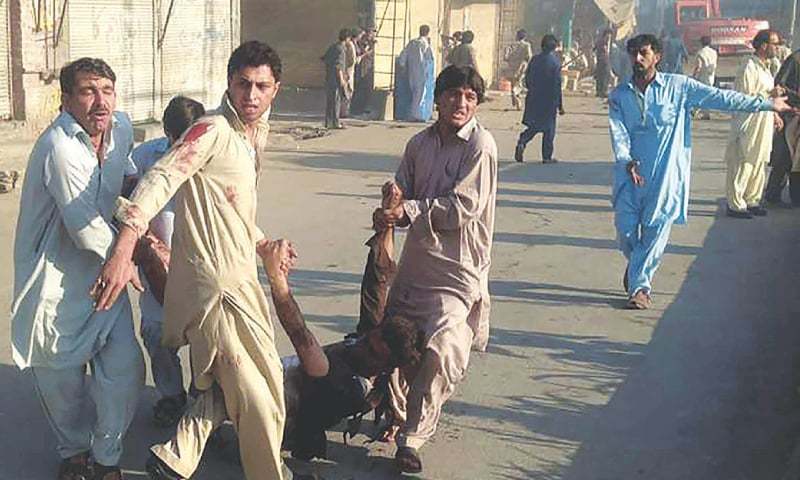 Fifty four people died and over 120 were injured in Parachinar, Quetta in Pakistan after twin blasts PHOTO/Dawn
Forget Raheel this, Bajwa that, Nawaz stupid, Imran clueless. Step back, breathe, and try and trace where this is going.
We are sinking into a militancy trap.
There’s a ghoulish metric that everyone knows, but humaneness means most deny: a big one in Parachinar or Quetta equals a small one in Karachi, Lahore or Islamabad.
Somewhere, someone knows the same. Somewhere, someone, here in this land, has decided that it’s a price worth paying — by us.
Because we’re hitting them, the militants, they can’t strike as much and as often as they did or would like.
But the pattern is clear. Occasionally, they’ll get past the defences and wreak carnage in the heartland — the east of Indus strike that rakes the maximum fear.
More often, the defences will work and they’ll have to stick with striking in the periphery — the west of Indus strike where bigger is easier and possible frequently enough to send ripples of fear nationally.
Grotesque, but relatively straightforward to chart.
But Parachinar and Quetta are also markers for something else — something the state knows, but would rather deny.
Parachinar and Quetta are shorthand for violence. If there were no militancy — no militancy of the kind the state is fighting — those areas would still be violent.
They were violent before the rise of this new militancy — the one over the last decade and a half — and, here’s the problem, they’ll probably be violent if the militancy the state is fighting disappears.
Parachinar and Quetta are violent because of state failure. Failures specific to the two places and general to the country.
And there lies the militancy trap we’re sinking in.
Assume what we’re told is true: Quetta was RAW, Parachinar, the Afghan NDS. Monsters both of them and not very hard to believe.
The bald version of why they’re doing it is that they hate us and hate the idea of Pakistan; they will not stop until Pakistan ceases to exist. They are therefore the eternal enemy.
The slightly more sophisticated version is that the militants are real — they exist independently of outside enemies — but India and Afghanistan prefer an appropriately unstable Pakistan to a meaningfully stable one.
The stronger version of that is a stable Pakistan is inimical to the interests of India and Afghanistan. The milder version is that it’s a game of reciprocity; they hit us because they think we’re hitting them.
Now take any of those theories, strong or mild, in whatever combination you like and you’re still left with:
So what?
Because of the way Pakistan is, because of the resources the state has and the ideas that flow through its people, Pakistan is — and will remain — vulnerable.
Not vulnerable in a do-as-you-please kind of way, but vulnerable in the way we’re seeing: this pattern of frequent, sometimes big strikes in the periphery and occasional, mostly small strikes in the heartland.
Let’s scratch around the RAW-NDS rabbit hole a bit more. The dirty little secret is not that Pakistan is newly vulnerable, but that Pakistan has always been vulnerable.
On India’s side, it was hesitation before — the system’s aversion to dabbling in non-states. In Afghanistan, it was chaos that prevented the coalescing of a tit-for-tat strategy.
So, if anything’s changed it’s the willingness of India and Afghanistan to do with enthusiasm now what they did reluctantly before, and their luck in finding these proxies here and now.
Terrible, awful, villainous. But that still leaves us with a question:
How do we get to zero?
From maximum militant violence, the peak between 2007-2011, we’ve arrived at the current point: the occasionally big attack in the heartland and the many, frequently big in the periphery.
Put a number on it. Let’s say we’re 70 per cent of the way there; the optimists may say 85.
Dawn for more