
by DANIEL GUTMAN
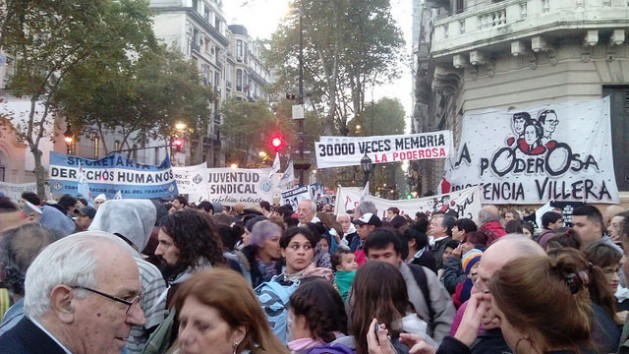 Hundreds of thousands of people poured into the Plaza de Mayo square in Buenos Aires on May 10 to protest a Supreme Court ruling that made it possible to reduce the prison sentences of dictatorship-era human rights abusers – a verdict neutralised by a new law passed by Congress on May 10 PHOTO/Daniel Gutman/IPS
What at first was terrible news that outraged a large proportion of Argentine society, who see the conviction and imprisonment of dictatorship-era human rights violators as an irrevocable achievement for democracy, became a cause for celebration a week later.
An unexpected ruling handed down by the Supreme Court on May 3 initially opened the door to hundreds of members of the military and civilians in prison for crimes against humanity committed during the 1976-1983 military dictatorship to seek a reduction of their sentences, which would in some cases even allow them to immediately be released.
However, the wave of outrage that arose in human rights groups spread in the following days throughout society, leading to changes that came about at a dizzying pace that made it unlikely for the court ruling, which applied to one particular case, to be used as a precedent for other human rights abusers to obtain a reduction in their sentences.
“It won’t go any farther than this. In the Argentine justice system, the Supreme Court’s decisions are not binding on lower courts. After the strong social repulsion and after all political sectors spoke out against the early release of human rights violators, this will end with Muiña,” Jorge Rizo, chairman of the Buenos Aires Bar Association, told IPS.
It was the case of Luis Muiña, a civilian in prison for his participation in kidnappings and torture in 1976, that sparked the massive protest demonstrations held over the past week.
In a divided ruling, the Supreme Court decided to apply the “two for one” law that compensates for time spent in pre-sentence custody, to reduce Muiña’s 13-year sentence to the nine years he has already served.
But exactly a week later, on May 10, Congress passed a law supported by all political sectors which established that the two-for-one law was not applicable in cases involving genocide, war crimes or crimes against humanity.
A few hours later, hundreds of thousands of people filled the Plaza de Mayo square in Buenos Aires, reminiscent of the biggest rallies in the country’s history.
Inter Press Service for more