
by ROOSBELINDA CARDENAS
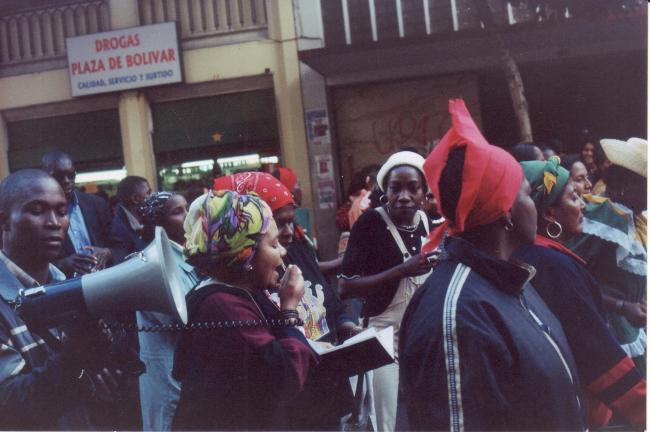 A protest by Afro-Colombian communities in Bogotá demanding the resumption of peace talks in 2002. PHOTO/Jared Goyette/Creative Commons
For Colombia’s Afro-Colombian communities, a peace process that seeks social inclusion alone will not remedy centuries of anti-Black racism
In recent months, the tortuous peace process between the Revolutionary Armed Forces of Colombia (FARC) and the Colombian government has garnered much international attention. In particular, the unexpected results of the October 2, 2016 referendum, in which voters rejected the accords by a small margin, bewildered the international press, as well as many Colombian citizens, who had long hoped for an overdue end to the hemisphere’s longest armed conflict. Since then, Colombian president Juan Manuel Santos and the Colombian Constitutional Court approved a “fast-track” process to expedite the ratification of a revised document, which was finally signed on November 30th of last year.
As thousands of former guerrillas reach disarmament zones and widespread efforts to begin implementing the accords unfurl, it has become clear that Colombia’s violence has not entirely dissipated and that the challenges ahead are formidable. It is especially imperative to look closely at the consequences of the peace accords on the lives of those who have been most directly affected by the war.
Colombia’s war victims are numerous, but it is now well known that Afro-Colombians make up a disproportionately large percentage of war victims and that their historical position within the nation continues to place them in particularly vulnerable situations. For this reason, it is important to ask: what are the possibilities that this peace process presents for the pursuit of an anti-racist agenda? As the enthusiasm for a peaceful Colombia grows—now that peace dialogues with the National Liberation Army (ELN) have begun as well—the question of whether the peace process will move us closer to dismantling one of the central mechanisms of inequality in Colombia looms large.
NACLA for more