
by BEC CREW
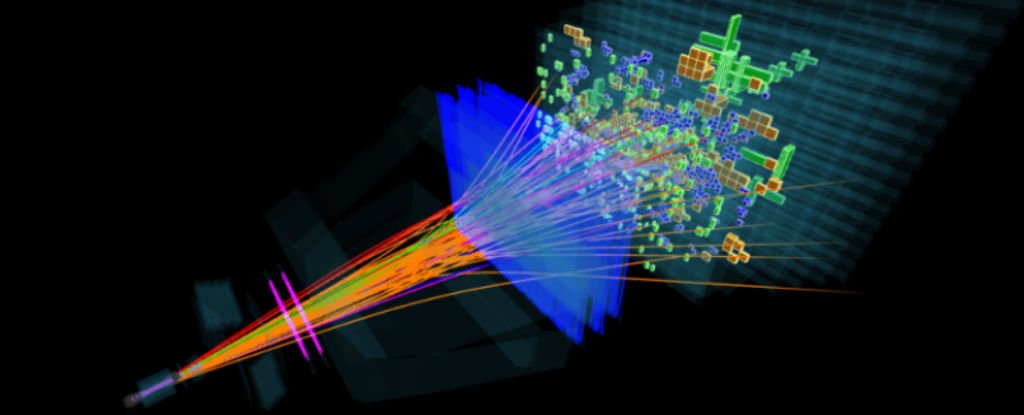
How our Universe broke the rules of symmetry.
Of the many unanswered questions that stand in the way of the Standard Model of physics being able to adequately explain the Universe and everything in it, the mystery of matter-antimatter asymmetry is one of the biggest.
The equal amounts of matter and antimatter produced by the Big Bang should have cancelled each other out, resulting in a Universe with barely any particles, and yet, here we are. Now, new results from a Large Hadron Collider detector at CERN could be our best chance at explaining the paradox of our own existence.
For a bit of background into our asymmetrical Universe problem, the laws of physics predict that for every particle of regular matter, there’s an equal but opposite antiparticle.
That means for every negatively-charged electron, there’s a positively charged positron. For every regular hydrogen atom, there’s an anti-hydrogen atom.
If an antiparticle happens to find a regular particle, they will annihilate each other, releasing energy in the form of light.
The problem arises when we consider that the Standard Model of physics predicts that the Big Bang would have produced equal amounts of baryon particles in matter and antimatter forms – called baryonic matter and antibaryonic matter.
Baryons are a crucial type of subatomic particle, because you know those protons and neutrons that make up most of the mass of the visible matter in the Universe? They’re baryons.
The fact that we ended up with so much more baryonic matter than antibaryonic matter in the Universe is a problem, because the equal amounts produced by the Big Bang should have instantly cancelled out almost everything, resulting in a Universe with barely any particles – just radiation.
The Standard Model does account for a tiny amount of asymmetry in baryon particles, but it certainly can’t explain the overabundance we see of baryonic matter today.
So how did all that matter survive?
The violation of symmetry in the Universe implies that the laws of physics are not the same for matter and antimatter particles, and physicists have been trying to figure out where these laws could diverge – a phenomenon known as charge-parity (CP) violation.
Previous research has found evidence of CP violation in mesons – part of the hadron particle family – but to predict the amount of matter in the Universe as it exists today, we have to find it in baryons too.
For more than half a century, scientists have been searching for evidence of CP violation in baryons, and now, researchers working with one of the Large Hadron Collider (LHC) detectors at CERN in Switzerland appear to have finally found some.
Using the LHCb detector, the team produced enormous amounts of a specific type of baryon (the ?b0 baryon) and its antiparticle version (?b0-bar), and observed how each decayed into a proton (or antiproton) and three charged particles called pions when smashed together.
“This process is extremely rare, and has never previously been observed,” the team explains.
Science Alert for more
via 3 Quarks Daily for more