
by STEVEN WEINBERG
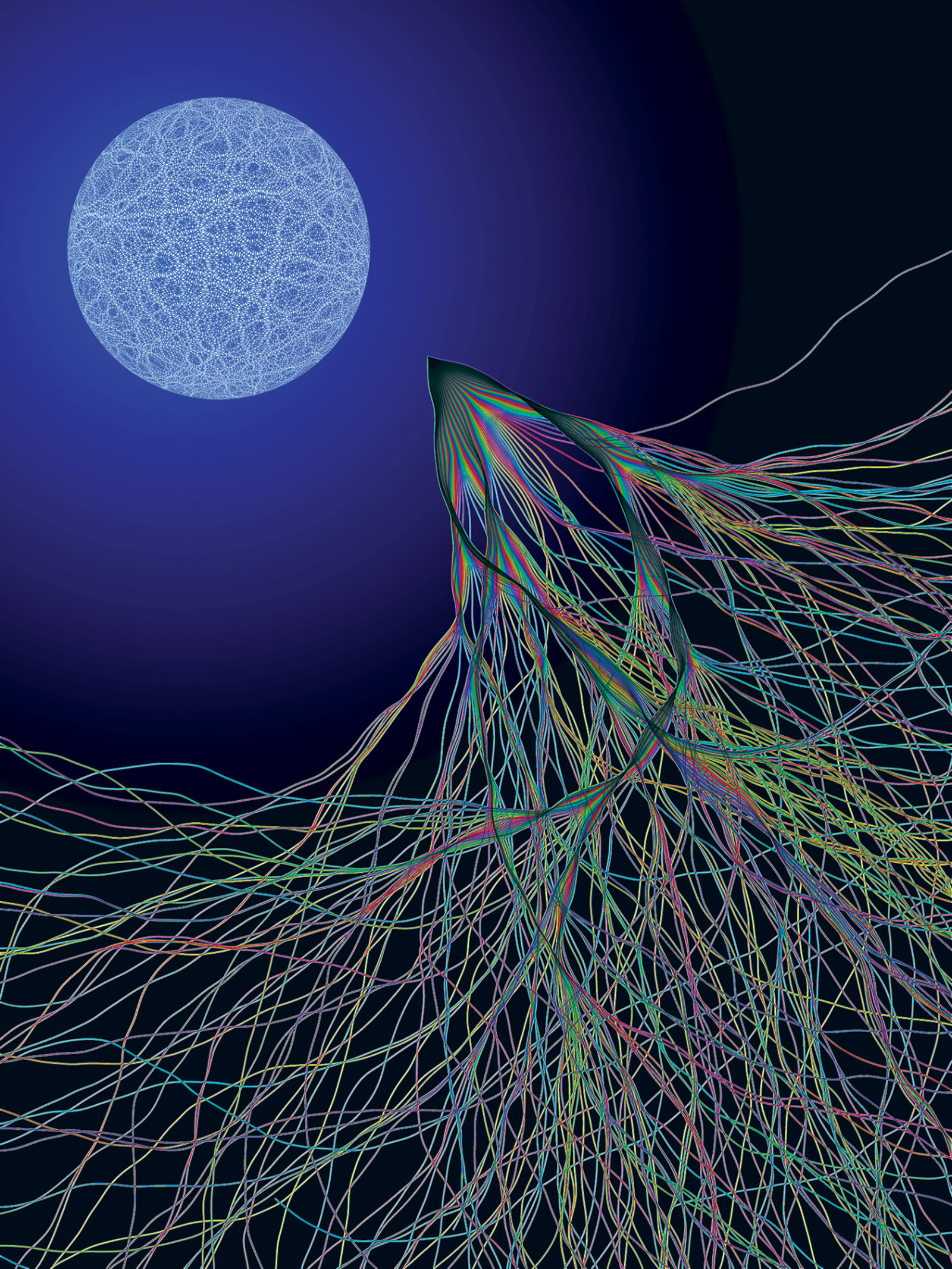 The physicist Eric J. Heller’s Transport XIII (2003), inspired by electron flow experiments conducted at Harvard. According to Heller, the image ‘shows two kinds of chaos: a random quantum wave on the surface of a sphere, and chaotic classical electron paths in a semiconductor launched over a range of angles from a particular point. Even though one is quantum mechanical and the other classical, they are related: the chaotic classical paths cause random quantum waves to appear when the classical system is solved quantum mechanically.’ IMAGE/Eric J. Heller
The development of quantum mechanics in the first decades of the twentieth century came as a shock to many physicists. Today, despite the great successes of quantum mechanics, arguments continue about its meaning, and its future.
1.
The first shock came as a challenge to the clear categories to which physicists by 1900 had become accustomed. There were particles—atoms, and then electrons and atomic nuclei—and there were fields—conditions of space that pervade regions in which electric, magnetic, and gravitational forces are exerted. Light waves were clearly recognized as self-sustaining oscillations of electric and magnetic fields. But in order to understand the light emitted by heated bodies, Albert Einstein in 1905 found it necessary to describe light waves as streams of massless particles, later called photons.
Then in the 1920s, according to theories of Louis de Broglie and Erwin Schrödinger, it appeared that electrons, which had always been recognized as particles, under some circumstances behaved as waves. In order to account for the energies of the stable states of atoms, physicists had to give up the notion that electrons in atoms are little Newtonian planets in orbit around the atomic nucleus. Electrons in atoms are better described as waves, fitting around the nucleus like sound waves fitting into an organ pipe.1 The world’s categories had become all muddled.
Worse yet, the electron waves are not waves of electronic matter, in the way that ocean waves are waves of water. Rather, as Max Born came to realize, the electron waves are waves of probability. That is, when a free electron collides with an atom, we cannot in principle say in what direction it will bounce off. The electron wave, after encountering the atom, spreads out in all directions, like an ocean wave after striking a reef. As Born recognized, this does not mean that the electron itself spreads out. Instead, the undivided electron goes in some one direction, but not a precisely predictable direction. It is more likely to go in a direction where the wave is more intense, but any direction is possible.
Probability was not unfamiliar to the physicists of the 1920s, but it had generally been thought to reflect an imperfect knowledge of whatever was under study, not an indeterminism in the underlying physical laws. Newton’s theories of motion and gravitation had set the standard of deterministic laws. When we have reasonably precise knowledge of the location and velocity of each body in the solar system at a given moment, Newton’s laws tell us with good accuracy where they will all be for a long time in the future. Probability enters Newtonian physics only when our knowledge is imperfect, as for example when we do not have precise knowledge of how a pair of dice is thrown. But with the new quantum mechanics, the moment-to-moment determinism of the laws of physics themselves seemed to be lost.
All very strange. In a 1926 letter to Born, Einstein complained:
Quantum mechanics is very impressive. But an inner voice tells me that it is not yet the real thing. The theory produces a good deal but hardly brings us closer to the secret of the Old One. I am at all events convinced that He does not play dice.2
As late as 1964, in his Messenger lectures at Cornell, Richard Feynman lamented, “I think I can safely say that no one understands quantum mechanics.”3 With quantum mechanics, the break with the past was so sharp that all earlier physical theories became known as “classical.”