
COPENHAGEN POST ONLINE
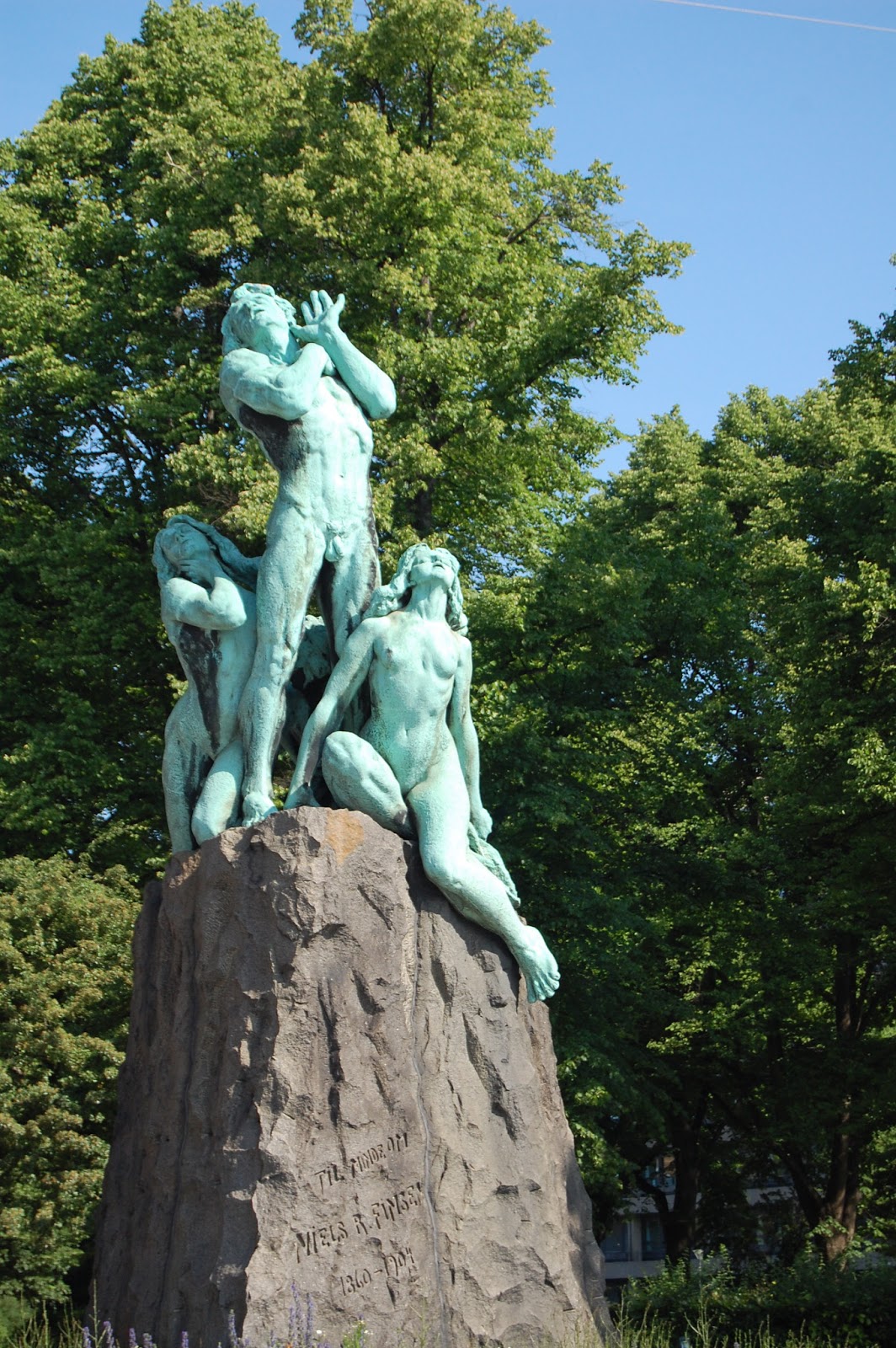 PHOTO/Denmark Art In 1904 the sculptor Rudolph Tegner won a commission to erect a monument in honour of Nobel Prize winner Niels Finsen: his epic piece proved controversial, but is still standing today
Danish design is generally noted for its clean minimalism and serene sense of harmony, while Danish art tends to portray domestic scenes and be rather inward looking. The grandiose splendour of Ancient Greek art may be appreciated, but is rarely replicated, and while the end of the nineteenth century saw the rise of the symbolist movement throughout the rest of Europe, Denmark’s own Golden Age was a little more down-to-earth.
The sculptor Rudolph Tegner looked a little further than the beach at Skagen for his inspiration: he wanted to build his own Aegean temple here on Sealand. While still a young man he visited Greece and the Acropolis, and immediately became besotted with Greek antiquity, something he took as a source of inspiration for the rest of his life.
Residing in Paris from 1893 to 1897, he came into contact with other Danish artists of the period such as Jens Lund and J.F. Willumsen, and soon became caught up in the dominant movement of the time, symbolism. He used Greek mythology as the subject matter for his heroic and tragic figures such as the trilogy ‘Guddommen and Mennesket’ (The Divine and the Human).
Finding Finsen
He was eventually to actualise that dream he had nurtured since his visit to the Acropolis on the land he bought near Dronningmølle on the north coast of Sealand, establishing a park where his monuments could stand out amidst nature in all their glory. The park, which can still be visited today, contains the formidable work ’King Oedipus’ as well as the artist’s own remains which were interred according to his own wishes upon his death in 1950.
Tegner was known to have said that ‘the most monumental, the most beautiful, lies in the tragic.’ And there was plenty of tragedy in the life of physician Niels Finsen, struck down by a debilitating disease while still young and confined to a wheelchair before the age of forty. His groundbreaking work on the healing powers of light, particularly in the case of smallpox and lupus, a form of tuberculosis, earned him a Nobel Prize in 1903.
Tegner won the bid to create a monument in honour of Finsen the following year, and chose to concentrate on the scientist’s work into the healing powers of light, calling his statue ‘Mod lyset’ (Towards the Light). The finished piece was erected on the corner of Blegdamsvej and Tagensvej in Copenhagen in 1909 where it still stands, close to Rigshospital and passed by thousands of people on their way in and out of the city every day. Niels Finsen, for whom the piece honours, died in 1904 aged just 44.
Calling on Carl
The impressive figurative work created from granite and bronze shows three figures, a man flanked by a pair of women, straining their bodies upwards towards the sun. Their extreme body language has been said to have been inspired in part by the writings of philosopher Friedrich Nietzche on the healthy and strong person, juxtaposed with Finsen’s own failing and sickly physical self. When Tegner showed his proposal for the piece feelings ran high against him, with one critic in particular on an apparent personal vendetta against the work. Tegner however found support in Carlsberg heir and wealthy arts patron Carl Jacobsen as well as in writer and idealist Georg Brandes, who was also a follower of Nietzche.
Copenhagen Post Online for more