
by PETER LEE
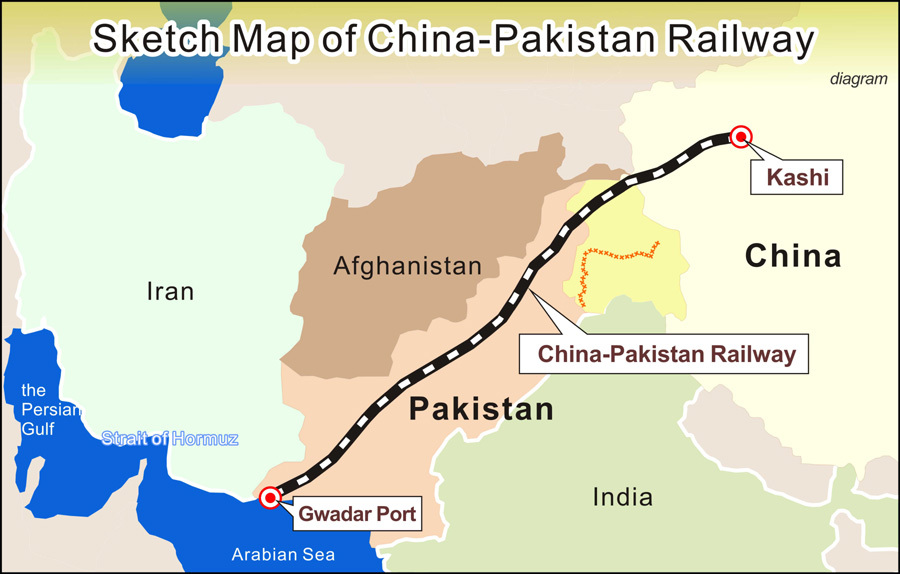 China – Pakistan Economic Corridor will connect Kashgar (a city in China’s Xinjiang Uyghur Autonomous Region) with Pakistan’s deep water Chinese-built Gwadar Port (in Balochistan province) SKETCH MAP/China/US Focus
Though you’ll only find discrete murmurings on the subject, especially in the inflamed Indian press, Indian Prime Minister Narendra Modi’s gambit to “internationalize” Balochistan and Gilgit-Baltistan in his August 15 Independence Day speech and in contemporaneous private but widely reported remarks to the BJP does not appear to be some of his best work.
His pious declarations of solidarity with the people of Balochistan and Gilgit-Baltistan not only provoked Pakistan’s anxiety over an India threat to its territorial sovereignty and virtual existence; it also put the PRC on notice that Modi was inviting further instability at both the northern and southern ends of the cherished China Pakistan Economic Corridor, which enters Pakistan at G-B in the north and terminates at Gwadar Port in Balochistan in the south.
And so the PRC has put its marker down on Kashmir in Pakistan’s favor, despite a spate of terror attacks against Indian forces in Kashmir.
Pakistan apparently did not stand idly by after August 15, as it seems likely that the deadly attack at Uri on September 18 in Jammu and Kashmir was a riposte to Modi’s more aggressive anti-Pakistan tack.
A retaliatory cycle was, predictably, the order of the day.
A plausible timeline of events is Modi’s speeches begat Uri which begat the cross LoC raid which begat the October 2 attack on Baramulla which will beget…?
An interesting subtext to the increased tempo of militant attacks in Kashmir is that the Indian military is getting freaked out.
First Post reported the Baramulla incident, an unsuccessful attack this weekend that nevertheless killed one BSF (Border Security Force) soldier, like this:
The file clips that television channels kept showing during Sunday night’s attack on armed forces camps in Baramulla did not begin to do justice to what was actually happening. Those who saw it at ground zero say that it was like Diwali [the Festival of Lights].
The divisional headquarters is right across the river from the Rashtriya Rifles and Border Security Force camps that were attacked. Apparently, army men opened up with whatever they had, firing from all directions. Some of those who heard the gunfire from up close say they must have heard the sound of no less than 3,000 bullets, and perhaps a dozen much louder blasts — no doubt from mortar shells.
There were also preliminary reports, later indignantly rebutted, that some Indian casualties were due to friendly fire.
Other than issues of fire discipline, there is also the matter that Baramulla is not a military camp near the Line of Control. It’s a sizable town with a population of over 100,000 about 35 miles from Srinagar, inviting speculation that the attack was staged by a sleeper cell in town and not via a border infiltration.
Asia Times Online for more