
by FABIANA FRAYSSINET
(translated from Spanish by STEPHANIE WILDES)
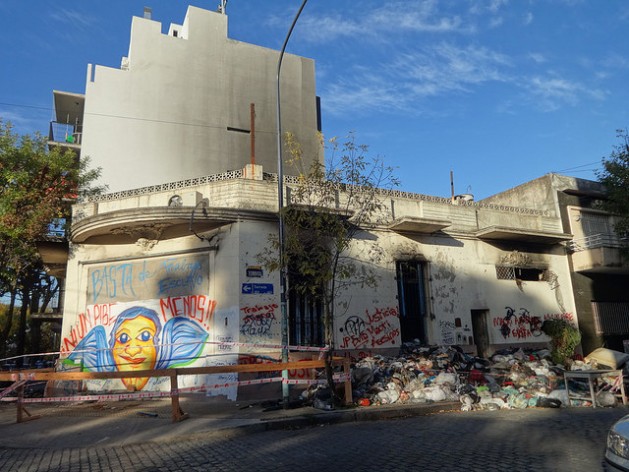 This Buenos Aires sweatshop was destroyed in April 2015 by a fire that claimed the lives of two Bolivian boys who were living there. The Clean Clothes network emerged in response to the indignation caused by the tragedy in this country, where 30,000 people work in sweatshops. PHOTO/Fabiana Frayssinet/IPS
The Ropa Limpia or Clean Clothes network emerged in 2015, with a successful fashion show held to demonstrate that it is possible to produce clothing without slave and child labour.
On Apr. 27, 2015, two Bolivian children died in a sweatshop fire.
“We started to receive a lot of phone calls from people who were indignant about what had happened, and concerned because we denounced many brand names of clothing for using sweatshops, and people asked us: so what are we supposed to wear?” said Tamara Rosenberg, the head of the cooperative.
“That’s when the idea came up to suggest to our customers that it is possible to produce in decent working conditions…it’s not the same thing to show that there’s a cooperative as to show that there are a number of designers who respect people’s rights, and charge appropriate prices.”
The very same clothing produced in sweatshops, which is sold at low prices in the city’s street markets, is sometimes sold by famous brand names at a higher mark-up.
The Argentine network was inspired by the global Clean Clothes Campaign, whose aim is to improve working conditions in the global garment and sportswear industries.
“The idea is to approach the sweatshops to raise awareness about the risks of not having their installations in proper working order, or of having children in the workshop, because the dust in the air hurts their respiratory system,” said Virasoro.
The members of the network also give advice to designers “who want to do things in a responsible manner,” she said.
“It’s not easy because they’re scared they’ll be reported,” she added. “The problem is that even though it’s not a clandestine workshop or a sweatshop using slave labour, they might not pay all their taxes, or their installations might not all be in order.”
Daza said: “You know you’re being mistreated, but the owner of the workshop tells you, ‘look, if you go, we have 10 others who want to work’. Since it’s hard to find a job, you bow your head and keep working.”
Others are worried about reporting the situation because the police themselves often “tell the owner, who fires (the whistle-blower),” he said.
Laura Méndez, who owns the Clara A brand name, decided to produce her accessories in the cooperative, after seeing “how they all worked crowded into a place with no exit” in a footwear factory, as well as other irregularities.
“The most important thing for me is to show clients that clothing can be produced in an ethical manner,” she told IPS. “I want the products to have a social impact.”
The 20 de Diciembre Cooperative employs 12 workers.
“In a sweatshop, people work 16 hours and earn 5,000 or 6,000 pesos (312 to 375 dollars) a month,” said Rosenberg. Here, most of the members of the cooperative work seven hours, earning 7,000 to 8,000 pesos a month (437 to 500 dollars), which is even higher than the wage agreed on with the industry.”
María Reina’s story is dramatic, like those of many of her fellow workers. Six years ago, when she was travelling from Bolivia to Argentina, where she had been hired to work in a garment workshop, the bus rolled and in the accident her boyfriend and brother-in-law were killed, and she lost a leg.
“When I got out of the hospital they took me to the workshop,” she told IPS. “I was in a wheelchair and they told me I had to work. I said I couldn’t, that I had to heal, that I was ordered to rest. They didn’t understand, and finally they threw me out on the street.”
She is now undergoing rehabilitation. And she has learned that South American immigrants like her have labour rights, and have the right to an identity card and to free healthcare and education.
Inter Press Service for more