
by NYLA ALI KHAN
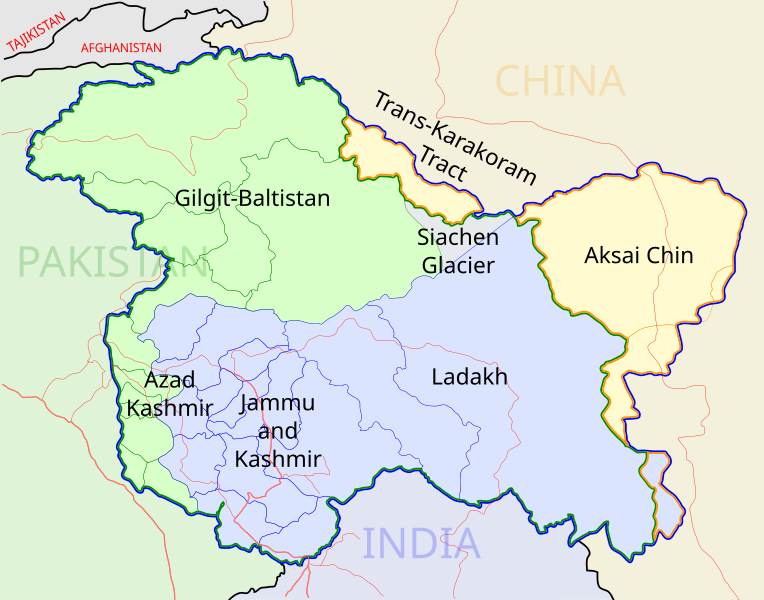 IMAGE/Wikimedia Commons

The ambiguous identity of a Kashmiri is one that some of us have had to live with for a while now. Indian nationalists are quick to claim their intractable hold on Kashmiris; Pakistani nationalists are just as quick to claim to speak for Kashmiris. Kashmir, despite having a real internal history and a place in the world, is suppressed by its positioning in the Indo-Pak conflict. Mainstream Kashmiri politicians culpably reiterate that “Kashmir is an integral part of India,” in the process negating the people’s voices and real existence. Separatists are just as quick to scrap that assertion with their vociferous calls for hartal (closing down businesses and educational institutions), in the process sidelining the educational and psychological needs of the younger generation. New Delhi in its signature style is straddling the fence by underlining the need for “dialogue” and “quiet diplomacy” but not taking any substantive measures to “talk” to Kashmiris. The profundity of memories and mourning of Kashmiris cannot be relegated to the background in official accounts of history. The aggressive statements, delusions of grandeur, melodramatic performances, and witty quips of Kashmiri mainstream politicians as well as separatist leaders have a short-lived glory and do nothing to alleviate the pain of anxious parents, destitute widows, bereaved mothers, vulnerable orphans, educated people unable to make a decent living.
Minority voices of Kashmiris that express dissension cannot be silenced forever. Indian and Pakistani nationalisms have sought to mold collective subjectivities by the evocation of pan-national religious affinities resulting in the stifling of minority voices that express divergent political, social, and cultural opinions. The unitary concept of nationalism that the nation-states of India and Pakistan subscribe to challenges the basic principle that the nation was founded on, namely, democracy. In the enthusiasm to nurture this nationalist project, the political autonomy endowed on J & K by the constitutional provisions of India should not be eroded. In October 1949, the Constituent Assembly of India reinforced the stipulation that New Delhi’s jurisdiction in the state would remain limited to the categories of defence, foreign affairs, and communications, as underlined in the Instrument of Accession. This stipulation was provisional and its final status would be decided upon the resolution of the Kashmir issue. Subsequent to India acquiring the status of a republic in 1950, this constitutional provision enabled the incorporation of Article 370 into the Indian Constitution, which ratified the autonomous status of J & K within the Indian Union. Article 370 stipulates that New Delhi can legislate on the subjects of defense, foreign affairs, and communications only in just and equitable consultation with the government of the state of J & K, and can intervene on other subjects only with the consent of the J & K State Assembly. In contravention of the autonomy of J & K, two highly federalist statutes of the Indian Constitution, Articles 356 and 357, were enacted in J & K in 1964. These draconian articles enabled the central government to autocratically dismiss democratically elected state governments if it perceived a dismantling of the law and order machinery. A constitutional order implementing these statutes was decreed by New Delhi. In the 1990s and the 2000s the military has carte blanche.
Counterpunch for more