
KURZWEIL
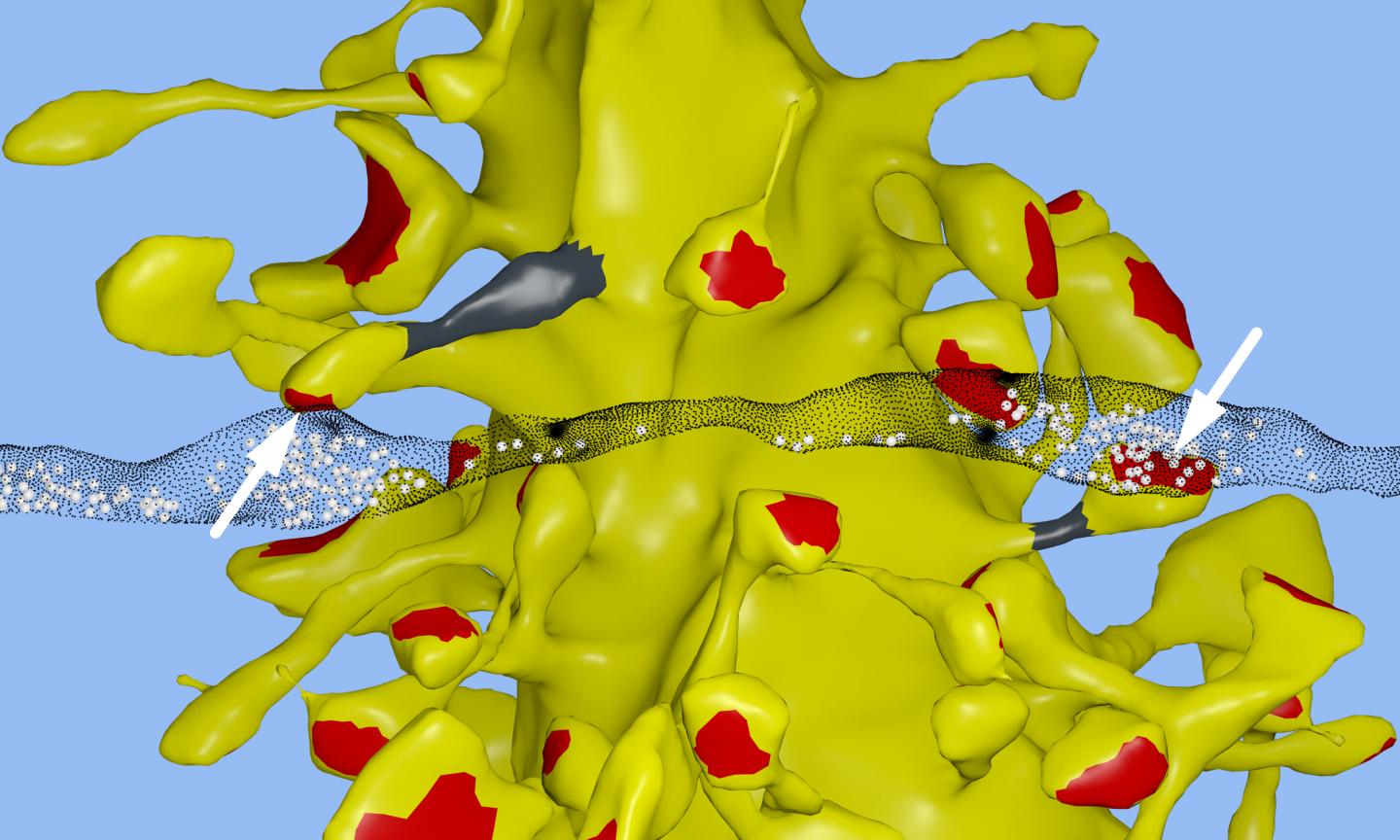 In a computational reconstruction of brain tissue in the hippocampus, Salk and UT-Austin scientists found the unusual occurrence of two synapses from the axon of one neuron (translucent black strip) forming onto two spines on the same dendrite of a second neuron (yellow). Separate terminals from one neuron’s axon are shown in synaptic contact with two spines (arrows) on the same dendrite of a second neuron in the hippocampus. The spine head volumes, synaptic contact areas (red), neck diameters (gray) and number of presynaptic vesicles (white spheres) of these two synapses are almost identical. IMAGE/Salk Institute
Salk researchers and collaborators have achieved critical insight into the size of neural connections, putting the memory capacity of the brain far higher than common estimates. The new work also answers a longstanding question as to how the brain is so energy efficient, and could help engineers build computers that are incredibly powerful but also conserve energy.
“This is a real bombshell in the field of neuroscience,” says Terry Sejnowski, Salk professor and co-senior author of the paper, which was published in eLife. “We discovered the key to unlocking the design principle for how hippocampal neurons function with low energy but high computation power. Our new measurements of the brain’s memory capacity increase conservative estimates by a factor of 10 to at least a petabyte (1 quadrillion or 1015 bytes), in the same ballpark as the World Wide Web.”
“When we first reconstructed every dendrite, axon, glial process, and synapse* from a volume of hippocampus the size of a single red blood cell, we were somewhat bewildered by the complexity and diversity amongst the synapses,” says Kristen Harris, co-senior author of the work and professor of neuroscience at the University of Texas, Austin. “While I had hoped to learn fundamental principles about how the brain is organized from these detailed reconstructions, I have been truly amazed at the precision obtained in the analyses of this report.”
10 times more discrete sizes of synapses discovered
The Salk team, while building a 3D reconstruction of rat hippocampus tissue (the memory center of the brain), noticed something unusual. In some cases, a single axon from one neuron formed two synapses reaching out to a single dendrite of a second neuron, signifying that the first neuron seemed to be sending a duplicate message to the receiving neuron.
At first, the researchers didn’t think much of this duplicity, which occurs about 10 percent of the time in the hippocampus. But Tom Bartol, a Salk staff scientist, had an idea: if they could measure the difference between two very similar synapses such as these, they might glean insight into synaptic sizes, which so far had only been classified in the field as small, medium and large.
Kurzweil for more
via 3 Quarks Daily