
by TARA ISABELLA BURTON
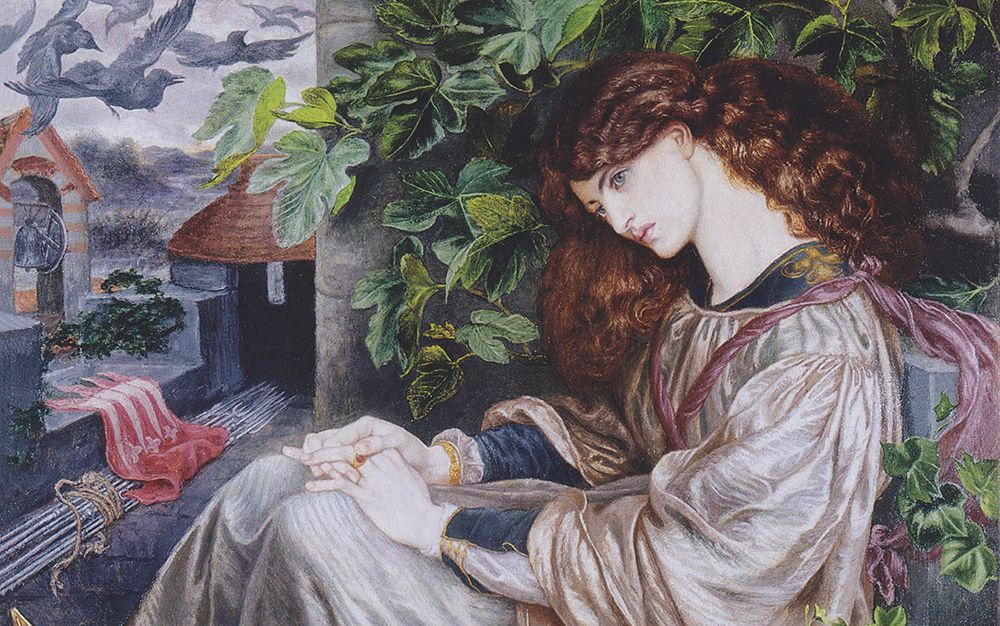 La Pia de Tolomei by Dante Gabriel Rossetti. Spencer Museum of Art, Kansas IMAGE/Wikimedia
Reading novels is good for you. This is the current wisdom, at least. A 2013 study by the New School for Social Research in New York City attempted to prove that reading passages by Don DeLillo and Lydia Davis had an immediate impact on participants’ ability to identify the emotions of others. Another, at Emory University in Georgia, found that reading novels had the potential to cause heightened ‘connectivity’ in the brain. A third, at the University of Sussex, made the case for books being one of life’s most effective stress-relievers.
While we might point to violent video games or sexually explicit films as potentially dangerous and corrupting influences on tender or vulnerable minds, the novel is treated as uplifting and salutary, regardless of its content: a kale smoothie for the soul. When we do talk about books being ‘dangerous’, it is usually with a knowing nod and a wink: and the implication is that those of us in the know know better. In a recent Guardian interview, the controversial British writer Melvin Burgess insists that ‘like most “dangerous” books, [Junk, his novel for young adults] is in fact a threat only to people who are themselves dangerous – people who want to control others’. Any suggestion that a book might be dangerous is, in other words, only ever a manifestation of bigotry or fear.
But it was not always thus. Throughout the 19th century, novels were regarded with the same suspicion with which we treat, say, Eli Roth’s ‘torture-porn’ Saw movies today. They were dangerous not simply because of the stories they might contain – the romantic expressions of wish-fulfillment, for example, that led Emma Bovary down the garden path of adultery – but also because reading itself was seen as a kind of possession: an encroachment of the ‘other’ upon the self.
In his condemnatory tract Popular Amusements (1869), the American clergyman Jonathan Townley Crane cautioned his flock against reading novels: ‘novel-readers spend many a precious hour in dreaming out clumsy little romances of their own, in which they themselves are the beautiful ladies and the gallant gentlemen who achieve impossibilities…’ only to find themselves ‘merged in the hero of the story’, losing the sense of who they really are.
Such a view might seem outdated now that we’re far more likely to talk about the health benefits of reading than its moral dangers. But in treating novels as the ultimate nutrition for the brain, do we risk neutralising their potency? After all, religious moralists such as Crane were not the only people to explore the dangers of novel-reading and the treacherous dynamics of story-telling: novelists and writers themselves drew attention to and critiqued the writer’s singular power over his readers.
Many of these authors – the philosopher Søren Kierkegaard in Denmark, the Decadent novelists Julés-Amedée Barbey D’Aurevilly and Octave Mirbeau in France, or Oscar Wilde in England – were responding to a wider intellectual trend in the 19th century: the configuring of the artist as a kind of replacement Creator-deity in an age turning away from traditional authoritarian conceptions of God; a quasi-divine artist whose words, according to the Romantic poet Samuel Taylor Coleridge, were ‘a repetition in the finite mind of the eternal act of creation in the infinite I AM’. Writer-philosophers such as Johann Gottlieb Fichte and Friedrich Schlegel drew on the philosophy of Immanuel Kant to celebrate the power of the human mind to impose order and form on the chaos of the world, and envisioned the artist or storyteller figure as a kind of über-Mensch, or superman, who could wield the organising power of narrative to lend form to the void.
But godlike power (as plenty of Romantic writers came to discover) has a dark side. And in the works of some of the greatest and most disturbing writers of the 19th century, we get a glimpse of what that dark side looks like: something at once more profound – and more diabolical – than Crane could have imagined.
‘The ironist is the vampire who has sucked the blood of the lover and while doing so has fanned him cool, lulled him to sleep, and tormented him with troubled dreams.’ Thus does Kierkegaard describe, in 1841, the ultimate artist, who takes a vital life-force from his spectator and then infuses – one might even say inseminates – him with poison. And throughout the 19th century, the storyteller was very often treated – literally or figuratively – as a vampiric figure: someone who infects a person’s sense of self and drains his life force by means of corroding influence.
Aeon for more