
by ANNE ENRIGHT
 Antigone IMAGE/Brooklyn Academy of Music
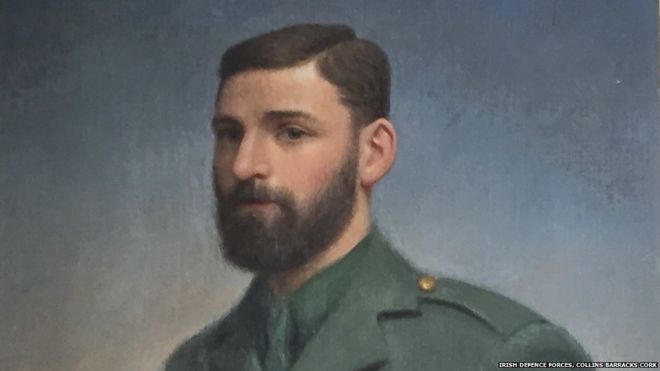 Thomas Kent was one of 16 men executed in the aftermath of the 1916 Easter rising PHOTO/BBC
In September, the Irish government held a state funeral for the exhumed remains of Thomas Kent, a rebel and a patriot who was executed in 1916 and buried in the yard of what is now Cork Prison, at the rear of Collins Barracks, once the Victoria Barracks. His coffin was first removed to the garrison church, where thousands of people – including Dr John Buckley, the bishop of Cork and Ross – filed past to pay their respects. The funeral echoed the reinterment of Roger Casement – thrown in a lime pit in Pentonville Prison in 1916 and repatriated in 1965 – when Eamon de Valera got out of his sickbed to attend and a million people lined the route. Thomas Kent was buried in the family plot at Castlelyons and the taoiseach, Enda Kenny, gave the graveside oration. ‘Today,’ he said, ‘we take him from the political Potter’s Field to lay him with all honour among “his own”.’ Although the land in which he had lain is now, technically speaking, Irish, the prison yard still held the taint of Britishness, the memory of his dishonour.
…
It is tempting to see Antigone as a play not just about the mourning female voice, or about kinship and the law, but about the political use of the body after death. Creon, the ruler of Thebes, dishonours the body of his nephew to serve as a warning to other potential enemies of the state. One brother, Eteocles, has been buried ‘in accordance with justice and law’, the other, Polynices, ‘is to lie unwept and unburied’ – this according to their sister Antigone, who has already decided at the play’s opening to ignore Creon’s edict and bury the corpse. And so she does. When asked to deny the crime, she says, in Anne Carson’s 2012 translation of Sophocles: ‘I did the deed I do not deny it.’ She does not seek to justify her actions within the terms of Creon’s law: she negates the law by handing it back to him, intact – ‘If you call that law.’
Antigone later says she is being punished for ‘an act of perfect piety’, but that act is also perfectly wordless in the play. The speeches she makes to her sister Ismene and to Creon are before and after the fact. She is a woman who breaks an unjust law. We can ask if she does this from inside or outside the legal or linguistic system of the play, or of the state, but it is good to bear in mind that Antigone does not bury her brother with words, but with dust.
London Review of Books for more