
by ALICIA SWORDS
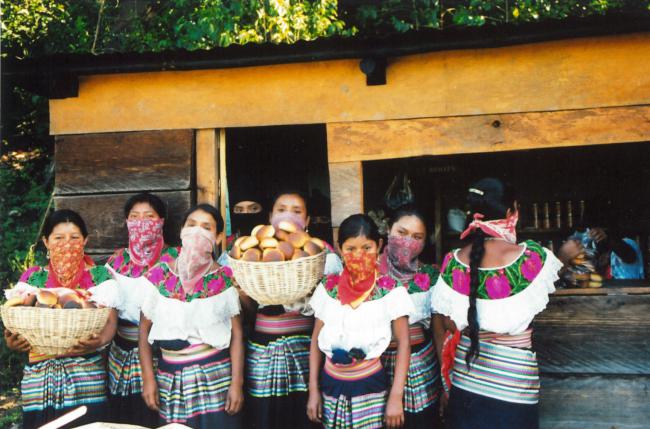 Zapatista collectve bakery, Olga Isabel, Chiapas, Mexico PHOTO/Hilary Klein
Compañeras: Zapatista Women’s Stories by Hilary Klein (New York: Seven Stories Press)
When poor, indigenous people and peasants took over land and municipal governments in Chiapas, Mexico on January 1, 1994 just as the North American Free Trade Agreement went into effect, the uprising shook the world. Through individual interviews and collective interviews at women’s assemblies, Hilary Klein’s book, Compañeras, charts the changes in women’s roles, leadership, rights, and power in intimate relationships, families, and communities that the Zapatista movement brought.
The title Compañeras captures the core of Klein’s project, which both describes her subject, Zapatista women and their political relationships, as well as her approach of being a compañera herself by building relationships of trust and mutual support. From 1997 to 2003, Klein worked in collaboration with women’s collectives in Zapatista communities in Chiapas. She co-developed a project called Mujer y Colectivismo, which supported Zapatista women’s cooperatives with leadership development, popular education materials, regional gatherings, and rotating loan funds. Regional authorities asked her to teach basic mathematics to women who needed these skills to run their cooperatives. In times of heavy state repression, she joined human rights delegations to interview women after military attacks on their communities. In the process Klein developed a high degree of trust with women leaders; she “slept in their homes, worked in their cornfields with them, and played with their children” (p. xxii). The richness of the interviews and collective testimony through group interviews is based on thattrust.
Other sympathetic outsiders-with-inside-perspectives and engaged scholar-activists in Chiapas have written about the Zapatistas, including June Nash, Rich Stahler-Sholk, Leandro Vergara-Camus, Mariana Mora, and Shannon Speed, to name a few. Klein’s work in Compañeras reflects this sort of committed engagement at its best.
With so much outside interest, Zapatista authorities developed criteria for engagement and meaningful involvement for scholars. In 2001, Zapatista women authorities in Morelia and La Garrucha asked Klein to conduct a set of interviews in more than two dozen communities to document and teach about the movement’s history from women’s perspectives. It is significant that Compañeras grew out of these interviews, driven by the movement participants’ own desire to teach the history of their organizing. Unlike descriptions of movements intended solely to inform outsiders, Compañeras addresses questions that clearly matter to the Zapatista women themselves, along with questions that matter to outsiders hoping to bring lessons from the Zapatista movement to their own spheres.