
by ZAHRA MOLOO
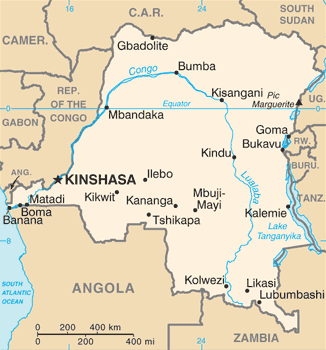 The map of Democratic Republic of Congo MAP/Wikipedia
How development institutions are financing land grabs in the Democratic Republic of Congo
Introduction
Kuyek traces the colonial origins of palm oil plantations in the DRC along the Congo River, dating back from the time of King Leopold and the Lever Brothers (which became Unilever), to present-day land grabs funded by development finance institutions and sanctioned by the World Bank; a process which has occurred as part of a re-orientation of aid from poverty alleviation to straightforward investment in private companies.
Community members interviewed as part of the report claim that their land was never ceded to the company and that conditions on the plantations are abysmal.
According to Kuyek, this type of large-scale intensive agricultural model that is expanding in different parts of Africa is deeply problematic, taking away valuable land and water resources from small farmers and pastoralists, and creating greater food insecurity in places that are suffering most from the global food crisis.
The Interview
ZAHRA MOLOO: Your recent report looks at what you call ‘agro-colonialism’ in the DRC, and in particular at a Canadian company that’s investing in palm oil plantations in the Congo. Perhaps we can start with some historical context. We think of agribusiness and land grabs more in a contemporary sense on the continent, but in the DRC there’s a whole history to palm oil. Can you go back a bit and give some historical context to palm oil plantations in the DRC?
DEVLIN KUYEK: Yes, many of the current land grabs are actually new companies taking over old plantation concessions. This is the case in the DRC with Feronia (a Canadian company). These plantations go back over 100 years and were set up by the Lever brothers at the time, which became Unilever, now one of the largest food multinationals in the world. They were given an enormous concession by King Leopold along the Congo River, which is a beautiful area of forest. Palm oil is a traditional crop of the people and has hundreds of different uses, one of which is palm oil. They started forcing people to collect and harvest palm oil for them. So initially it wasn’t plantation agriculture, but it quickly moved to a plantation model as they took over vast areas of land. Their concessions were for around 100 000 hectares. It was the most severe and grave forms of colonial plantation exploitation you can imagine. Most of the local people would describe it as slavery and this is how it was for about 80, 90 years. Then into the 90s, with war in that part of the Congo, Unilever’s activities started to decrease and they put their plantations up for sale. And you now have this new investor, Feronia, set up by financial players that have no experience in the agricultural sector, but were interested in taking advantage of the new push into agribusiness in Africa. They set up Feronia and were going to turn the DRC into the new Brazil of Africa, introducing a Brazilian model of GMO, intensive monoculture, large-scale farming in the Congo, which is a mainly a country of small-scale production.
ZM: Can you tell me more about Feronia, where exactly it is based, what investments it has?
DK: It started off in the Cayman Islands, where it was first registered in 2008. They then acquired the Unilever plantations and paid Unilever 3 – 4 million dollars for those plantations. In about 2010, they became a publicly listed company on the Toronto Stock Exchange. By 2012, their stock prices had collapsed quite significantly. The company had been running losses for a number of years, well, all the years of its existence. Then you had these development funds, DFIs, which are the arms of European and US development agencies; they have these branches that invest in foreign or private companies involved in agribusiness and other activities in developing countries. These DFIs started buying shares in Feronia and today they control over half of the company’s shares. So Feronia itself is now controlled by European and US governments.
Pambazuka News for more