
by NYLA ALI KHAN
 IMAGE/Amazon
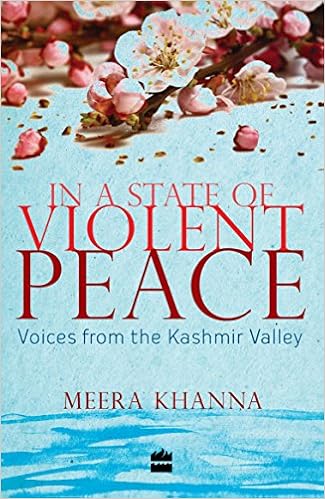
In a State of Violent Peace: Voices from the Kashmir Valley by Meera Khanna (New Delhi: Harper Collins, 2015)
How are Kashmiri identities related to the invention, transmission, and revision of nationalist histories? How do narratives from the Kashmir Valley affect mainstream understandings of the Kashmir conundrum?
In exploring these questions, Meera Khanna’s book, In a State of Violent Peace: Voices from the Kashmir Valley (New Delhi: Harper Collins, 2015), focuses on the representation of Kashmiri life in nostalgic, emotive, and sometimes mesmerizing narratives by fifteen natives of the Valley, with different ideological, religious, and political leanings. Concentrating on the intertwined topics of Kashmiri nationalism, beginning of resistance politics, nation-building, Kashmiriyat, militarism, militancy, and fundamentalism (of various hues), the narratives in this book address the transformations associated with these phenomena. Meera Khanna does something similar to what I have done in my first book, The Fiction of Nationality in an Era of Transnationalism (New York: Routledge, 2005), which is offering a critical dialogue between these narratives and the history they encounter, using history to interrogate memoirs and using memoirs to think through historical issues. Either directly or indirectly, the types of conflictual situations that exacerbated the murkiness of Kashmir resonate throughout the narratives with which Meera is concerned in this book.
Cultural notions of Kashmiris in image and word have been reconstructed to emphasize the bias that reinforces the propagandist agendas of the hegemonic powers involved in the Kashmir dispute, India and Pakistan, as A. S. Dulat’s recent book does. His book leaves no doubt in my mind that in establishment Indian and Pakistani thought, Kashmiris are defined as different from the nationals of the two countries. As opposed to Dulat’s book, Meera’s humanizes the Kashmir conflict and the individuals most impacted by it, who are oftentimes forgotten in the highfalutin political analyses and policy statements of India and Pakistan. She makes no attempt to caricaturize the people of the Valley and does not mock their sentiments, which I, for one, greatly appreciate. One might have political differences with some of the perspectives in the book, but that doesn’t delegitimize any of them. Plurality of thought in Kashmir defies every attempt to create a homogenizing discourse, which is what makes me proud of my identity as a Kashmiri Muslim, raised in a pluralistic culture.
Several of the narratives mourn the loss of “Kashmiriyat.” What is that notion/ sentiment? The various ethnic and religious groups in the state of Jammu and Kashmir have tried time and again to form a national consciousness in order to name its cultural alterity through the nation, as “Kashmiriyat.” But due to the regional sentiments that are so well entrenched in the psyche of the people, this attempt continues to remain in a volatile stage. The symbols of nationhood in Jammu and Kashmir, flag, anthem, and constitution, have thus far been unable to forge the process of nationalist self-imagining. Some of the narratives recognize that although separatist movements have been surfacing and resurfacing since 1947, the attempt to create a unitary cultural identity bolstered by nationalist politics has been subverted by regional political forces, backed-up by the governments of India and Pakistan. The acts of demanding the right of self-determination and autonomy for Jammu and Kashmir have not been able to nurture a unity amongst all socioeconomic classes and religioethnic groups.
Through the narratives of a an eminent Kashmiri physician, the daughter of the chief officer of Muzzaffarabad in 1947, a renowned female educationist, a former female commissioner of tourism, a brigadier, a homemaker, a former militant, the wife of a militant, the daughter of a militant, former DIG, the daughters of Sheikh Mohammad Abdullah, former principal of the Government Medical College and Chair of the State Commission for Women, former principal of the Government College for Women, and writer and translator of Kashmiri stories, Meera animates the mosaic of Kashmir. The painstaking process of nation-building; the deep investment in the construction of a society; the meaningfulness of the Naya Kashmir manifesto, which, in my opinion, should be revived and implemented; the identity formation of the people of Kashmir shaped by history and politics; the alienation of the people through duplicitous policies are palpable in every single narrative. These narratives of people of various religious, ideological, and political leanings underline that Kashmiris have tried, time and again, to translate themselves from passive recipients of violence legitimated by the legislations of the physically and psychologically parliaments of India and Pakistan into subjects who recognize that they can exercise agency and take control of their lives. Although all the narrators don’t subscribe to this ideology, they recognize that the insistence on rejecting the trajectory charted out for Kashmiris by the power structures of India, Pakistan, and the West, and the urge to proclaim themselves a nation that is capable of exercising the right of self-determination has been haunting the psyche of the Kashmiri people for ages.
The emotive narratives explore that over the years, tremendous political and social turmoil has been generated in the state by the forces of militarism, militancy, political and religious bigotry that seek to erode the cultural syncretism that is part of the ethos of Kashmir. Over the past several decades, Kashmiris, who do not have recourse to the judicial system, have been caught between a rock and a hard place. These forces are responsible for the repression of women, political anarchy, economic deprivation, lack of infrastructure, and mass displacements that have been occasioned by these events. As I said in one my recent facebook posts, the India-Pakistan proxy war has been tremendously detrimental to the people of J & K. While the exodus of the Kashmiri Pandit community is a dark blot of our politics and history, the Kashmiri Muslim community has also suffered tremendous losses during these decades of insurgency and counter insurgency.
(Nyla Ali Khan is a visiting professor at the University of Oklahoma. She earned her PhD in Post-colonial literature from OU. She is a member of the Scholars Strategy Network. She has written several books including The Fiction of Nationality in an Era of Transnationalism (Routledge, 2005), Islam, Women, and Violence in Kashmir: Between India and Pakistan (Palgrave Macmillan, 2010), Parchment of Kashmir: History, Society, and Polity (Palgrave Macmillan, 2012), and The Life of a Kashmiri Woman: Dialectic of Resistance and Accommodation. Dr. Khan lives in Edmond with her husband Dr. Khan a practicing Rheumatologist and their daughter. Dr. Khan can be reached at nylakhan@aol.com)