
by BERNARD D”MELLO
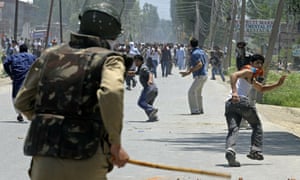 Unrest in Kashmir, where a leaked cable said the Indian government ‘condoned torture’ PHOTO/Tauseef Mustafa/AFP/Getty Images/The Guardian
When it comes to Kashmir, official mendacity in India seems to cross all bounds. So even a prominent member of the Indian Establishment felt that the Defence Minister Manohar Parrikar’s recent (May 22) open advocacy of “kaante-se-kaanta-nikaalte-hein” (a-thorn-to-remove-a-thorn) counterinsurgency tactics was “terrible” and that he should withdraw his out-of-line statement forthwith. “You have to neutralise terrorist through terrorist only”, Parrikar had insisted, but the Establishment, which knows only too well that this has been the norm in Kashmir since 1994, obviously doesn’t consider it prudent to admit to it openly. The Establishment’s propaganda is all too familiar, though it is very hard to effectively counter it, what with big media on its side. Be that as it may, one should never forget the past — memory has to be kept alive.
Here, of course, memory takes one on a passage to hell. You cannot but encounter the demons of violence, the devils of rapacity. But as one goes through the horror, the grotesque and the macabre, one should never lose one’s capacity to reflect, one’s faculty to be in empathy with the feelings of the Kashmiri people. In a way, the truth about the Indian Establishment is revealed in Kashmir — cruel, destructive and malicious; the lie of Indian democracy is evident in Kashmir.
Take the “terrible” terror-for-terror counterinsurgency tactics that have been practiced with a vengeance in Kashmir since 1994. Of course, you’d have to go back to what happened in 1953 and the period until 1975 when Kashmir was governed by the Delhi-centred Establishment’s chosen ones from Srinagar; to 1984 (the hanging of Maqbool Butt); and then to the manipulation of the 1987 state assembly elections that denied the Muslim United Front (MUF) the democratic representation that was its due, culminating in the insurgency. The Jammu Kashmir Liberation Front’s (JKLF) leadership of the insurgency didn’t last long, indeed, 1990-92 marked its high points, and then it lost out, but the mass appeal of its goal of independence (neither Pakistan nor India) is still alive and well.
With the decline of the JKLF, another organisation, whose social-political roots were indigenous, came to lead the insurgency — the Hizbul Mujahideen (HM). Its social and political base came from the Jammu Kashmir Jamaat-e-Islami, which was an important constituent of the MUF that was the victim of the rigging of the 1987 elections. The HM held on, and together, much better than the JKLF in the face of the brutal counterinsurgency (even today, there are 600,000+ Indian troops, including the paramilitaries and the J&K armed police, in Kashmir). But when defectors from the insurgents were adopted by the Indian state — they came to be known as “Ikhwanis” — to join the counterinsurgency in large numbers, former militants who knew much more about the militants and their families and sympathisers, and assumed a crucial role, including that of local intelligence, in targeting the latter, the Jamaat had to move away from supporting the HM. By the beginning of the new millennium, the Indian security forces and the Ikhwanis forced the HM to retreat. As a WikiLeaks cable of 4 June 2007 puts it: “Ikhwan has a reputation in the Valley for committing brutal human rights abuses — including extra-judicial killings of suspected terrorists [insurgents], and their family members, as well as torturing, killing, raping, and extorting Kashmiri civilians suspected of harboring or facilitating terrorists [insurgents].”
Monthly Review for more