
by FAISAL DEVJI
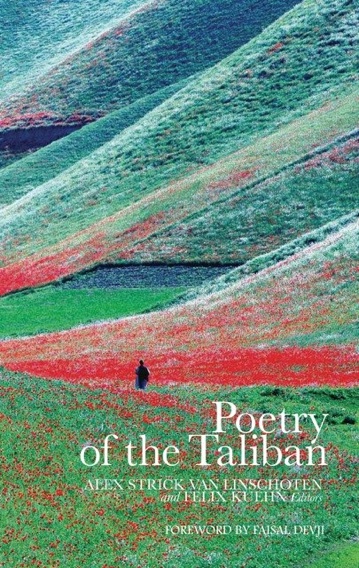 IMAGE/Poetry of the Taliban
A journalist I know had the opportunity of meeting Mullah Mohammad Omar early in the Taliban’s career, just as they were embarking upon the conquest of Ghazni, in February 1995. The Taliban leader, he told me, extracted the gilded wrapping-paper from an empty pack of Silk Cut cigarettes and penned instructions for his army on the back of it. In a region where Silk Cut is known as a “woman’s brand,” this image is curious enough. More interesting, however, is the possibility that the shiny cigarette paper served as an impoverished descendant of the gilded edicts or farmans of past monarchs. Did Mullah Omar, I wondered, possess a collection of empty Silk Cut packets for his official pronouncements?
If nothing else, this story tells us how important the aesthetic dimension is for even the most utilitarian militant practices, and how intertwined it is with all that is modern, western and indeed “quotidian” about the world. There is no easy way of distinguishing tradition from modernity here.
The aesthetic dimension of Taliban life is even clearer in these verses from a poet named Sayyed:
I keep the arrows of expectation in my heart like flowers;
My friend, I keep the lamp of hope lit for your coming.
I incite many lovers’ hearts to dance to the sound of my voice;
Always, like the nightingale, I keep the melody of grief in my heart.
Yet it is too young to be hurt; I am afraid it may hurt itself;
I will certainly safeguard this lion from the forest.
Even if time brings the ugliest revolutions,
I will keep the fold of my turban pious.
Sayyed! Even if I am destined to live in far away cities,
I will remain the rough Pashtun of the mountains.
…
It is not surprising, then, that poetry has long been a part of Muslim radicalism, with the Ayatollah Khomeini himself the author of a large collection of verse. In keeping with his traditional background, Khomeini wrote mystical couplets in which God is commonly portrayed as an alluring woman, divine knowledge described as intoxicating wine, and the arid piety of cleric and mosque rejected for the pleasures of heresy and the tavern. Rather than displaying a prurient interest in sin, poetry of this conventional kind represents a realm of inner freedom. Even the most observant Muslim can thus adopt a critical distance from the regulations of faith, while at the same time investing them with an apparently alien pleasure. In one couplet the Ayatollah, who used the pen name Hindi (Indian), describes the darkness of his character’s skin as a lover’s blush:
The Indian doesn’t utter the secret of your love
What can I do if his colour betrays him?
While Khomeini’s verse was old-fashioned enough to make no explicitly political statement, the Taliban’s poetry, which draws upon many of the same literary sources as the Ayatollah’s, is replete with them. Instead of turning to the Koran or Islamic law for their politics, however, Taliban poets tend to refer to the literature produced in this region by nationalist and socialist authors during the twentieth century.
So, unlike the preoccupation of al-Qaeda’s writers with what they see as Islam’s long and global history of conflict with Christendom, Taliban versifiers are concerned with a past that is largely Afghan, one whose chief example of conflict is provided by the Anglo-Afghan Wars of the last two centuries. Indeed, the Persian literary tradition that links Taliban poetry to the refinements of Khomeini’s verse also distinguishes it from the Arabic themes preferred by al-Qaeda’s writers, which are characterised by the charging horses and fiery deserts of pre-Islamic lore. Yet every now and then al-Qaeda’s poetry also attempts to describe an Afghan landscape, as in the following verses by Osama bin Laden from an audiotape addressed to the Iraqi people in 14 February 2003:
I shall lead my steed
And hurl us both at the target.
Oh Lord, if my end is nigh,
May my tomb not be draped in green mantles.
No, let it be the belly of an eagle,
Perched up on high with his kin.
So let me be a martyr,
Dwelling in a high mountain pass
Among a band of knights who,
United in devotion to God,
Descend to face armies.
The Wire for more
via 3 Quarks Daily